



What We Do
The mission of the Hydrocarbons and Geothermal Energy Office (HGEO) Office of Geothermal, formerly the Geothermal Technologies Office (GTO), is to increase geothermal energy deployment through research, development, and demonstration (RD&D) of innovative technologies that enhance exploration and production.
The Office of Geothermal funds RD&D through three office sub-programs:
The Pilots & Demonstrations sub-program manages:
- Pilot projects, particularly pilots for pre-commercial-scale enhanced geothermal systems (EGS) deployments in new geologies/structural environments
- Improving the fracturing techniques for EGS and the thermal cycling protocols for Thermal Energy Storage (TES)
- Managing the Utah FORGE project
The Commercial Scale-Up sub-program manages:
- Identifying and enacting new methods for accelerating and streamlining the permitting process
- All modeling associated with geothermal power and storage uptake
- The Geothermal Data Repository (GDR) and implementation of real-time interface capabilities among the Office of Geothermal's analytical tools
- Tracking office-wide progress against metrics and goals
- Leading analysis and assessments that outline and estimate the value of geothermal electricity generation to the grid
- Identifying products that ISOs/RTOs and vertically integrated utilities could leverage for firm and flexible geothermal power
- Analyzing the geothermal workforce and developing workforce initiatives to engage skilled workers in scale up of industry
- Increasing the general public’s awareness and acceptance of geothermal energy as baseload source of energy
The Technology Research & Development sub-program manages:
- Developing and deploying advanced geophysical tools and inversion methods, integrated characterization workflows, and AI-driven sensing tools or analysis methods
- Cost-shared drilling programs to ground-truth exploration advances
- Increasing drilling speed and reducing materials costs, partnering with oil & gas service companies to adapt technologies and workflows for high-temperature, hard-rock environments
- Improving the efficiency of power conversion technologies, improved pump efficiency/reliability, and head losses across the full circulation system
- Assessing opportunities for rare earth elements and critical materials extraction from geothermal brines
We work in partnership with industry, academia, the U.S. Department of Energy (DOE) national laboratories, the Geothermal Center of Excellence (CoE), and others. The CoE is a consortium launched in 2026 to support DOE’s goals of accelerating the discovery and development of gigawatt-scale geothermal energy by driving innovation and serving as industry’s main entry point to the national laboratories.
The HGEO Office of Geothermal's RD&D activities pursued with these partners focus on these research areas:
Enhanced Geothermal Systems (EGS)
Advancing commercial viability of EGS, with a focus on reservoir characterization, enhancement, and sustainability. Initiatives include FORGE, Wells of Opportunity, and EGS Pilot Demonstrations.Hydrothermal Resources
Improving geothermal exploration, subsurface characterization, and drilling to reduce overall geothermal deployment costs. Initiatives include Hidden Systems, Lithium, and Drilling Research.Low Temperature and Coproduced Resources
Improving the efficiency of low-temperature (<300° F) geothermal systems and expanding their utility through additional revenue streams, such as opportunities for geothermal energy storage. Initiatives include District-Scale Geothermal Energy Pilots and Federal Geothermal Partnerships.Data, Modeling, and Analysis
Addressing nontechnical barriers to geothermal deployment with environmental and resource assessments, data stewardship, and analytical tools that advance geothermal exploration and development. Initiatives include the U.S. Geothermal Market Report, Permitting for Geothermal Power Development Projects, GRID, and the Geothermal Data Repository (GDR).
The Office of Geothermal advances the nation's potential to generate electricity and produce heating and cooling for U.S. homes and businesses from domestic geothermal resources by releasing competitive solicitations. These take the forms of Notice of Funding Opportunities (NOFOs), Notices of Technical Assistance, Prizes, Competitions, and Small Business Innovation Research and Small Business Technology Transfer Programs. Learn more about past and present Office of Geothermal funding opportunities.
The Office of Geothermal follows U.S. Department of Energy (DOE) guidelines to fund research, development, and demonstration (RD&D) that advances geothermal energy. Here’s how that works.
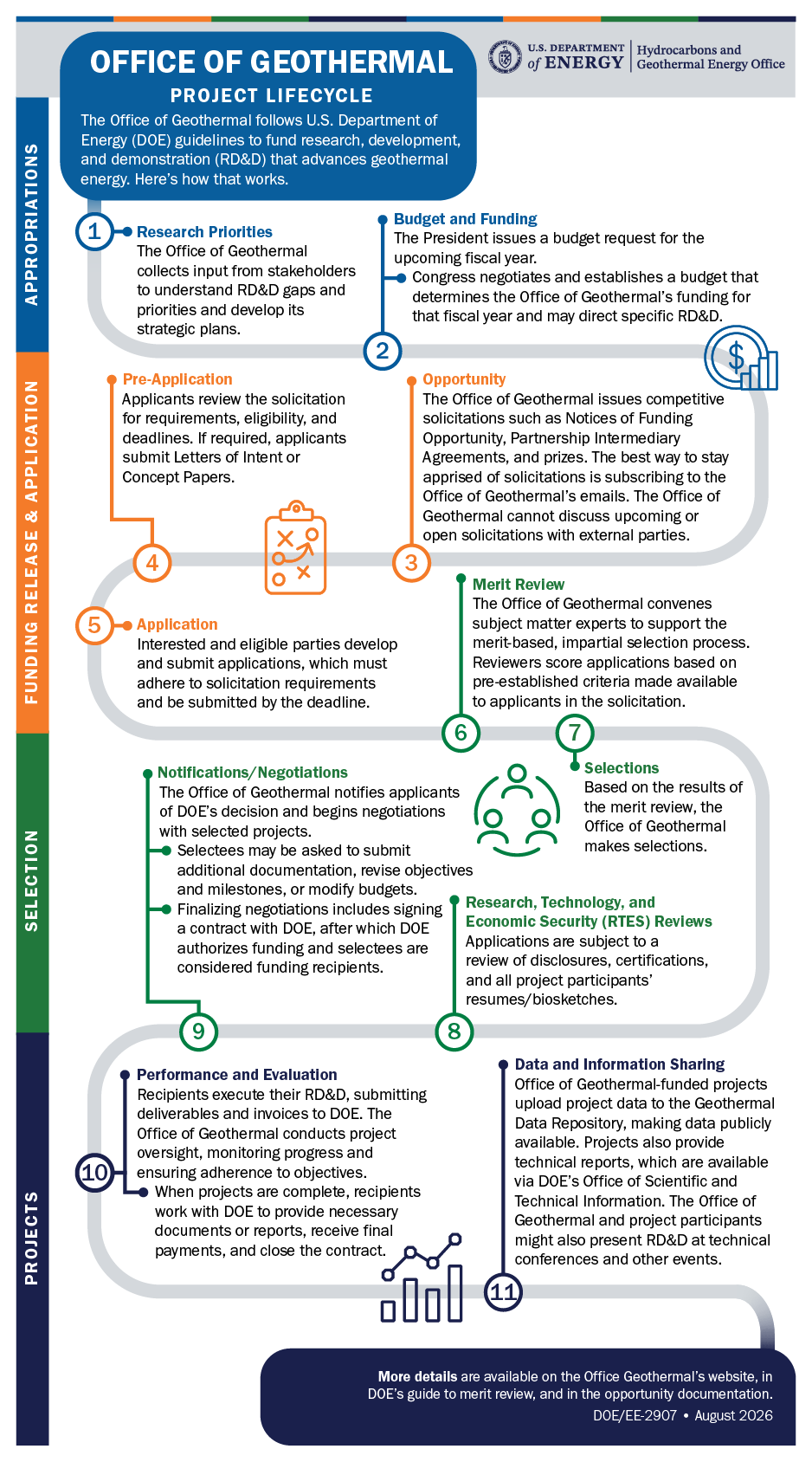
- Research Priorities. The Office of Geothermal collects input from stakeholders to understand RD&D gaps and priorities and develop its strategic plans.
- Budget and Funding. The President issues a budget request for the upcoming fiscal year. Congress negotiates and establishes a budget that determines the Office of Geothermal’s funding for that fiscal year and may direct specific RD&D.
- Opportunity. The Office of Geothermal issues competitive solicitations such as Notices of Funding Opportunity, Partnership Intermediary Agreements, and prizes. The best way to stay apprised of solicitations is subscribing to the Office of Geothermal’s emails. The Office of Geothermal cannot discuss upcoming or open solicitations with external parties.
- Pre-Application. Applicants review the solicitation for requirements, eligibility, and deadlines. If required, applicants submit Letters of Intent or Concept Papers.
- Application. Interested and eligible parties develop and submit applications, which must adhere to solicitation requirements and be submitted by the deadline.
- Merit Review. The Office of Geothermal convenes subject matter experts to support the merit-based, impartial selection process. Reviewers score applications based on pre-established criteria made available to applicants in the solicitation.
- Selections. Based on the results of the merit review, the Office of Geothermal makes selections.
- Research, Technology, and Economic Security (RTES) Reviews. Applications are subject to a review of disclosures, certifications, and all project participants’ resumes/biosketches.
- Notifications/Negotiations. The Office of Geothermal notifies applicants of DOE’s decision and begins negotiations with selected projects. Selectees may be asked to submit additional documentation, revise objectives and milestones, or modify budgets. Finalizing negotiations includes signing a contract with DOE, after which DOE authorizes funding and selectees are considered funding recipients.
- Performance and Evaluation. Recipients execute their RD&D, submitting deliverables and invoices to DOE. The Office of Geothermal conducts project oversight, monitoring progress and ensuring adherence to objectives. When projects are complete, recipients work with DOE to provide necessary documents or reports, receive final payments, and close the contract.
- Data and Information. Sharing Office of Geothermal-funded projects upload project data to the Geothermal Data Repository, making data publicly available. Projects also provide technical reports, which are available via DOE’s Office of Scientific and Technical Information. The Office of Geothermal and project participants might also present RD&D at technical conferences and other events.
More details are available on the Office Geothermal’s website, in DOE’s guide to merit review, and in the opportunity documentation.
Find out how to become a merit reviewer on the Funding Opportunities page.

Why Geothermal Matters
Geothermal energy, which comes from the heat beneath our feet, is more vital than ever:
SUSTAINED – Geothermal resources will be continually replenished for billions of years and can supply power around the clock.
RELIABLE – Geothermal energy provides baseload power and delivers a high capacity factor—typically ~90%—meaning that geothermal power plants can operate at maximum capacity nearly all the time. This high capacity factor allows geothermal power generation to balance changing loads on the grid, making it a critical part of the nation's energy system.
VERSATILE – Geothermal is a total energy solution, providing electricity, heating and cooling, even access to critical minerals like lithium.
HUGE POTENTIAL – Geothermal has vast potential to provide energy solutions across the entire nation.
Despite its benefits, geothermal energy is still largely untapped in the United States. By researching, developing, and demonstrating innovative geothermal technologies, the Office of Geothermal is stimulating the growth of the geothermal industry and helping the nation leverage its abundant heat resources.
Geothermal Energy News


Receive news of geothermal funding opportunities, events, publications, and activities in your inbox.