



Geothermal project developments are subject to numerous permits, authorizations, and other regulatory requirements in the United States at different project phases and levels of government. These permitting and regulatory requirements are necessary to address potential impacts to land use, water quality and usage, and much else, but may also act as non-technical barriers to geothermal project development, affecting project timelines, costs, and risks.
The Bureau of Land Management’s (BLM) Geothermal Guidance website is the primary source of information related to permitting for geothermal power development projects. It contains a repository of reading material and information for the BLM’s geothermal program, including guidance for exploration development, frequently asked questions, and more.
Explore the resources on this page for helpful guidance on understanding and addressing the permitting process for geothermal power development projects.
The Potential in Permitting
As part of the U.S. Department of Energy’s 2019 GeoVision analysis, the GeoVision Analysis Supporting Task Force Report: Barriers analyzed the non-technical barriers to geothermal deployment and potential improvement scenarios. The modeling in this report indicates that, through an expanded Categorical Exclusion for Exploration Drilling and a Centralized Permitting Office, the resulting project timeline reductions could lead conventional geothermal power capacity to achieve in excess of 12GW by 2050 – a 113% improvement over the Business as Usual (BAU) baseline.
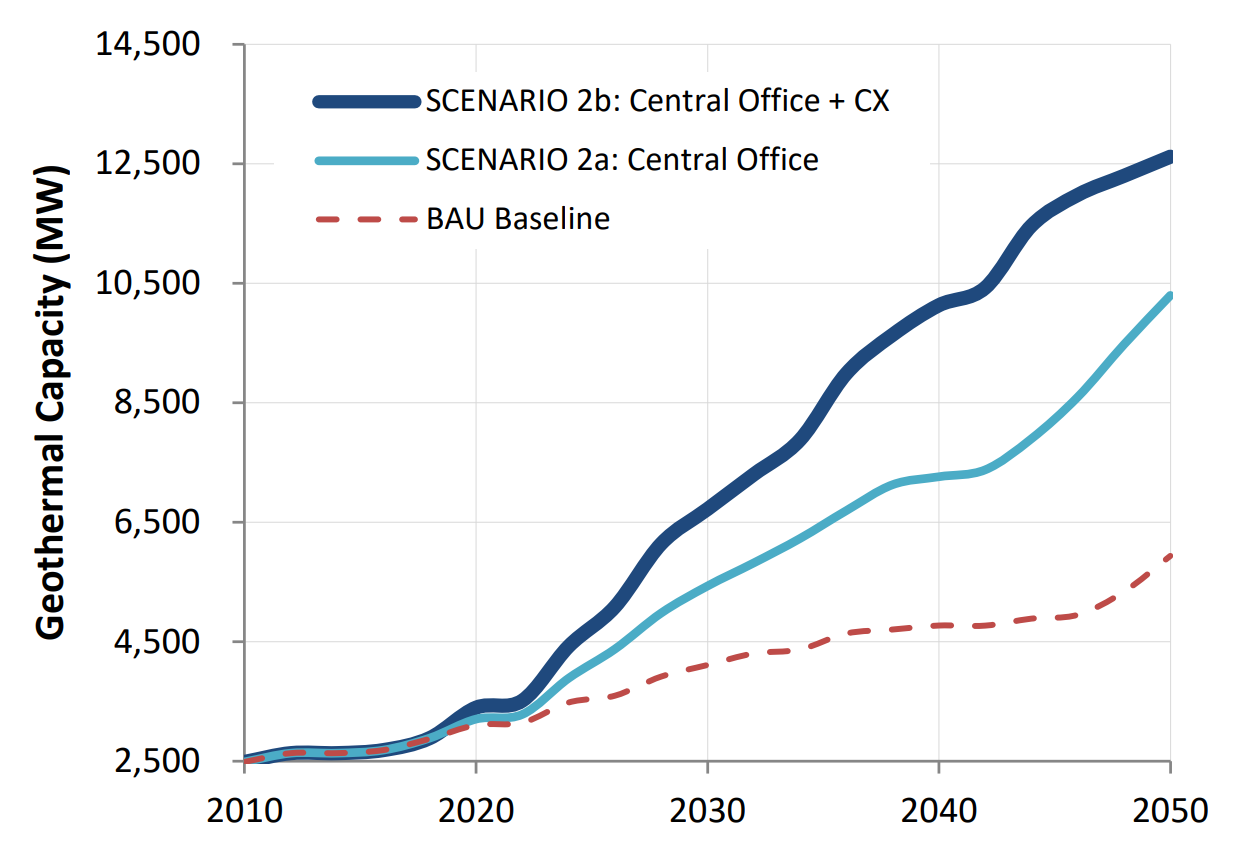
Modeled improvement in timelines. Improvement Scenario 2a results in 4.4 GW, or 74%, over BAU, while Improvement Scenario 2b results in 6.7 GW, or 113%, over BAU. Source: GeoVision Analysis Supporting Task Force Report: Barriers
Figure Note: CX = categorical exclusion, IRT = Improved Regulatory Timeline.
To learn more, explore the GeoVision analysis, which includes the examination of key regulatory, permitting, and land-access barriers to geothermal development.
Environmental Review
Stakeholders embarking on a geothermal power development project must navigate environmental review requirements under the National Environmental Policy Act of 1969 (NEPA), as well as the federal, state, and local agencies’ regulatory roles. A geothermal power development project on federal land can require multiple phases of environmental review under NEPA, including land use planning, leasing, exploration, drilling, and utilization operations.

Example timeline of a geothermal project on federal lands, illustrating that a single location could trigger National Environmental Policy Act analysis six separate times. Source: GeoVision analysis
Figure Note: EA = Environmental Assessment, EIS = Environmental Impact Statement, CX = categorical exclusion, MT = magnetotelluric, and TGH = temperature-gradient hole.
Review the GeoVision analysis for more information on federal regulations related to geothermal power development projects.
In addition to federal regulations, geothermal projects may be subject to environmental review at the state and local levels, for instance the California Environmental Quality Act (CEQA) requirements. Tables 6 and 7 below from the National Laboratory of the Rockies (NLR) Non-Technical Barriers to Geothermal Development in California and Nevada report depict agency and tribal government roles in the geothermal regulatory process in Nevada and Imperial County, California.

Federal Agency, State Agency, Local Agency, and Tribal Geothermal Regulatory Roles in Imperial County, California
For more on state and local regulations, read the Non-Technical Barriers to Geothermal Development in California and Nevada report, or explore the State Specific Resources on BLM’s Geothermal Guidance website.
Permitting and Regulatory Improvements
Firm electricity generation like that provided by geothermal will become particularly important to help balance the changing and expanding grid; yet deployment of new geothermal plants has been slow. The Office of Geothermal funded Lawrence Berkeley National Laboratory (LBNL) to conduct an analysis quantifying disparities in historical deployment, resulting in Mind the Gap: Comparing the Net Value of Geothermal, Wind, Solar, and Solar+Storage in the Western United States. This resource quantified the dramatic difference between prices for geothermal power purchase agreements and related wholesale market value, illustrating that geothermal is significantly undervalued, especially when accounting for the services it provides to the grid. Projects funded under the GRID initiative, prompted by this analysis, will further illustrate geothermal’s value and help utilities and regulatory bodies understand geothermal’s contributions to the grid.
The Office of Geothermal’s Topics and Considerations for Developing State Geothermal Regulations report provides a resource for all states, inclusive of all geothermal power and heating technologies, to inform the development of geothermal regulations. The Office of Geothermal, in collaboration with partners at NLR, convened a Geothermal Regulatory Stakeholder Working Group to advise and review the geothermal regulatory synthesis as it was in development. This report, which includes a catalogue of existing state and federal geothermal regulations as well as best practices from geothermal and related industries, saw 10x more unique downloads in the first six months of its release compared with similar Office of Geothermal publications released in the past decade.
The Salton Sea Geothermal Development: Nontechnical Barriers to Entry—Analysis and Perspectives report found that permitting costs play only a minor role in determining the viability of geothermal development in this location. Other factors such as permitting timelines, government/agency coordination, and the potential colocation of lithium extraction with a geothermal plant may result in much larger impacts on project viability. Based on these findings, the analysis also includes recommendations to streamline geothermal development in the Salton Sea region and beyond.
The Office of Geothermal funded the Non-Technical Barriers to Geothermal Development in California and Nevada and the Economic Impact of Permitting Timelines on Geothermal Power in California, Nevada, and Utah studies to deliver analyses specific to those states, where geothermal power generation is already present but there is significant potential for more. These studies identified numerous state-specific barriers; for example, geothermal permitting timelines can vary from six months to several years depending on biological resources, cultural resources, and sensitive environmental issues at a project site.
In collaboration with the Bureau of Land Management (BLM), the Office of Geothermal convened, supported, and participated in Renewable Energy Coordination Office (RECO) Interagency Geothermal Permitting Working Group (IGPWG) to improve geothermal project permit coordination. IGPWG’s areas of focus stem from the 2022 Geothermal Interagency Collaboration Task Force: Summary of Findings, which recaps themes and recommendations from Tribes, Tribal organizations, environmental non-government organizations, industry, and state and federal agencies during listening sessions, meetings, and stakeholder forums related to geothermal regulatory approvals and permitting.
IGPWG discussions influenced two categorical exclusions (CE) published by BLM in the years following: the Geothermal Resource Confirmation CE (2024) and the Geothermal Exploration Operations CE (2026). Both CEs help facilitate faster permitting timelines for geothermal power development projects by minimizing the need for BLM environmental assessments for actions that have been demonstrated to result in no significant environmental impacts.
The Geothermal Power Accelerator is a 15-state effort to expand the use of firm, flexible geothermal power by working with states to set statewide geothermal goals, strengthen resource mapping, and advance policies and programs that reduce project costs and address regulatory barriers, including barriers derived from permitting processes. Through this National Association of State Energy Officials (NASEO)-run initiative, DOE’s National Laboratory of the Rockies will provide technical assistance to help states in the Accelerator understand and implement effective geothermal permitting processes. NASEO also published an Office of Geothermal-funded comparative analysis of geothermal-related policies, regulations, and legislation across seven states to examine how different jurisdictions approach geothermal power development. Separately, NASEO also prepared a summary of recent federal legislative measures addressing geothermal permitting, available on the NASEO website.
The Office of Geothermal's Publications and Technical Resources
Check out the Office of Geothermal’s collection of Technical Resources for more sources of federal and state permitting information, access to renewable energy data, cost, and performance modeling tools, and much more to help in your geothermal permitting process.
You can also dig deeper into non-technical barrier reports, the Office of Geothermal’s strategic plan, market reports, and other publications on the office’s Geothermal Publications page.
Further Resources
For additional background information, research, and guidance for geothermal power development projects, refer to the resources at the following links:
- NEPA
- OpenEI Geothermal Energy NEPA page
- NEPATEC: Using its ground-breaking PermitAI™ tool, the research team at the Pacific Northwest National Laboratory (PNNL) has created a machine-readable dataset, known as the NEPA Text Corpus (NEPATEC), to make labor-intensive searches across permitting documentation much simpler. The team has released its AI-ready, open-access NEPATEC 2.0 database to the public, housing environmental documents from the last 50 years organized using 14 metadata properties. Learn more and read the report on how PNNL constructed the data.
- Regulatory and Permitting Information Desktop (RAPID) Toolkit: The Regulatory and Permitting Information Desktop (RAPID) Toolkit includes geothermal regulations and permitting information by state, as well as federal regulations that apply to all states and a reference library, collection of best practices, and NEPA database.
- Geothermal Data Repository: Search for ‘Permitting’ or ‘Non-Technical Barriers.’ Recent examples of Office of Geothermal-funded non-technical barriers analysis work include:
- The Office of Geothermal's Environmental Analysis page