



RSS




The U.S. aviation sector, responsible for around 2% of the nation’s annual carbon emissions, is a key target for emissions reduction—but there are many technical and logistical hurdles remaining when conceptualizing an efficient, scaled future for the production and use of sustainable aviation fuels (SAF).
DOE today announced $8,055,000 to to support seven projects that will advance efficient, scalable, high-throughput, and high-quality processes for manufacturing fuel cell and electrolyzer materials through the Roll-to-Roll (R2R) Consortium.
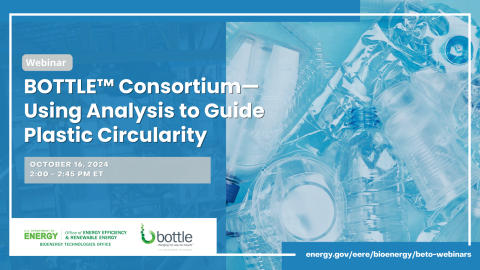
Join the U.S. Department of Energy’s (DOE’s) Bio-Optimized Technologies to keep Thermoplastics out of Landfills and the Environment (BOTTLE™️) consortium on Oct. 16, 2024, 2–2:45 p.m. ET, for a webinar titled, A Primer on Using Analysis to Guide Plastic Circularity.
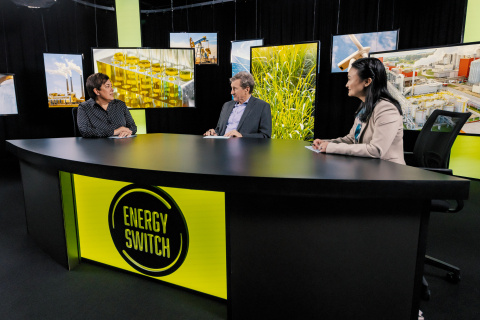
Tune in to PBS’s newest season of Energy Switch! U.S. Department of Energy (DOE) Bioenergy Technologies Office (BETO) Director, Dr. Valerie Sarisky-Reed, will be interviewed on Energy Switch’s upcoming season to discuss the importance of biofuels to the U.S. bioeconomy and the progress that has been made to support energy innovation and research.
This funding opportunity from DOE's Office of Fossil Energy and Carbon Management will support research and development of technologies that convert biomass and other waste materials into an affordable, low-carbon fuel.
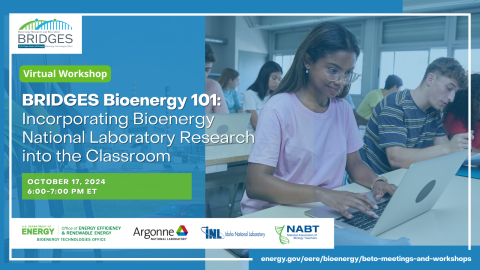
The Bioenergy Research and Education Bridge Program (BRIDGES) is partnering with the National Association of Biology Teachers (NABT) to host the BRIDGES Bioenergy 101 Virtual Workshop from 6 p.m. to 7 p.m. ET on Thursday, Oct. 17, 2024. Educators will be introduced to bioenergy national laboratory research that can be integrated into classrooms. Bioenergy knowledge is not required.
National Renewable Energy Laboratory (NREL) scientists engineered a process for making β-ketoadipic acid from lignin for $2 per kilogram, approaching cost-competitiveness with petroleum-based chemicals used for making nylon today. With support from the U.S. Department of Energy Bioenergy Technologies Office, researchers are a step closer to addressing one possible answer to the persistent question of lignin.
The U.S. Department of Energy (DOE) Office of Technology Transitions (OTT) announced their Notice of Intent (NOI) to issue a call for proposals from DOE National Laboratories, Plants, and Sites for the Fiscal Year (FY) 2025 Core Laboratory Infrastructure for Market Readiness (CLIMR) Lab Call. The goal of OTT's Technology Commercialization Fund (TCF) is to improve America’s energy competitiveness and security by accelerating commercialization of critical energy technologies to market. DOE anticipates releasing the FY25 CLIMR Lab Call in October 2024.
The U.S. Department of Energy's Advanced Research Projects Agency-Energy this week announced $18 million for nine projects to accelerate research that supports the detection and quantification of hydrogen emissions throughout the supply chain.
Today, an interagency team led by the U.S. Department of Energy (DOE), U.S. Department of Agriculture (USDA), and U.S. Department of Transportation’s (DOT’s) Federal Aviation Administration (FAA) released the Sustainable Aviation Fuel (SAF) Grand Challenge: Tracking Metrics and Mid-2024 Dashboard. USDA Secretary Thomas Vilsack made the announcement at the North American SAF Conference in St. Paul, Minnesota. The Metrics Dashboard summarizes actions and progress to help drive innovation and expand the production and use of SAF to meet the Grand Challenge target of 3 billion gallons of SAF in the United States by 2030.