



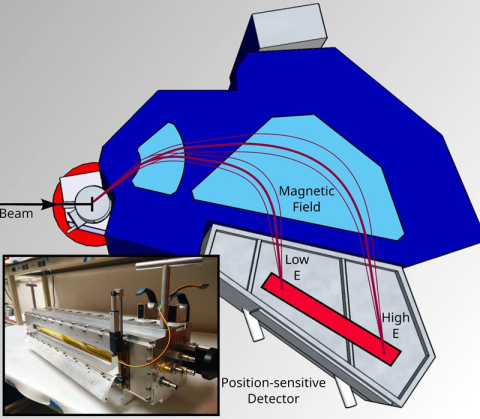
The energy of a key resonance in sodium destruction is found, affecting our understanding of globular cluster evolution.
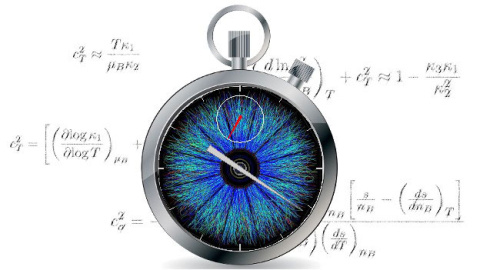
Nuclear scientists devise an indirect method of measuring the speed of sound in matter created in heavy-ion collisions.
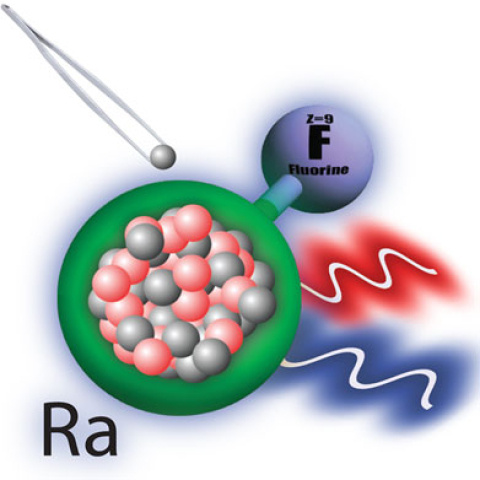
Scientists measure radioactive molecules at the extremes of physics.
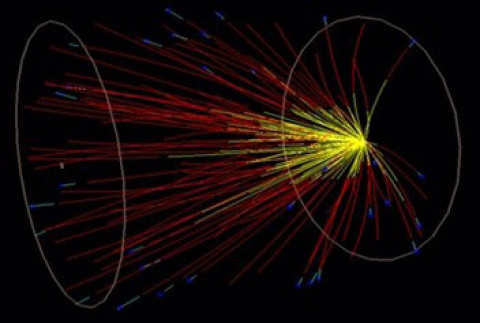
Measurements of particle “flow” and hot matter created in low-energy collisions provide key data in understanding nuclear phase transition.
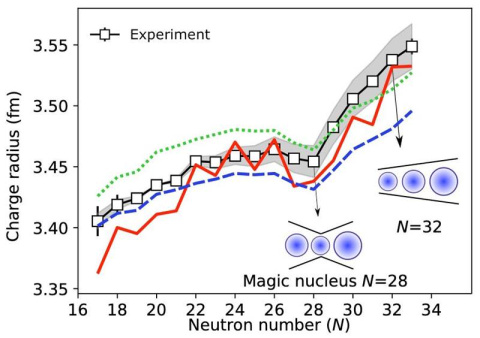
Measurements of nuclear charge radii and state-of-the-art nuclear models challenge the magic of neutron number 32 in potassium isotopes.

A team studied some of the smallest particles in the Universe on the nation’s fastest computer, Summit at Oak Ridge National Laboratory.
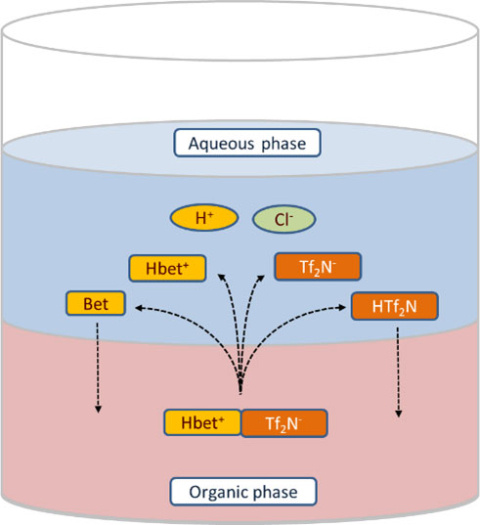
Research on techniques for studying the chemical properties of superheavy elements might also help recover a strategically important metal.
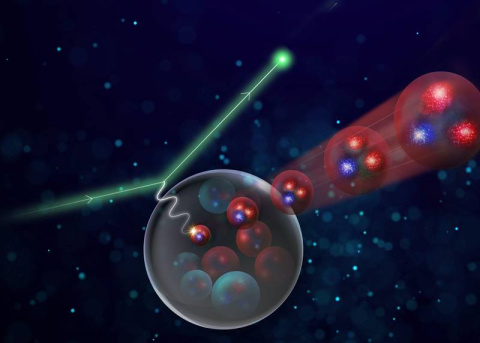
If physicists can find it, color transparency in protons could offer new insight into the particles that build our universe.
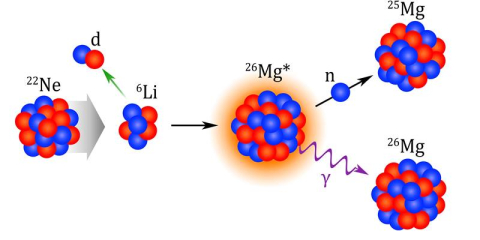
A key reaction in the slow neutron-capture process that forms elements occurs less frequently than previously thought.

Scientists explore the origin of Aluminum-26 in stars with a nuclear reaction that exploits the fact that neutrons and protons are stunningly similar.