



Microgrid Program Strategy
The strategic vision of the DOE OE Microgrid program is that microgrids will become essential building blocks of the future electric grid, leveraging all sources of affordable, reliable, and secure energy. The program mission is to accelerate beneficial microgrid innovations that improve the reliability, resilience, security and affordability of the U.S. electricity delivery system—advancing U.S. energy independence and dominance. Over time, program investments will enable microgrids to evolve from isolated emergency power sources into dynamic, interconnected energy ecosystems that enhance grid resilience and provide critical stability to the broader electricity delivery system. To implement this vision and mission, the program strategy includes goals across the following three broad domains, also illustrated in Figure 1 below:
- Infrastructure, Operations, and Control: Contains research, development and demonstration (RD&D) goals associated with the operational aspects of microgrid technologies, including microgrid monitoring, control, optimization, communication, and protection.
- Multi-Domain Analysis and Decision-Making Tools: Contains RD&D goals associated with the design, planning, and analysis aspects of microgrid technologies, including tools, computational methods and models, and corresponding simulation approaches.
- Engagement and Institutional Frameworks: Contains goals associated with market, regulatory, and institutional barriers to microgrid system adoption.
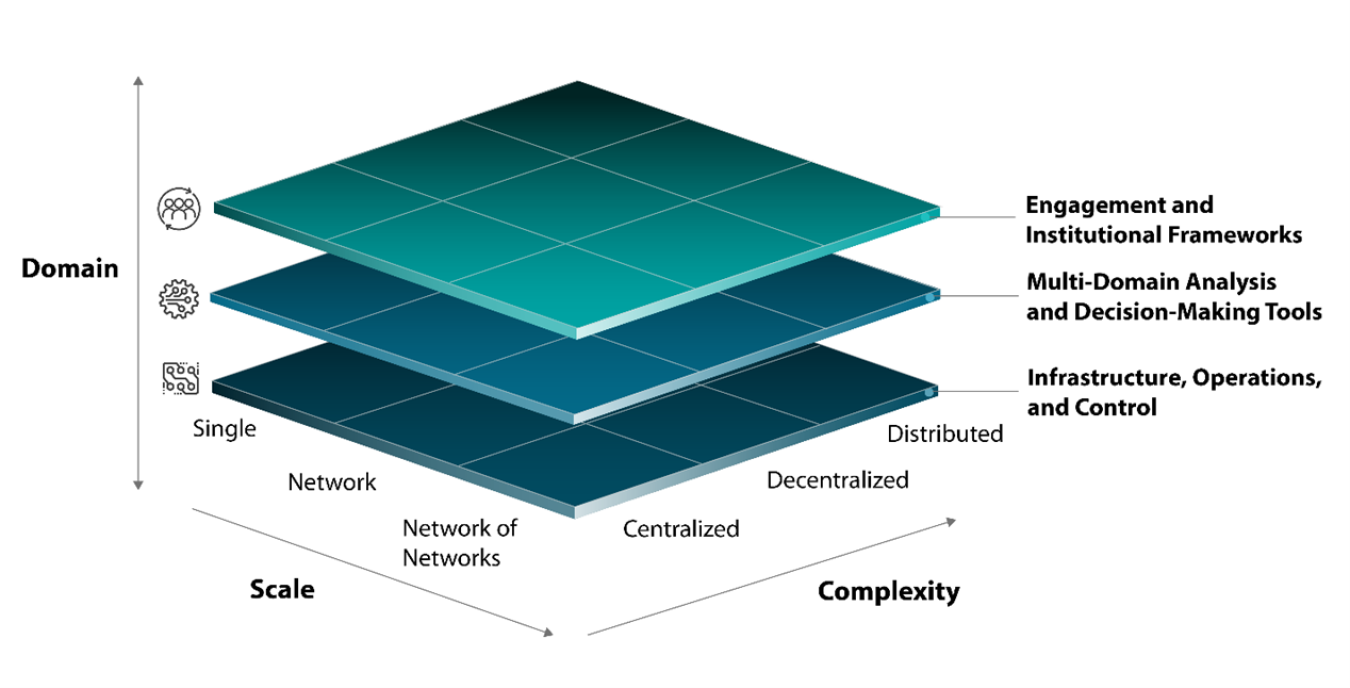
The Microgrid Systems RD&D program addresses architectural challenges across these three domains, focusing on both scale and complexity. It examines system scale, progressing from single microgrids to networked and then to networks of networked systems. Additionally, it tackles architectural complexity, such as controls and computing, by transitioning from centralized to distributed paradigms.
These broad domains serve as the foundational structure for the core program focus areas and associated activities, all of which support overarching program goals centered about advancing grid resilience, reliability, security, and affordable energy abundance. The overarching program goals are presented below.
Develop advanced microgrid systems with standardized, adaptive controls, automation, and protection to enhance energy resilience for local loads under all operating conditions. This ensures grid survivability and continuous high-quality electricity service to support local loads—residential, communal, commercial, industrial, and/or defense loads—amidst dynamic operating grid conditions and disturbances.
Develop robust, co-designed microgrid control and communication systems that enhance microgrid-to-grid interactivity and seamless coordination, supporting both core and ancillary grid operational needs, while withstanding adversarial attacks—thus fostering reliable and secure grid operations. This will also include development of self-sufficient (including self-healing) systems that integrate and optimize diverse energy sources for local use, responding adaptively to dynamic grid operational requirement
Advance affordable energy abundance by enabling regulatory, business and market design innovations that support energy additions through accelerated microgrid deployment—where microgrids serve as strategic grid assets, delivering timely and firm energy solutions that enable expedited load interconnection ahead of and complementarily to long-lead infrastructural upgrades.
Strategic Program Portfolio of Activities

Research, Development, Demonstration and Deployment Activities
The program strategy identifies and will deliver impactful outcomes across key R&D areas, including areas grandfathered in from a prior strategy development and implementation cycle. These activity areas are covered across nine strategy documents, the first of which presents the overarching program vision, objectives, and targets. Each strategy document was developed by a team of national laboratory and university members and then reviewed by an industry advisory panel. Below is the list of program strategy plan documents, followed by goal alignment.
Strategy Document Title Performers/Partners Introduction—Overall Program Vision, Objectives and Targets
SNR, SNL, PNNL T&D Co-simulation of Microgrid Impacts and Benefits
ANL, LANL, LLNL Building Blocks for Microgrids NLR, ORNL, PNNL, SRNL, Virginia Tech Microgrids as a Building Block for Future Grids
LLNL, NLR, ORNL, SNL Advanced Microgrid Control and Protection
INL, LLNL, ORNL, SNL Integrated Models and Tools for Microgrid Planning and Designs with Operations ANL, LANL, LLNL, ORNL Small Nuclear Reactors in Future Microgrids
ANL, INL, LLNL, SRNL, SNL Artificial Intelligence and Machine Learning for Microgrid Applications ANL, LLNL, INL, SNL, PNNL, ORNL, NLR, SNL, SRNL Enabling Regulatory and Business Models for Broad Microgrid Deployment LBNL, LLNL, NLR, SNL, ORNL
The table below shows the alignment of the programs strategy plan documents with the program goals outlined earlier.
Program Goals Strategy Plan Alignment Advance Resilience: Provide Resilient Support to Local Loads - Strategy Document 5 – Advanced Microgrid Control and Protection
- Strategy Document 6– Integrated Models and Tools for Microgrid Planning and Designs with Operations
Advance Reliability and Security: Support Reliable and Secure Grid Operations - Strategy Document 2 – Transmission and Distribution (T&D) Co-simulation of Microgrid Impacts and Benefits
- Strategy Document 3 – Building Blocks for Microgrids
- Strategy Document 4 – Microgrids as a Building Block for Future Grids
- Strategy Document 5 – Advanced Microgrid Control and Protection
- Strategy Document 7 – Small Nuclear Reactors in Future Microgridshttps://energy.gov/documents/microgrids-rd-strategic-plan-topic-8-ai-and-machine-learning
- Strategy Document 8 – Artificial Intelligence and Machine Learning for Microgrid Applications
Advance Affordable Energy Abundance: Enable Energy Abundance through Energy Additions - Strategy Document 3 – Building Blocks for Microgrids
- Strategy Document 4– Microgrids as Building Blocks
- Strategy Document 6–Integrated Models and Tools for Microgrid Planning and Designs with Operations
- Strategy Document 7 – Small Nuclear Reactors in Future Microgrids
- Strategy Document 8 – Artificial Intelligence and Machine Learning for Microgrid Applications
- Strategy Document 9 – Enabling Regulatory and Business Models for Broad Microgrid Adoption

Technical Assistance (TA) Activities
The Office of Electricity developed the Community Microgrid Assistance Partnership (C-MAP) program to extend technical support and funding to communities seeking to build a microgrid or optimize their existing microgrid systems. C-MAP brings together organizations and energy sector actors that are working to understand, improve, and implement advanced microgrid technology in historically underserved and Indigenous communities in remote areas, facilitating a new forum for innovation and collaboration.
Strategic Program Benefits

Over the years, the Microgrid program has funded multiple developments—including methods, tools, testing platforms, software, and other hardware/software-integrated products—that have made it to market as well as into commercial products, enabling enhanced and innovative solutions to both existing and emerging industry challenges. The table below highlights some of these developments, including their respective value propositions, application use cases, and how they may be accessed by interested parties.
Resource Description Public Release/Access Value Proposition Industry Applications Contacts Power Models ONM helps varied users optimize distribution power networks, featuring networked microgrids and dynamic microgrid formation. Open-source toolkit with user manual and tutorials. Users of this toolkit leverage networked microgrids to improve day-to-day operations, stabilize the grid, and enhance grid reliability and resilience, minimizing impacts faced by end-consumers in extreme events. Design of networked microgrids, contingency grid planning.
Users: Utilities, cooperatives, Grid management software providers, microgrid designers.
David Forbes (LANL), Murali Baggu (NLR) The Maritime Port Electrification Handbookexplains the technologies and key considerations for deploying microgrids and electrification A practical free accessible framework outlining microgrid benefits and challenges and step-by-step implementation. Ports and other stakeholders decrease their regulatory burden and gain insight into microgrid solutions that provide backup power or offer economic advantages. Port grid electrification planning.
Users: Stakeholders of maritime ports, state and federal agencies.
Francis Tuffner (PNNL) The Microgrid Policy and Regulatory Framework is a guide for State Energy Offices and Public Utility Commissions developing state microgrid policy, programs, or regulation. An online framework for navigating evolving microgrid deployment scenarios. This go-to resource can decrease regulatory burden and help state decision-makers understand their roles and implement scalable strategies for grid reliability and affordability. Microgrid policy and regulation programs.
Users: State Energy Offices, Public Utility Commissions, regulatory authorities.
Miguel Heleno (LBNL)
LPNORMis a tool that electric distribution system planners use to evaluate how distribution feeders with microgrids respond to extreme events and prioritize the most cost-effectivesystem upgrades. Integrated into the free accessible Open Modeling Framework tool to optimize system design. Rural electric cooperatives can optimize capital investment to advance growth, reliability, and affordability of the grid. Optimizing the capital Investment for rural electric cooperatives.
Users: Utilities, cooperatives, microgrid designers.
David Forbes (LANL) REPAIRis a tool for grid expansion planning that incorporates microgrids and co-optimizes local energy generation and infrastructure upgrades to improve distribution system reliability. Open-source software for grid and microgrid planners. REPAIR supports resilient grid development by allowing electric utilities to make informed and transparent cost versus risk decisions for grid infrastructure planning and growth. Utility distribution system expansion, Valuation of local energy assets and microgrids in distribution planning.
Users: Utilities, microgrid designers, large load customers.
Miguel Heleno (LBNL) The Small Nuclear Reactor Module helps users add nuclear power into microgrid planning, including safety, feasibility, and cost analysis. A capability within Xendee commercial microgrid optimization platform, also available through some DOE national laboratories. Users can explore feasible options for adding small reactors to microgrids, particularly in areas that call for energy dominance such as data centers, manufacturing, and mining. Microgrid design and planning.
Users: Nuclear and power industries, microgrid designers, large loads stakeholders (data centers).
(INL)
The Multigrade Industrial Heat Module helps users add high-grade heat or industrial-scale applications into microgrid planning. A capability within Xendee commercial microgrid optimization platform, also available through some DOE national laboratories. This model advances nuclear reactor technologies for powering industry loads in optimal way. Combined Heat and Power grid applications.
Users: Electric and thermal industry, microgrid designers, large load stakeholders (data centers).
(INL)
A digital twin is a physics-based replica of a microgrid, such as the one developed by the Office of Electricity for Cordova, Alaska Custom digital twin that matches the assets, operating conditions, and the behavior of a real-world microgrid. Realistic emulations allow microgrid planners to vet new technologies or designs in the safety of the digital space before rolling them out to customers, thereby lowering deployment costs, supporting affordability, and exploring opportunities to stabilize the grid. Testing new grid technologies
Users: Original Equipment Manufacturers utilities and cooperatives, regional grid entities, microgrid designers.
Murali Baggu (NLR) The Microgrid Design Toolkit supports feasibility studies by modeling, analyzing, and optimizing microgrid design. A windows desktop application available for free download and use. This toolkit helps optimize, stabilize, and grow the grid by speeding up the design and evaluation process, reducing technical complexity, financial risk, and deployment time for resilient, stand-alone systems Microgrid design, sizing, and evaluation.
Users: Utilities and cooperatives, state and local government, research and academia, microgrid investors and designers, large loads stakeholders (data centers).
(SNL)
DER-CAMoptimizes the portfolio, sizing, placement, and dispatch of local energy assets while factoring for additional value streams such as load shifting and participation in energy markets. Open-source decision-support software tool that can be used for microgrids design including local energy assets. When weighing investment decisions, energy managers use this tool to optimize resources, stabilize operations, and support the growth of the grid by selecting the right mix of assets that meet local conditions and reliability needs at the lowest cost, supporting affordability. Optimal sizing and placement of local energy assets
Users: Utilities and cooperatives, power industry, microgrid investors and designers, large load stakeholders (data centers).
(LBL)
The Resilient Node Cluster Analysis Tool (ReNCAT) is a desktop optimization application for siting and characterizing localized distribution grid investment options that keep key critical infrastructure powered. A windows desktop application available for free download and use. This tool provides decision support for stakeholders to identify and understand options for grid investments such as microgrids, line hardening, and backup generation that can be used to power key infrastructure while balancing multiple objectives including cost, critical service availability, and mission availability under varying grid outage and threat scenarios. Distribution grid investment planning for critical infrastructure.
Users: Community planners, utilities, military installations, researchers, and academics.
Amanda Wachtel (SNL)
Summer Ferriera (SNL)