Mission-critical commercial and military applications have extremely high uptime requirements and tight deployment space constraints. Advanced small nuclear reactors, packaged as compact units and deployed in microgrids, present a tantalizing option to meet these constraints and advance many of our nation’s priorities.
June 3, 2026 Estimated Read Time min
Dr. Chukwuemeka Obikwelu

Dr. Obikwelu serves as Director of Grid Systems within the U.S. Department of Energy’s (DOE) Office of Electricity, where he oversees a multi-year energy research and development portfolio focused on advancing grid affordability, reliability, resilience, and security. His work spans the intersections of technology, policy, and business, including advanced microgrid technologies, inverter-based-resources, hybrid energy systems (integrating small nuclear reactors, energy storage, etc.), advanced transmission and distribution (T&D) technologies, and emerging energy challenges associated with electrification, AI-driven load growth, and evolving power system demands.
Dr. Obikwelu's industry background spans electric utilities, engineering-procurement-construction (EPC) consulting, technology R&D, and academia. Prior to joining DOE, he held engineering and leadership roles supporting transmission and distribution systems, protection and control engineering, utility operations, compliance, and large-scale energy infrastructure and capital projects across the power sector. His experience also includes teaching power systems engineering courses in academic and professional settings and supporting workforce and technical training initiatives.
He holds a Ph.D. in Electrical Engineering (Energy Systems) from Georgia Institute of Technology, a Master of Science in Electrical Engineering (Power/Energy Systems) from Michigan Technological University, a Master of Education from Harvard University focused on higher education leadership, and a Bachelor of Science in Electrical and Computer Engineering from Wayne State University. He is currently pursuing a Master of Business Administration (MBA) from Indiana University-Bloomington Kelley School of Business, majoring in Business Strategy and Leadership. His hobbies of interest include lawn tennis, chess, a good read, mixed martial arts, running, and long walks.
Dan Ton

Dan Ton is Program Manager at the U.S. Department of Energy (DOE) Office of Electricity (OE), responsible for developing and managing the OE Microgrids R&D Program. He also serves as the OE lead for the Community Microgrid Assistance Partnership (C-MAP) program.
From May 2014 until July 2015, he served as Acting Deputy Assistant Secretary of OE’s Power Systems Engineering Division. Before joining OE, Dan managed the Renewable Systems Integration program within the DOE Solar Energy Technologies Program.
Dan holds a Bachelor of Science in Electrical Engineering and a Master of Science in Business Management, both from the University of Maryland.
The need to accelerate deployment of nuclear powered microgrids include:
- Transporting fuel and water resulted in over half the American casualties in the Iraq and Afghanistan wars provides one driving imperative to localize nuclear energy in military microgrid applications that include the abundance of energy to desalinize and purify water sources.
- Removing barriers for large load application developers needing to “bring your own power” to ensure the nations AI and industrial dominance.
- Relieving pressure on the need to build out expensive and time-consuming electricity and gas infrastructure to power our artificial intelligence and industrial dominance.
- Creating energy dominance solutions for mining of energy industry resources by enabling portable microreactors, which have the capacity to support remote extractive sites.
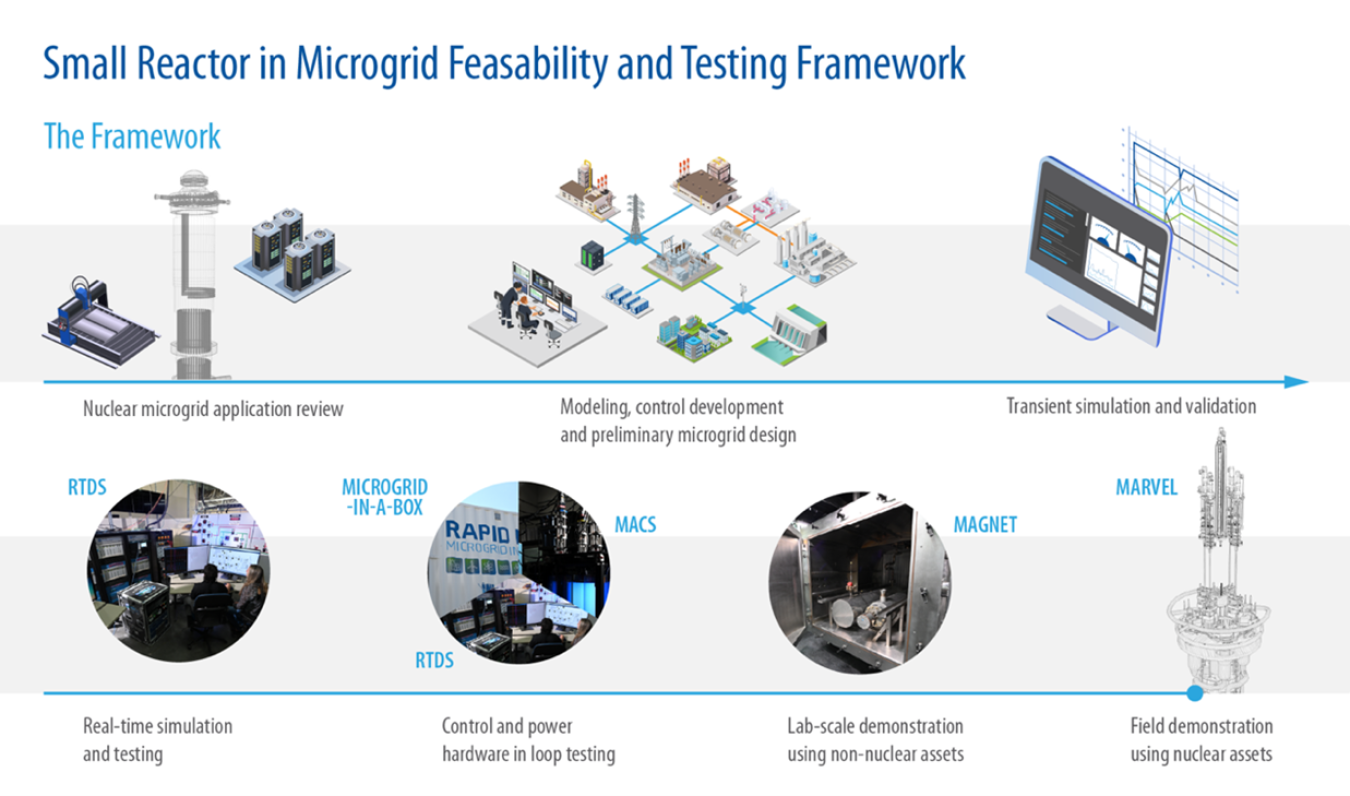
Implementing first-of-a-kind demonstrations of such emerging nuclear capabilities comes with new challenges requiring a multi-office approach from the U.S. Department of Energy (DOE) to bridge advanced nuclear reactor technology to emerging nuclear energy entrepreneurs and aspiring nuclear powered application developers. DOE Office of Electricity (OE) and national laboratory complex provide the nation with the brain trust needed to build out the facilities and develop the capabilities American industry and commerce need from nuclear-powered microgrids. DOE-OE’s Microgrid Program leverages its long-standing role to advance new technology through partnerships with other DOE offices, government agencies, and industry. The Microgrid Program’s Nuclear Powered Microgrid initiative (NPM) is designed to accelerate private sector-led innovation to advance grid reliability, resilience, security, and affordability through collaboration with the Office of Nuclear Energy’s Microreactor Program. It does so by providing unique platforms and capabilities throughout the DOE laboratory complex to accelerate demonstration and deployment that advance the robustness of for first-of-a-kind nuclear powered microgrids. Because the historical delays and cost overruns of large nuclear power plants will not suffice, the initiative intends to collaborate with DOE’s Office of Nuclear Energy (DOE-NE) Light Water Reactor Sustainability Program’s Capacity Expansion Pillar to establish regulatory frameworks that provide certainty to microgrid application developers. Defeating the regulatory and technological barriers for these innovations is an imperative.
Finally, it intends to cultivate industry-driven technical standards and best practices for enhanced grid reliability, resilience, security, and affordability. The strategic plan of the NPM initiative sets out a steadfast approach to rapidly harness the unique attributes of nuclear power for microgrids. Nuclear power has unique attributes that microgrids can take advantage of. Nuclear-powered microgrids will potentially run for up to 10 years without refueling, operate at a capacity factor of 95% or more, require only 1 acre to serve a load of 20 megawatts, and lower the cost of electricity by more than 50% in remote communities, military or industrial applications that use diesel generators. Modularity and transportability of small reactors make them ideal for remote site applications that are challenged by lack of electricity transmission or potential disruption of fuel supply. Factory production will drive down costs. Advanced small reactors are safe by design, thereby mitigating the risks traditionally associated with nuclear energy and improving the already exceptional safety record of the U.S. nuclear power industry. Unlocking the full potential of nuclear-powered microgrids requires a concerted research effort to tackle key gaps and challenges:
- Implement control and protection strategies in new nuclear powered microgrid management systems to seamlessly integrate the interactions between thermal and electrical storage with the unique characteristics of small reactors.
- Finalize new microgrids standards, codes, and guidance that specifically address the unique characteristics of small reactors for small reactors and microgrid developers.
- Demonstrate nuclear powered microgrids to foster public and stakeholder understanding and engagement to help tackle regulatory challenges and social acceptance.
- Develop a testing platform to rapidly move nuclear powered microgrid development from conceptual and preliminary design to incremental testing of real-world components and control systems through to deployment.
To address these gaps and challenges, the NPM initiative has been established as an R&D area within the Microgrid Program. This includes dedicated resources and expertise designed to reduce development risk and accelerate the commercial adoption of nuclear powered microgrids. This is accomplished through the development of a standard nuclear microgrid design and pre-deployment testing framework to validate system integration while avoiding the risks and costs associated with direct experimentation on one-of-a-kind equipment. The framework includes technoeconomic feasibility analysis, energy management and control system design to coordinate nuclear, energy storage and other grid assets, system transient modeling and control validation, and power and control component testing.