Microgrids have emerged as a promising part of the solution to the challenges of increasing electricity costs, power outages and increasing loads.
June 3, 2026 Estimated Read Time min
Dr. Chukwuemeka Obikwelu

Dr. Obikwelu serves as Director of Grid Systems within the U.S. Department of Energy’s (DOE) Office of Electricity, where he oversees a multi-year energy research and development portfolio focused on advancing grid affordability, reliability, resilience, and security. His work spans the intersections of technology, policy, and business, including advanced microgrid technologies, inverter-based-resources, hybrid energy systems (integrating small nuclear reactors, energy storage, etc.), advanced transmission and distribution (T&D) technologies, and emerging energy challenges associated with electrification, AI-driven load growth, and evolving power system demands.
Dr. Obikwelu's industry background spans electric utilities, engineering-procurement-construction (EPC) consulting, technology R&D, and academia. Prior to joining DOE, he held engineering and leadership roles supporting transmission and distribution systems, protection and control engineering, utility operations, compliance, and large-scale energy infrastructure and capital projects across the power sector. His experience also includes teaching power systems engineering courses in academic and professional settings and supporting workforce and technical training initiatives.
He holds a Ph.D. in Electrical Engineering (Energy Systems) from Georgia Institute of Technology, a Master of Science in Electrical Engineering (Power/Energy Systems) from Michigan Technological University, a Master of Education from Harvard University focused on higher education leadership, and a Bachelor of Science in Electrical and Computer Engineering from Wayne State University. He is currently pursuing a Master of Business Administration (MBA) from Indiana University-Bloomington Kelley School of Business, majoring in Business Strategy and Leadership. His hobbies of interest include lawn tennis, chess, a good read, mixed martial arts, running, and long walks.
Varsha Menon

Varsha Menon is a Program Analyst with the U.S. Department of Energy’s Office of Electricity. Her work supporting the OE Microgrid Program focuses on collaboration with the states to identify and address policy and regulatory barriers to microgrid deployment. Her interests in the energy space include microgrids, economics, and policy and regulation. Varsha holds a Master of Public Policy from American University and a Bachelor of Arts in public policy and political science from the University of North Carolina at Chapel Hill.
As the nation’s energy demand continues to grow, driven in part by the rapid expansion of energy-intensive sectors such as Artificial Intelligence, ensuring the national objectives are met for affordable, reliable, and secure electricity is more critical than ever for maintaining American economic competitiveness and global leadership. Microgrids have emerged as a promising part of the solution to these challenges.
Microgrids are generally deployed for their resilience benefits, serving businesses or communities that cannot tolerate the risk of significant power outages. However, even during normal “blue sky” operations, grid-connected microgrids can deliver substantial economic benefits. Microgrids lower site-level electricity costs through strategies such as time-of-use (TOU) rate arbitrage, peak demand charge reduction, and reducing fuel expenses by optimizing on-site generation and storage. A California program reported energy and demand charge savings for three grid connected microgrids of between 20 and 58 percent after at least one year of operation. In Alaska, fuel savings opportunities reduced energy costs of a remote resort’s microgrid by $300k per year by augmenting their grid with geothermal energy.
Beyond individual facilities, microgrids can also provide important benefits to the broader electric grid. Strategic integration of microgrid resources can potentially reduce transmission and distribution losses and create opportunities for operational efficiencies that improve the effectiveness of utilities and grid operators to manage system performance. When deployed as distribution assets, microgrids can serve as cost-effective complements to traditional infrastructure upgrades, enabling grid planners to augment long-lead infrastructure investment with the rapidly deployable microgrid asset to match changing system conditions. Their ability to act as reliable, fast-responding assets offers utilities an additional pathway to maintain reliability and power quality at the lowest possible cost.
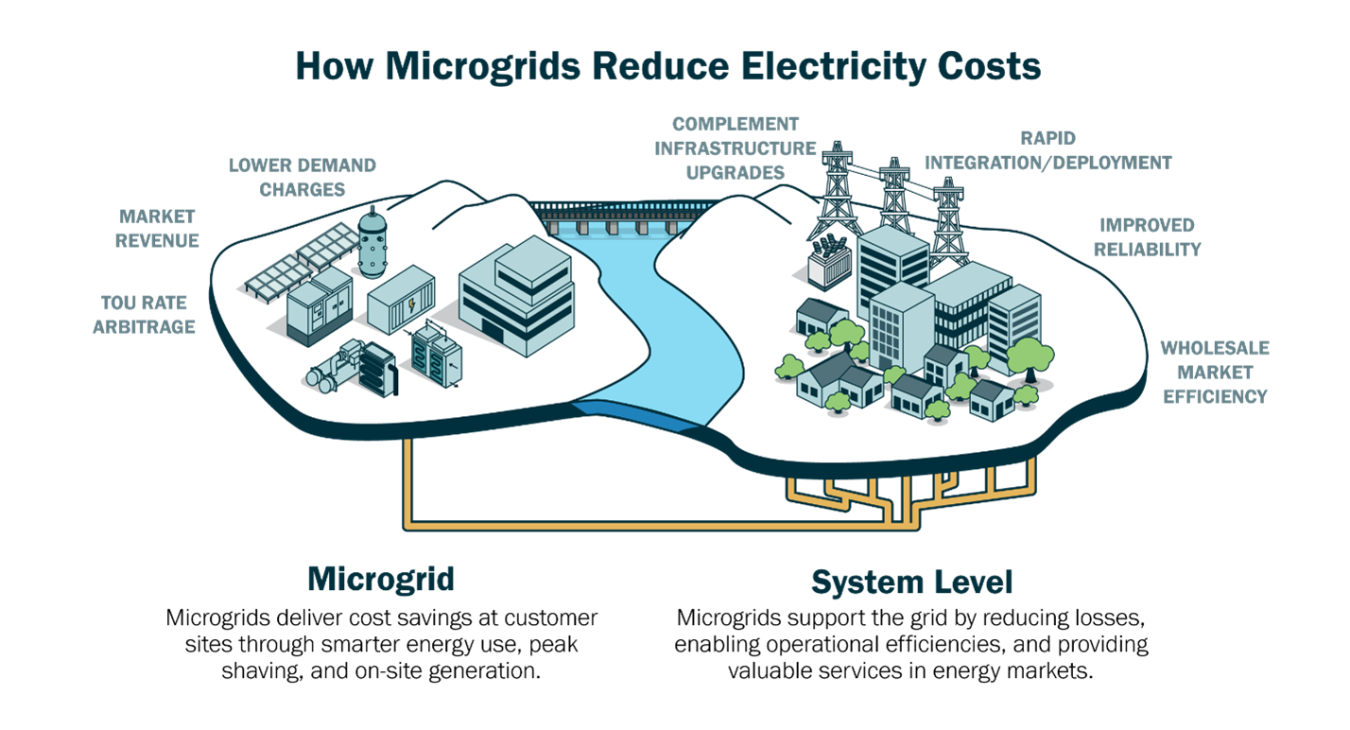
Historically, the Office of Electricity (OE) in the US Department of Energy has maintained a research portfolio that accelerates innovation in the private sector for advancing electricity grid reliability, security, and affordability. OE’s Microgrids program has funded early research for advanced controls, test beds, and demonstrations that have led to increased industry adoption of microgrid technologies. They continue to advance the microgrids R&D that will result in site-level and system-level savings with a focus on advanced analytics for visibility and monitoring, systems integration, project valuation, and planning, all while engaging utilities and communities to support scaling microgrid deployments.
Today, advanced algorithms and technology integration have enhanced today’s microgrids capabilities. Modern microgrids can optimize energy generation and consumption to simultaneously meet local demand, provide services to the grid, and participate in bulk power system wholesale electricity markets. They have the potential to manage demand response and other program participation, and can be strategically deployed to aggregate, organize, and coordinate behind-the-meter distributed energy assets/resources with their own for emerging opportunities as markets open to distributed resources. By taking part in energy transactive markets, microgrids may improve their economic efficiency, supplying ramping capacity where it is most needed which supports the expansion of base load capacity, and ultimately contributing to lower marginal electricity costs for all consumers.
Current utility rate structures, planning tools, and operational controls may be insufficient for emerging microgrid business models. This creates opportunities for innovation that can improve the capture of the system and site-level value that microgrids offer. Today’s utility tariffs and interconnection rules often do not fully recognize or reward the diverse services microgrids can provide. By designing new approaches that enable and incentivize microgrid contributions, such as distribution grid service provision or wholesale market access, utilities and regulators can better align customer investments with broader grid needs.
Microgrids with advanced control capabilities are uniquely positioned to take advantage of new opportunities created by evolving energy markets. With the implementation of FERC Order 2222, distributed and behind-the-meter resources can now be aggregated by microgrid intelligence to participate in wholesale electricity markets, opening up new revenue streams for microgrid owners and operators to offer aggregation as a service. Further, microgrids can also serve as flexible assets for emerging Distribution System Operator models, supporting cost-effective local grid management and enhancing overall system reliability.
For utilities, integrating microgrids into distribution planning creates a cost-effective complement to traditional infrastructure investments. Improved planning tools that accurately reflect the operational value of microgrids can streamline or automate required complex engineering studies, making it easier and less expensive for utilities to evaluate and interconnect microgrid projects. This enables faster and more informed investment decisions to meet evolving grid needs.
Several specific research and development opportunities are critical to realizing the full economic potential of microgrids:
- There is a need for novel optimization and management algorithms that allow microgrids to aggregate their own resources with other behind-the-meter assets to provide reliable grid services while maintaining resilience and adapting to changing risks.
- Research exploring new business models will help microgrids capture multiple value streams from both distribution systems and wholesale markets, enhancing their economic viability and scalability.
- System-level studies and modeling are necessary to quantify the value of microgrids at scale and to demonstrate how they can complement traditional grid investments to lower electricity costs for all customers.
- Advancing planning and analysis tools will help utilities and stakeholders evaluate, integrate, and operate microgrids more efficiently within the broader power system.
- Supporting standardization of interconnection and operational protocols will simplify deployment and facilitate greater participation in system operations and energy markets.
Microgrids represent a powerful tool for modernizing the U.S. power system and maintaining global leadership in energy innovation. The Department of Energy Office of Electricity’s Microgrid Program, which supports research topics in standardization, analysis and tools, and operations and control, is well positioned to complement its existing research portfolio by developing research targeted at the topics that show the cost-reducing value of microgrids. By driving advancements in microgrid integration and deployment, the program can help deliver significant reductions in electricity costs, ensuring affordable, reliable, and secure energy for all Americans.