37 homes at The Medley at Southshore Bay in Tampa kept the lights on during Hurricane Ian in Florida. Their resilience was bolstered by a microgrid.
June 2, 2026 Estimated Read Time min
Dr. Chukwuemeka Obikwelu

Dr. Obikwelu serves as Director of Grid Systems within the U.S. Department of Energy’s (DOE) Office of Electricity, where he oversees a multi-year energy research and development portfolio focused on advancing grid affordability, reliability, resilience, and security. His work spans the intersections of technology, policy, and business, including advanced microgrid technologies, inverter-based-resources, hybrid energy systems (integrating small nuclear reactors, energy storage, etc.), advanced transmission and distribution (T&D) technologies, and emerging energy challenges associated with electrification, AI-driven load growth, and evolving power system demands.
Dr. Obikwelu's industry background spans electric utilities, engineering-procurement-construction (EPC) consulting, technology R&D, and academia. Prior to joining DOE, he held engineering and leadership roles supporting transmission and distribution systems, protection and control engineering, utility operations, compliance, and large-scale energy infrastructure and capital projects across the power sector. His experience also includes teaching power systems engineering courses in academic and professional settings and supporting workforce and technical training initiatives.
He holds a Ph.D. in Electrical Engineering (Energy Systems) from Georgia Institute of Technology, a Master of Science in Electrical Engineering (Power/Energy Systems) from Michigan Technological University, a Master of Education from Harvard University focused on higher education leadership, and a Bachelor of Science in Electrical and Computer Engineering from Wayne State University. He is currently pursuing a Master of Business Administration (MBA) from Indiana University-Bloomington Kelley School of Business, majoring in Business Strategy and Leadership. His hobbies of interest include lawn tennis, chess, a good read, mixed martial arts, running, and long walks.
Dan Ton

Dan Ton is Program Manager at the U.S. Department of Energy (DOE) Office of Electricity (OE), responsible for developing and managing the OE Microgrids R&D Program. He also serves as the OE lead for the Community Microgrid Assistance Partnership (C-MAP) program.
From May 2014 until July 2015, he served as Acting Deputy Assistant Secretary of OE’s Power Systems Engineering Division. Before joining OE, Dan managed the Renewable Systems Integration program within the DOE Solar Energy Technologies Program.
Dan holds a Bachelor of Science in Electrical Engineering and a Master of Science in Business Management, both from the University of Maryland.
Varsha Menon

Varsha Menon is a Program Analyst with the U.S. Department of Energy’s Office of Electricity. Her work supporting the OE Microgrid Program focuses on collaboration with the states to identify and address policy and regulatory barriers to microgrid deployment. Her interests in the energy space include microgrids, economics, and policy and regulation. Varsha holds a Master of Public Policy from American University and a Bachelor of Arts in public policy and political science from the University of North Carolina at Chapel Hill.
In September 2022, Hurricane Ian battered Florida with 160 mph winds, causing service interruptions for 2.2 million electricity customers. However, 37 homes at The Medley at Southshore Bay in Tampa kept the lights on during the storm. Their resilience was bolstered by a microgrid. Resilience events like this in addition to sustained load growth, and other capacity challenges prompted the administration to sign Executive Order 14262 to strengthen the reliability and security of the United States electric grid, highlighting the critical role of a resilient and reliable power grid for energy dominance.
Microgrids contribute to administration goals of a more resilient, reliable, and secure grid. The Office of Electricity’s Microgrid R&D program has developed key tools, methods, standards, and information resources that help industry stakeholders to translate grid insights and strategic priorities into practical, risk-informed action items. Streamlined microgrid deployment, reduced market barriers, domestic skilled labor, and accelerated private sector investment foster U.S. technology and economic leadership by maximizing the resilience and reliability value streams of microgrids.
Resilience is a key property of a power system that reflects the ability of the electric grid to withstand, adapt to, and rapidly recover from widespread disruptions (also called “black sky” events). Historically, utilities have relied on undergrounding networks, hardening overhead lines, and vegetation management to manage the resilience of their system. However, microgrids are a key emerging technology that can improve electric grid resilience, just like it did with the Tampa customers. Microgrids directly improve availability of power to its host customers and can contribute in several ways to rapid recovery of interrupted customers by supporting critical facilities and restoration efforts.
In addition to resilience during “black sky” days, microgrids add value to the system in “blue sky” or typical days by producing energy, contributing to resource adequacy, and providing ancillary services, including supporting loads upon short duration interruptions. Microgrids enable loads to operate in islanded mode during long duration power interruptions, providing resilience services to their hosts (see call out box). However, there are no planning frameworks that can capture the resilience value of microgrids for customers, communities, and utilities, while meeting additional planning objectives related to reliability and affordability. A planning framework that implements comprehensive resilience valuation will be a key driver of microgrid infrastructure investments.
Valuing microgrid resilience usually follows the approach described in Figure 1. First, host customers determine the types of threats or hazards they are exposed to, and their frequency, by using a mix of historical data and forward-looking projections. Second, they estimate how often and severe main grid outages may be, what these interruptions would look like, and how much energy may not be served. Third, they put a dollar value to this lost energy using the Value of Lost Load (VOLL), which describes the customer’s willingness to pay to have power at a higher reliability than the main grid. Key assumptions, data, and methods used to assess microgrid resilience would benefit from frameworks, guidelines, and research supported by state regulators and utilities.
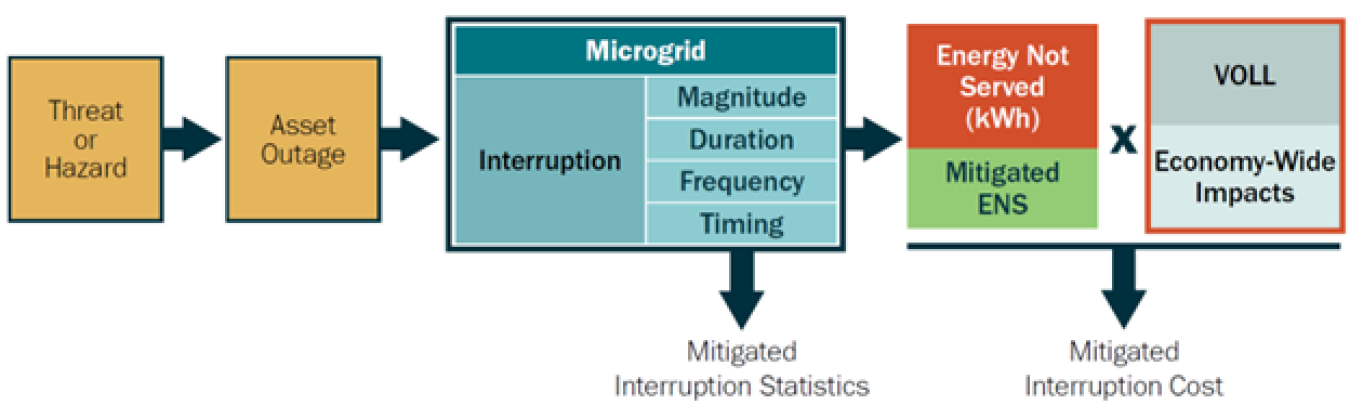
The microgrid developer, whether a utility or a customer, uses this technical and economic assessment to design a system that reduces the expected energy not served by operating in islanding mode when the main grid is out. The lost energy mitigated by the microgrid can then be monetized to quantify its value. However, there are additional benefits hard to monetize such as spillover effects over neighboring economic activity that can be supported by the microgrid, as well as reduction of social burden.
The Office of Electricity Microgrid R&D program is supporting key opportunities to improve capturing and monetizing the resilience value of microgrids, which include:
- Developing accepted resilience metrics that allow us to standardize and market microgrid services more effectively (REAP project). A lack of resilience metrics means that it is harder for regulators to set a resilience target that microgrids could support achieving.
- Developing comprehensive regulatory frameworks that include rate/tariff design, rigorous valuation of resilience benefits, and incentives for microgrid deployment, which could be adopted by any jurisdiction (BRICK-MG project)
- Microgrid customization is key to meet host customer needs, which means their design and operation varies widely from behind-the-meter to intra-feeder, to campus level, to a remote microgrid. This diversity makes it hard to develop general valuation frameworks, which means flexible approaches will be preferred (Networked Microgrids project).
The U.S. Office of Electricity Microgrid R&D Program provides essential support to scale up the technical and economic development of microgrids that support resilient, reliable, and secure power systems. The institutional knowledge, industry partnerships, and national lab partnerships developed over the years by the Microgrid R&D uniquely position the program to support these challenges and administration objectives.