Microgrids offer a promising solution to enable the fast, reliable, and affordable build-out of data centers with shorter timelines relative to distribution/transmission grid expansion.
June 3, 2026 Estimated Read Time min
Michael Pesin

Chief Engineer
As Chief Engineer in the U.S. Department of Energy (DOE)'s Office of Electricity, Michael Pesin brings over 35 years of distinguished experience to the forefront of electric utility innovation. His career is characterized by significant leadership in directing the development and execution of advanced technology programs.
Before joining DOE, Mr. Pesin spent the majority of his career leading technology organizations at a number of electric utilities, where he developed comprehensive technology strategies, managed complex research and development projects, and guided strategic programs and demonstration initiatives. He further extended his impact by founding and leading a technology management consulting company, serving electric utilities, technology companies, and investors across the U.S. and internationally. Mr. Pesin's commitment to advancing the industry is demonstrated through his board memberships in various technology organizations and his active participation as a frequent speaker within numerous electric power industry groups.
Dr. Chukwuemeka Obikwelu

Dr. Obikwelu serves as Director of Grid Systems within the U.S. Department of Energy’s (DOE) Office of Electricity, where he oversees a multi-year energy research and development portfolio focused on advancing grid affordability, reliability, resilience, and security. His work spans the intersections of technology, policy, and business, including advanced microgrid technologies, inverter-based-resources, hybrid energy systems (integrating small nuclear reactors, energy storage, etc.), advanced transmission and distribution (T&D) technologies, and emerging energy challenges associated with electrification, AI-driven load growth, and evolving power system demands.
Dr. Obikwelu's industry background spans electric utilities, engineering-procurement-construction (EPC) consulting, technology R&D, and academia. Prior to joining DOE, he held engineering and leadership roles supporting transmission and distribution systems, protection and control engineering, utility operations, compliance, and large-scale energy infrastructure and capital projects across the power sector. His experience also includes teaching power systems engineering courses in academic and professional settings and supporting workforce and technical training initiatives.
He holds a Ph.D. in Electrical Engineering (Energy Systems) from Georgia Institute of Technology, a Master of Science in Electrical Engineering (Power/Energy Systems) from Michigan Technological University, a Master of Education from Harvard University focused on higher education leadership, and a Bachelor of Science in Electrical and Computer Engineering from Wayne State University. He is currently pursuing a Master of Business Administration (MBA) from Indiana University-Bloomington Kelley School of Business, majoring in Business Strategy and Leadership. His hobbies of interest include lawn tennis, chess, a good read, mixed martial arts, running, and long walks.
Dr. Roxana Melendez

Dr. Roxana Melendez is an Electrical Engineer and Engineering Project Management Specialist with a Ph.D. degree in Electrical Engineering from Florida Atlantic University. She is an engineering advocate who is passionate about Smart Grids, Microgrids and Electrical Power Systems. She is convinced that the reliable, secure and optimal operation of the grid constitutes one of the main pillars for the development and advancement of communities all over the world.
Roxana was a postdoctoral research fellow at Florida Atlantic University, through the eFellows engineering program administered by the American Society for Engineering Education and funded by the U.S. National Science Foundation. Roxana also has taught at academic institutions such as Florida Atlantic University, University of Texas at Dallas, Palm Beach State College, Collin College, Miami Dade College, and others abroad. She has been working in the engineering field since 2001, worked as an engineering project manager for multiple companies, in Texas, Florida and Colombia, and has taught engineering courses since 2008.
Roxana envisions herself serving the community through the government, providing solutions that will enhance people’s quality of life. Currently, she works at the U.S. Department of Energy's Office of Electricity as a General Engineer.
The rapid growth of data centers and other large electric loads (LELs), such as advanced industrial manufacturers, crypto mining facilities, mining & extraction installations, and large dynamic digital loads (like data centers), has created a pressing need for innovative solutions to support their power requirements. Microgrids offer a promising solution to enable the fast, reliable, and affordable build-out of data centers with shorter timelines relative to distribution/transmission grid expansion. By leveraging microgrid innovations, such as DC microgrids, modular build approaches, and networked coordinated control, data centers can be powered efficiently. Microgrids have a proven track record of providing power to critical loads, and they can address reliability and co-located generation control concerns by providing storage and other back-up generation sources.
The swift installation of data centers is crucial to meet national goals of AI dominance, but their deployment is being hindered by grid capacity constraints and lengthy timelines for grid expansion and interconnection. Total data center electricity usage climbed from 58 TWh in 2014 to 176 TWh in 2023 and is estimated to increase to between 325 to 580 TWh by 20281, with single sites requesting power capacity of up to 4.5 GW2 (the average electricity demand of the entire state of Connecticut3). Interconnecting LELs at this pace in traditional power systems is challenging. It requires permitting and building new generation and transmission at a historically unforeseen pace. To accelerate data center development, co-location with existing or refurbished power generation facilities is being explored. However, this approach presents regulatory challenges at the federal, state, and local levels, such as the lack of visibility of grid operators to sudden losses of data center loads and issues around fair allocation of distribution system costs4.
The Department of Energy's (DOE) Office of Electricity (OE) has played a significant role in advancing microgrid technologies and their adoption since the early 2000s. The OE's microgrid program has been instrumental in enabling practical, innovative, and highly relevant solutions to address the complexities and challenges associated with microgrid development and deployment. The OE's microgrid program addresses market failures and gaps in existing industry solutions, such as high upfront costs, technical complexities, and regulatory hurdles. It also undertakes high-impact tasks that the private sector cannot or will not address, such as developing advanced microgrid control systems, modeling and simulation tools, and cybersecurity frameworks. The OE can support large-scale demonstration projects that may be too costly or complex for the private sector to undertake alone and can take a long-term view, focusing on research and development that may not yield immediate returns but can have significant long-term benefits. The DOE plays a crucial role in coordinating large stakeholders, including utilities, regulators, data center builders, data center operators, and electric equipment manufacturers. The DOE can support research to determine fair and robust cost recovery of grid and microgrid assets supporting LELs, such as data centers. Furthermore, continued research is needed on microgrid design and optimization, considering unique features of data centers, supply chain bottlenecks, and the impact on speed to deployment.
Grid-connected microgrid system architectures, as shown in Figure 1, are particularly beneficial, as they allow the microgrid system to support the grid and provide benefits to the larger ratepayer/taxpayer base. LEL utility customers can benefit from utility-owned/managed microgrids, which can be used as a "capacity reserve" system asset to aid the main grid during capacity constraints. Due to the challenging timelines for grid connection described above, microgrids can be built stand-alone as a “bridge” until grid connection is obtained, at which point they can provide essential support to the broader electrical grid. By strategically managing energy generation and storage, microgrids can offer ancillary services, such as frequency regulation and demand response, which are vital for maintaining grid stability. During excessive generation, microgrids can export surplus electricity back to the grid, thereby supporting overall grid resilience and reducing the need for peaking power plants.
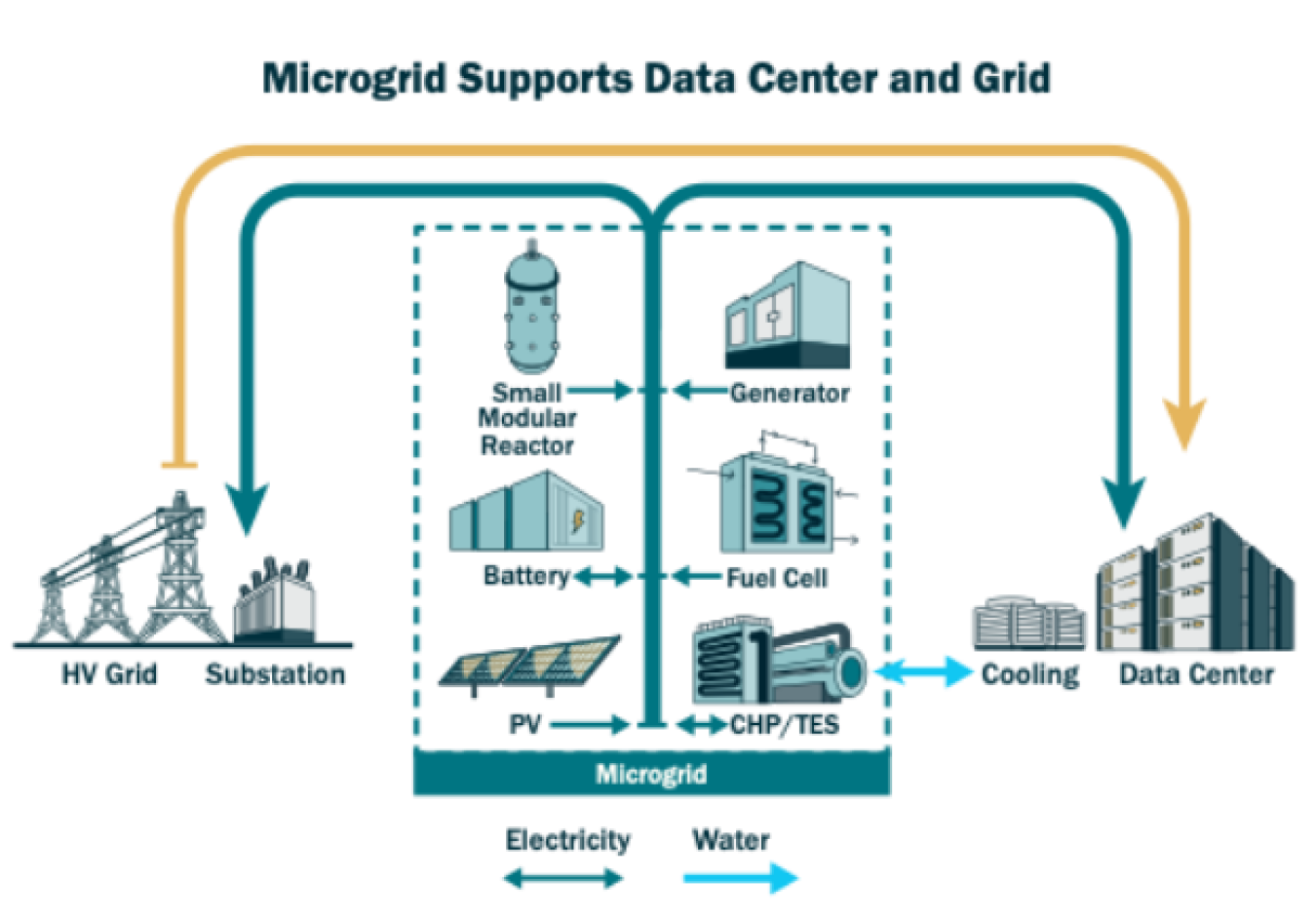
However, several challenges need to be addressed. The integrated design of data centers and microgrids must consider electric loads and water needed for cooling, as well as optimal operation to minimize impact on the grid or match generation and storage when islanded. Different generation sources, such as geothermal and nuclear, show promise in powering data centers but require storage and other microgrid components to minimize generator sizes and manage variable data center and other LELs. Combined heat and power (CHP) systems can convert waste heat into electricity and thermal energy storage (TES) can store excess thermal energy generated during low-demand periods and release it during peak demand times, effectively smoothing out the energy supply. Optimal integrated design of the various methods of generation, storage, and thermal management vary with the type of LEL and require further research and engineering, especially as the power, storage, and load technologies advance rapidly.
Microgrids offer a viable solution to support the rapid growth of data centers and other LELs while addressing the challenges associated with their power requirements. By leveraging microgrid innovations and grid-connected architectures, data centers can be powered efficiently and reliably, ultimately contributing to the nation's goals of AI and manufacturing dominance. Addressing the challenges and research needs outlined above through federal research efforts, such as DOE OE’s microgrid program, will be crucial to ensuring the successful deployment of data centers and other LELs.