



RSS



Subscribe to the Marine Energy Newsletter
H2O's Marine Energy newsletter shares news and updates on tools, analysis, and emerging technologies to advance marine energy.
Below are stories about marine energy featured by the U.S. Department of Energy (DOE) Hydropower and Hydrokinetic Office.
From a report on markets marine energy could serve, a national lab team focuses on 10 key research areas that are fundamental challenges for marine energy to integrate into high-priority ocean-based industry applications.
The newly awarded Atlantic Marine Energy Center will provide research and testing capabilities for marine energy, with the awarded coalition focusing on ocean-based industries.
Competitors presented, tested, and evaluated small, modular, cost-competitive desalination systems powered by ocean waves through two rounds of the Waves to Water prize and five concepts earned a chance to compete in the final test in the open water.
WPTO selected 10 projects to receive funding as part of efforts to support marine energy R&D and testing infrastructure.
To support the critical step for industry to model and evaluate systems, a multilab team made significant additions to a marine energy data processing software, called MHKiT, to include functions to download and process new types of data.
With the first stages of directional drilling nearly complete, land-based construction begins on PacWave South, the United States’ first accredited, grid-connected, open-ocean wave energy testing facility.
The TEAMER program grew substantially in its second year to 37 requests for technical support in Fiscal Year 2021—and expanded its network from 30 to include more than 90 different capabilities.
Research team conducts tests to advance a flying underwater kite that could power deep sea research by harnessing and storing clean ocean energy from slow-moving currents.
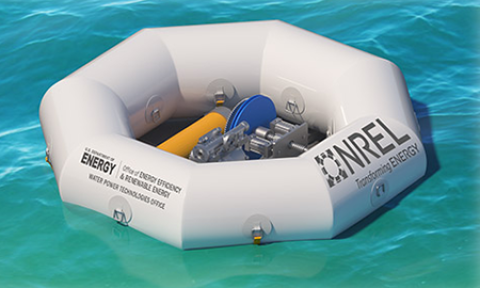
Researchers at the National Renewable Energy Laboratory outfitted the SeaRAY autonomous offshore power system with a customized Modular Ocean Data Acquisition system, which will allow handlers to control the device from afar and collect real-time data.
The Portal and Repository for Information on Marine Renewable Energy now features a centralized search engine for marine energy information, and the team launches a lessons-learned documentation effort.