



Vehicle telematics systems can support federal fleet management, safety, cost efficiency, and vehicle acquisition planning. The Federal Energy Management Program (FEMP) provides information about telematics to help agencies deploy and integrate telematics systems into fleet management processes and maximize telematics value.
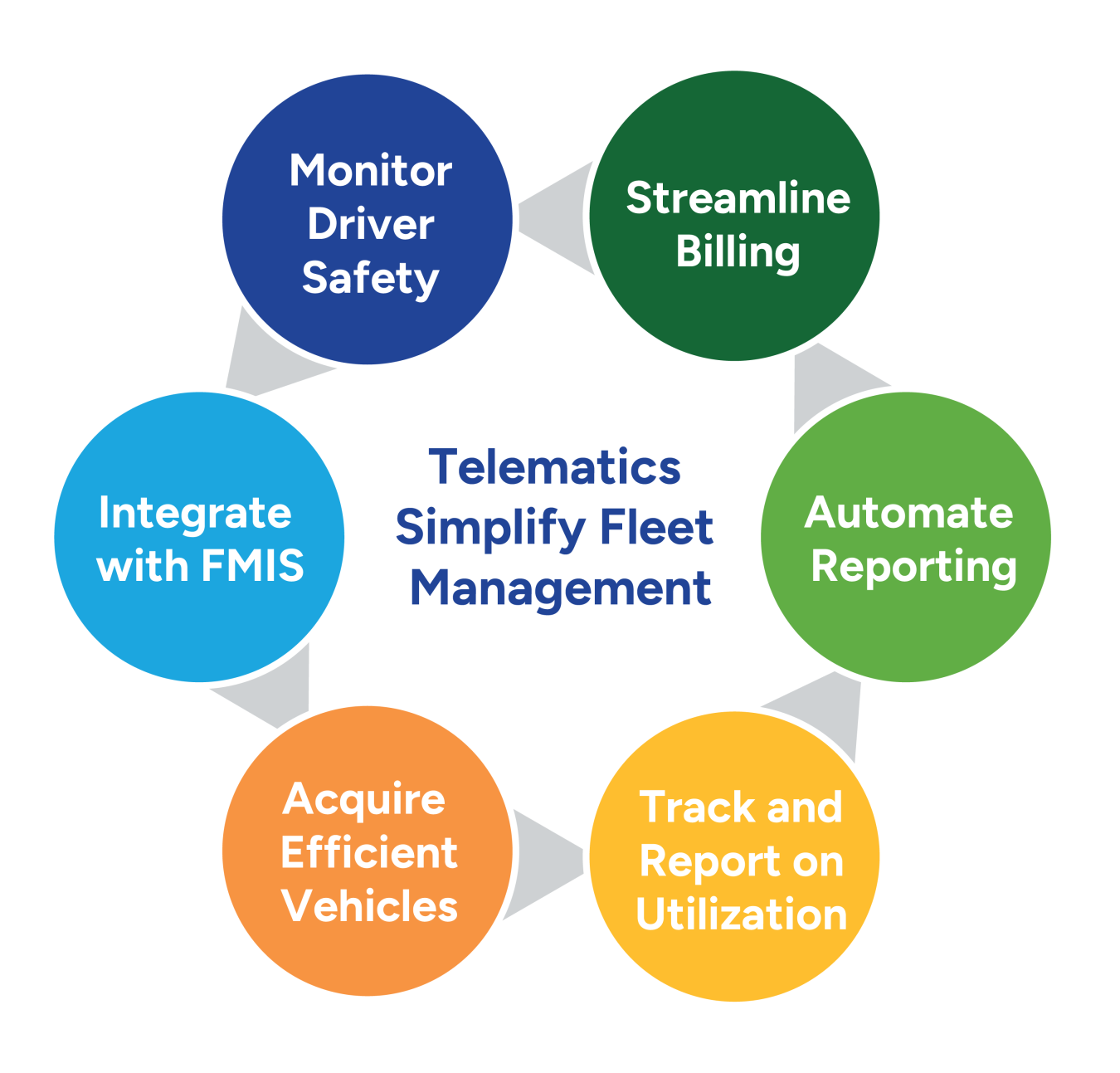
Image illustrates how telematics help simplify federal fleet management by streamlining billing, automating reporting, tracking vehicle utilization, informing efficient vehicle acquisitions, integrating with fleet management information systems (FMIS), and monitoring driver safety. Illustration by Fred Zietz, National Laboratory of the Rockies.
Overview of Telematics Systems
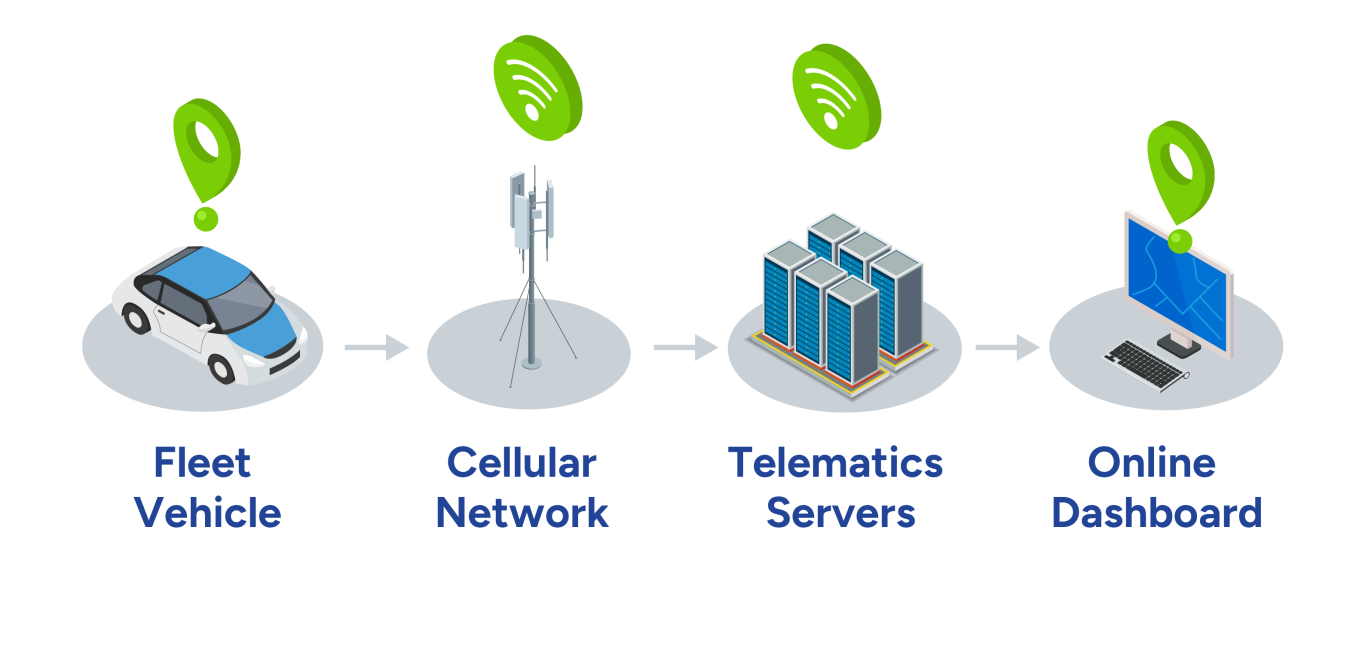
Telematics systems collect and transmit near real-time vehicle data—including global positioning system (GPS) location and diagnostics from vehicle on-board diagnostic (OBD) ports—via a cellular network to a secure, cloud-based platform. These insights help federal fleets optimize operations, reduce costs, support federal reporting requirements, and enhance both driver safety and vehicle performance.
Telematics for GSA Leased Vehicles
The General Services Administration (GSA) is currently contracted with Geotab to provide telematics to GSA-leased vehicles. The telematics installation and data plan costs have been incorporated into the monthly lease rate for all GSA leased vehicles regardless of whether they have telematics installed. Geotab is the only fully integrated, FedRAMP Authorized telematics solution in government. Federal fleets can also use the GSA contract to install Geotab devices on agency-owned vehicles or choose to work with a different telematics provider. Contact your agency’s headquarters fleet manager or refer to the GSA Fleet telematics webpage to find more information.
Telematics Installation Modes
There are three main deployment types or installation modes for telematics systems used in federal fleets:
- Original equipment manufacturer (OEM) telematics use factory-installed telematics, eliminating aftermarket needs for current and future model years. They offer seamless integration with vehicle systems, often including manufacture support and over-the-air updates, but can be limited in customization and might not work across fleet makes and models. Ford and GM currently offer OEM telematics integration with telematics providers such as Geotab.
- Aftermarket telematics plug into the vehicle’s OBD-II port or are hardwired into the vehicle. These devices are easy to upgrade or switch providers, and work across all vehicle makes and models.
- Temporary telematics are designed for quick installation and removal, typically using plug-in OBD ports. They are ideal for short-term use on a vehicle to track data, typically to make acquisition decisions or conduct pilot studies.
| Type | Installed by | Best For | Example |
| OEM | Manufacturer | Homogeneous fleets | Ford Pro, GM OnStar |
| Aftermarket | Third-party | Long-term management of fleets | Geotab, Samsara, Verizon Connect |
| Temporary | User/fleet | Short-term use, trials | Verizon Connect |
Telematics Data Elements




Simplified Fleet Management




Vehicle Acquisition Support
Telematics data provides valuable insights that support more strategic and cost-effective vehicle procurement decisions. By analyzing usage patterns, mission needs, and vehicle performance, fleet managers can right-size fleets, reduce redundancy, and identify opportunities, if necessary, to acquire alternative fuel vehicles.
- Pooling vehicles: Usage data supports implementation of motor pools and shared-use models, reducing redundant assets.
- Vehicle allocation methodology (VAM) support: Telematics help justify vehicle needs by providing accurate and detailed utilization data.
- Optimal vehicle profile: Optimizing fleet size and selecting the right vehicle class can potentially lower acquisition and operating costs.
- Life cycle costs: Combine utilization and financial data to calculate true cost of ownership.
Cybersecurity Best Practices
Telematics systems handle sensitive fleet data—including vehicle location, usage patterns, and driver behavior—which makes cybersecurity a top priority. Federal agencies must ensure that systems comply with stringent government standards to protect data integrity, privacy, and operational security.
Fleet managers do not need to become cybersecurity experts, but they should consult such experts when choosing a telematics provider. Often, an agency’s own information technology (IT) team can help determine which issues to prioritize. Consider the following:
- Compliance with federal and industry standards:
- FedRAMP certification: Check if the telematics provider is FedRAMP Authorized, ensuring its cloud infrastructure meets federal cybersecurity standards.
- Privacy protection: Understand how personally identifiable information (PII) is handled.
- Data encryption: Understand how devices encrypt data at rest and in transit and ensure that they meet federal encryption standards.
- Data ownership and access control: Agencies retain control over their data and can configure role-based access controls to limit data access by user roles.
- Continuous monitoring: Security logs and audit trails can support agency compliance with external and internal policies.
- Secure data storage: Clarify data retention and deletion policies.
Total Cost Savings and Recommendations
Telematics systems can deliver measurable cost savings and operational improvements across multiple areas of fleet management.
- Fleet oversight and labor savings: Automated mileage tracking, predictive maintenance alerts, and centralized dashboards reduce administrative burden, streamline reporting, and minimize paperwork.
- Driver fuel efficiency: Real-time driver feedback and behavior monitoring (e.g., reducing speeding, idling, and harsh braking) can lower fuel use by 10–25%, and reduce wear and tear.
- Collision rate reduction: Telematics can reduce collision rates by monitoring and influencing driver behavior, improving vehicle maintenance, and providing valuable data for accident analysis.
- Maintenance cost reduction: Early detection of engine faults and automated service reminders help prevent costly repairs, extend vehicle life, and minimize downtime.
Telematics enable better driver safety, efficient operations, and targeted vehicle acquisitions. Agencies are encouraged to coordinate with fleet, IT, and cybersecurity teams to maximize telematics value and streamline acquisitions.