



RSS
Scientists have found lasofoxifene may be a safer and more effective treatment for breast cancer than the current gold standard.
Collecting New Data on Atmospheric Particles like Pollution for Storm Forecasting and Climate Models
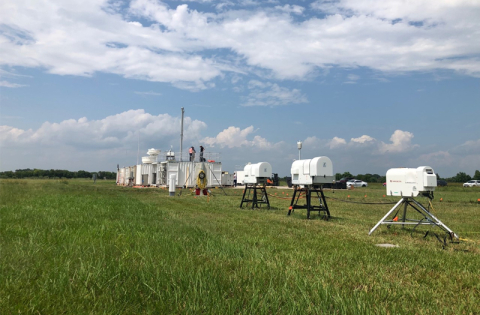
A mobile Office of Science observatory is tracking clouds over Houston through summer 2022.
Researchers at the University of Miami found that salinity changes as a result of water cycle changes lead to less surface warming.
The team will create “circular polymers” materials that break the current linear economic framework of make, use, and dispose.
Contrary to Expectations, Study Finds Primate Neurons Have Fewer Synapses Than Mice in Visual Cortex
The team determined that the metabolic cost of building and maintaining synapses likely drives larger neural networks to be sparser.
Oregon State University chemistry professor May Nyman has been selected as one of the leaders of a $24 million federal effort.
As rising sea levels threaten coastal areas, scientists are using an emerging nuclear dating technique to track the ins and outs of water flow.
The goal of the funding program is to harness cutting-edge research tools for new scientific discoveries fundamental to clean energy solutions.
Based on the latest data, NOvA did not observe a significant asymmetry in the rates of electron neutrino and electron antineutrino appearance.
“Science in Time of COVID” is a contest to educate, inspire, and entertain audiences about the extraordinary science, innovation, and people at DOE.