



RSS
Frontier raised the bar for calculating the number of atoms in a molecular dynamics simulation 1,000 times greater in size and speed.
A collaboration yields a powerful combination of high-throughput computation & fabrication techniques to accelerate the discovery of quantum defects.
An ultrathin film of tungsten ditelluride circularly polarizes light when oriented in a specific direction and subjected to linear terahertz radiation
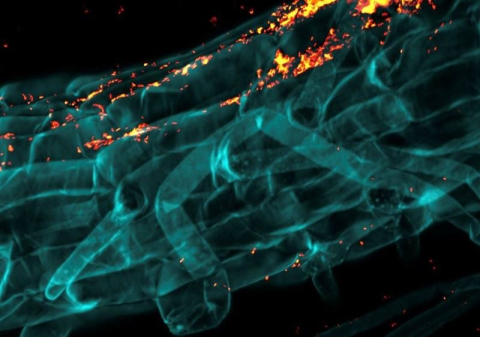
Researchers are looking below the soil’s surface to better understand how a plant thrives.
University of Pennsylvania physics and engineering researchers have created a local learning network that is fast, low-power, and scalable.
The Department of Energy has chosen Cornell and three partner institutions to establish the new DOE Tigner Traineeship in Accelerator Science program.
A combination of supercomputing and traditional techniques allowed Jefferson Lab theorists to better describe the unstable sigma meson particle.
Global scientific community members and EIC supporters came together recently at two major meetings to plan the next steps to make the EIC a reality.
The surface oxygen functionality of graphene oxide may be tuned using ultraviolet light, affecting how differently charged ions move through material.
University of New Mexico graduate student Josef Sorenson will pursue his Ph.D. proposal next year at Lawrence Berkeley National Laboratory.