



RSS
The faculty members, postdoctoral researchers, and graduate students from Old Dominion Physics Department are doing research at the Jefferson Lab.
The project includes research teams from all three state universities in Arizona and partnerships with the National Weather Service and others.
Federal, state and local officials joined DOE and Argonne leaders to cut the ribbon on the upgraded Advanced Photon Source on July 17, 2024.
Modeling the diffusion of oxygen into niobium accelerator cavities allows scientists to tailor their properties for maximum efficiency & minimum cost.
A study reveals a four-fold increase in cycle life for electric aircraft batteries due to electrolyte solution discovered using a bioscience technique
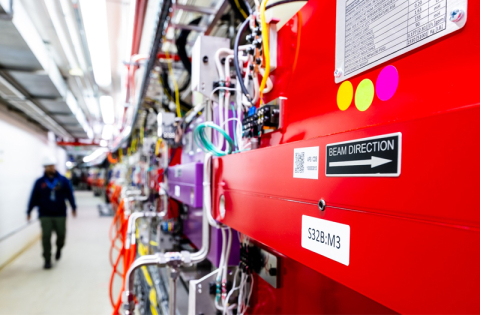
The Advanced Photon Source at Argonne National Laboratory recently underwent an upgrade that will make it more powerful than ever before.
James Christie, Love Christie, Andy Tanjaroon Ly, and Jinu Thomas have been selected for DOE's Office of Science Graduate Student Research program.
A research team is focusing on finding the conditions for a new stellar process in an experiment at Argonne National Laboratory.
Researchers investigated one potential silicon replacement - transition-metal dichalcogenide, a 2D material, to produce chips with smaller features.
Undergraduate students learned how to do research following the scientific method in the SM2ART Research Experience for Undergraduates summer program.