



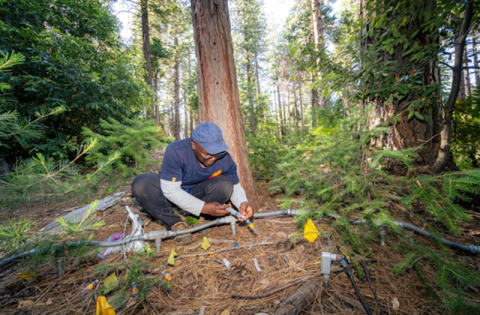
Researchers work in the mountains and at the seashore to study how warmer temperatures impact the ability of deep subsoils to store carbon.
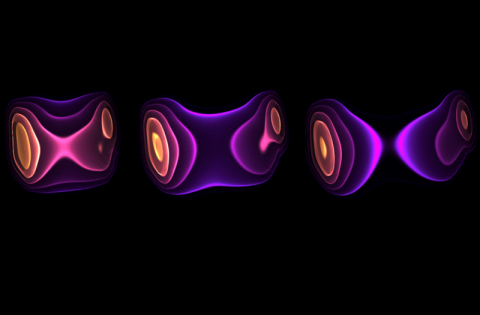
Both data from the Large Hadron Collider and theoretical analysis suggest that photons colliding with ions may be producing the quark-gluon plasma.
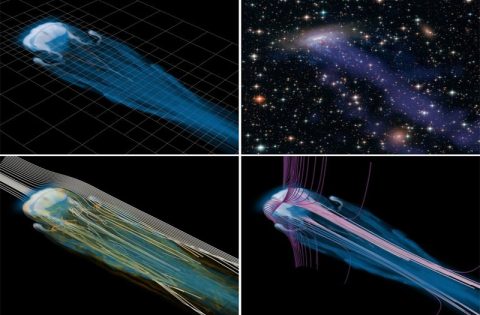
A trio of new and improved cosmological simulation codes heralds a new era of exascale computational astrophysics that promises to advance our understanding of the universe with models of unprecedented scale and resolution.

Yuan Ping developed measurement methods that helped scientists properly control fusion energy losses at the National Ignition Facility.
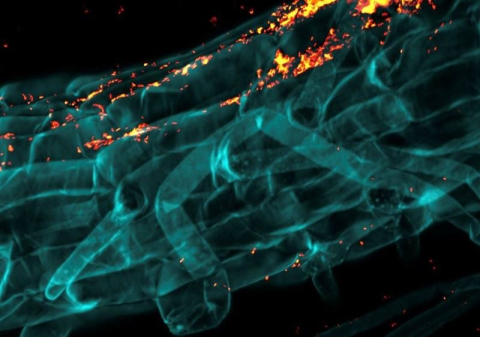
Researchers are looking below the soil’s surface to better understand how a plant thrives.
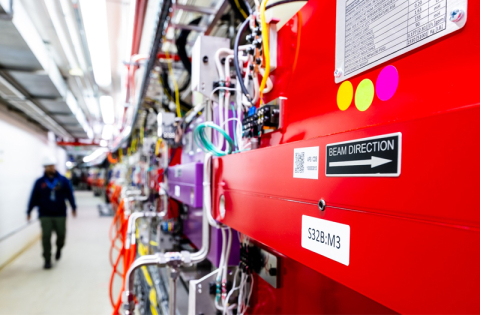
The Advanced Photon Source at Argonne National Laboratory recently underwent an upgrade that will make it more powerful than ever before.
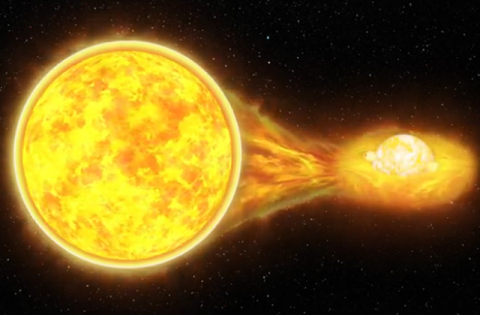
To learn more about valuable elements being made in space, researchers brought the void above to the lab below.
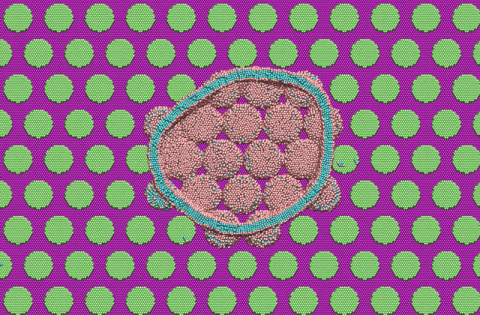
Scientists used multiple DOE Office of Science user facilities to understand the bacteria-busting properties of cicada wings.
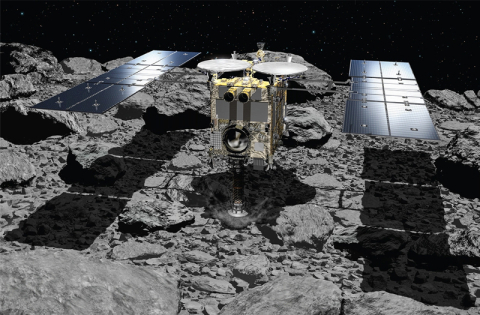
Researchers used the powerful X-rays at the Advanced Light Source to analyze a sample from the asteroid Ryugu.
Lijuan Ruan studies the strong force interactions that occur in the quark-gluon plasma created at Brookhaven Lab’s Relativistic Heavy Ion Collider.