



Challenge
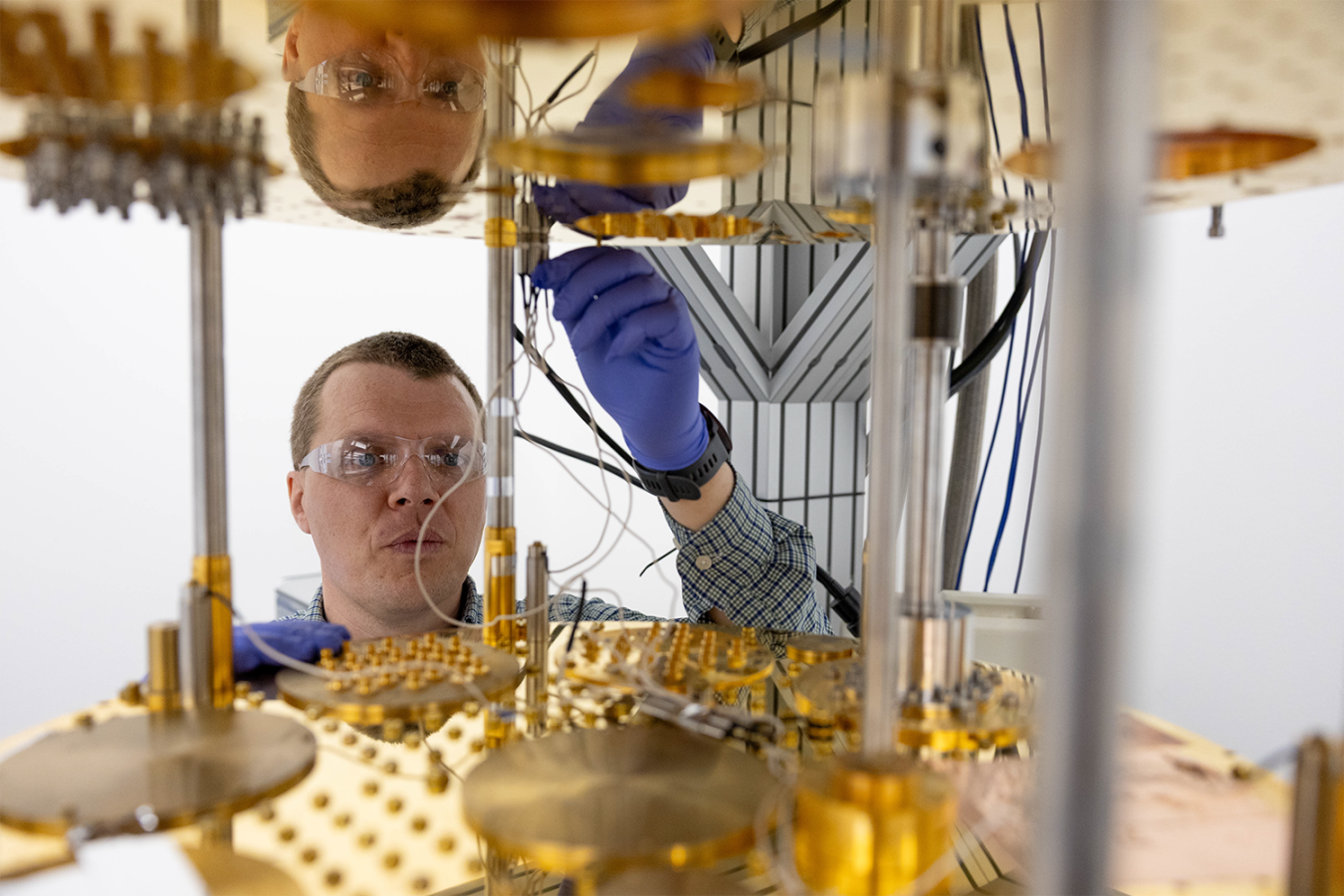
Discovering new quantum algorithms is an exceptionally difficult challenge due to the number of potential quantum operations and is highly counterintuitive for human researchers to navigate. U.S. leadership in the emerging quantum computing revolution will require accelerating the design and development of quantum algorithms (including those that capitalize on the convergence of classical HPC, AI, and quantum computers) that demonstrate scientific utility and a provable quantum advantage.
AI Solution
Novel AI could discover new quantum algorithms by automating and optimizing their design and translating them into applications without requiring prior domain knowledge. Furthermore, AI-powered platforms can translate high-level problem descriptions in natural language into executable quantum circuits, making algorithm design more accessible to researchers from various fields. AI could help establish scientific workflows that leverage the interplay of classical and quantum resources, managing data flow and executing complex computations across platforms.
Justification
There is strong evidence that quantum computers and algorithms will offer solutions to computational problems with high impact to the scientific community, beyond the limits of classical HPC and AI. DOE hosts the most complete suite of scientific computing capabilities and these advances in quantum capability will enable computations that are classically intractable.
National Impact
The discovery of new quantum algorithms will have broad applications to science domains, such as fusion sciences, high energy physics, nuclear physics, materials science, and chemistry, with proposed commercial applications for the acceleration of drug, material, and chemical discovery. This technological leap would not only bolster the nation’s economy and security but also provide tools to address some of the most challenging scientific and societal problems.
Projects selected under the Genesis Mission Request for Applications (RFA) are addressing some of the nation’s most pressing energy, scientific, and engineering challenges, including in nuclear energy, critical mineral extraction, intelligent chip design, and commercial fusion energy.
AI-Enabled Optimization of Quantum Circuit Design for Realistic Nuclear Problems
National Challenge: Discovering Quantum Algorithms with AI
Lead Institution: Argonne National Laboratory
Partners: Infleqtion; Northwestern University; Dakota State UniversityQuantum computing could eventually enable nuclear-physics calculations that are too difficult for classical computers, but translating realistic nuclear problems into efficient quantum circuits is a challenge. The complexity of realistic nuclear interactions leads to complicated circuit-design tradeoffs across a vast design space involving choices of qubit mappings, solvers, state-preparation methods, measurement strategies, and hardware.
Argonne National Laboratory is developing a tool-enabled SI-agent framework to automate the search for efficient quantum workflows for nuclear applications. The framework will represent possible workflow choices with nodes corresponding to design decisions and connections representing compatibility and expected performance. SI agents will evaluate outputs using measures such as circuit depth, resource requirements, systematic error, and accuracy to identify promising end-to-end workflows from nuclear-problem encoding through target quantum hardware.
Automating this design process could reduce the trial and error required to adapt realistic nuclear calculations to quantum computers, helping researchers more rapidly identify where quantum hardware and algorithms can provide meaningful advantage for nuclear and hadronic science.
DOE’s National Labs are leading many of the projects aligned with the Genesis Mission to address science and technology challenges of national importance.
Speeding Up Essential Groundwork for Quantum Computing
National Challenge: Discovering Quantum Algorithms with AI
Leading Lab: Pacific Northwest National LaboratoryQuantum computers have the potential to dramatically accelerate complex calculations, but inefficient data preparation remains a major bottleneck to achieving quantum advantage. To meet this national challenge, Pacific Northwest National Laboratory developed “Picasso,” a Super Intelligence-enabled parallel algorithm that uses classical computing to efficiently prepare data for quantum systems. By leveraging SI-augmented graph coloring to optimize how quantum workloads are grouped, Picasso can process problems of unprecedented scale—handling millions of Pauli strings in minutes and one trillion-plus relationships while using modest GPU memory. This advance significantly expands the class of problems that can be explored with quantum algorithms, accelerating progress toward practical quantum computing.
Related Challenges
This was last updated .