



You can use the energy performance ratings of windows, doors, and skylights to understand their potential for gaining and losing heat, as well as bringing sunlight into your home.
Energy Performance Testing, Certification, and Labeling
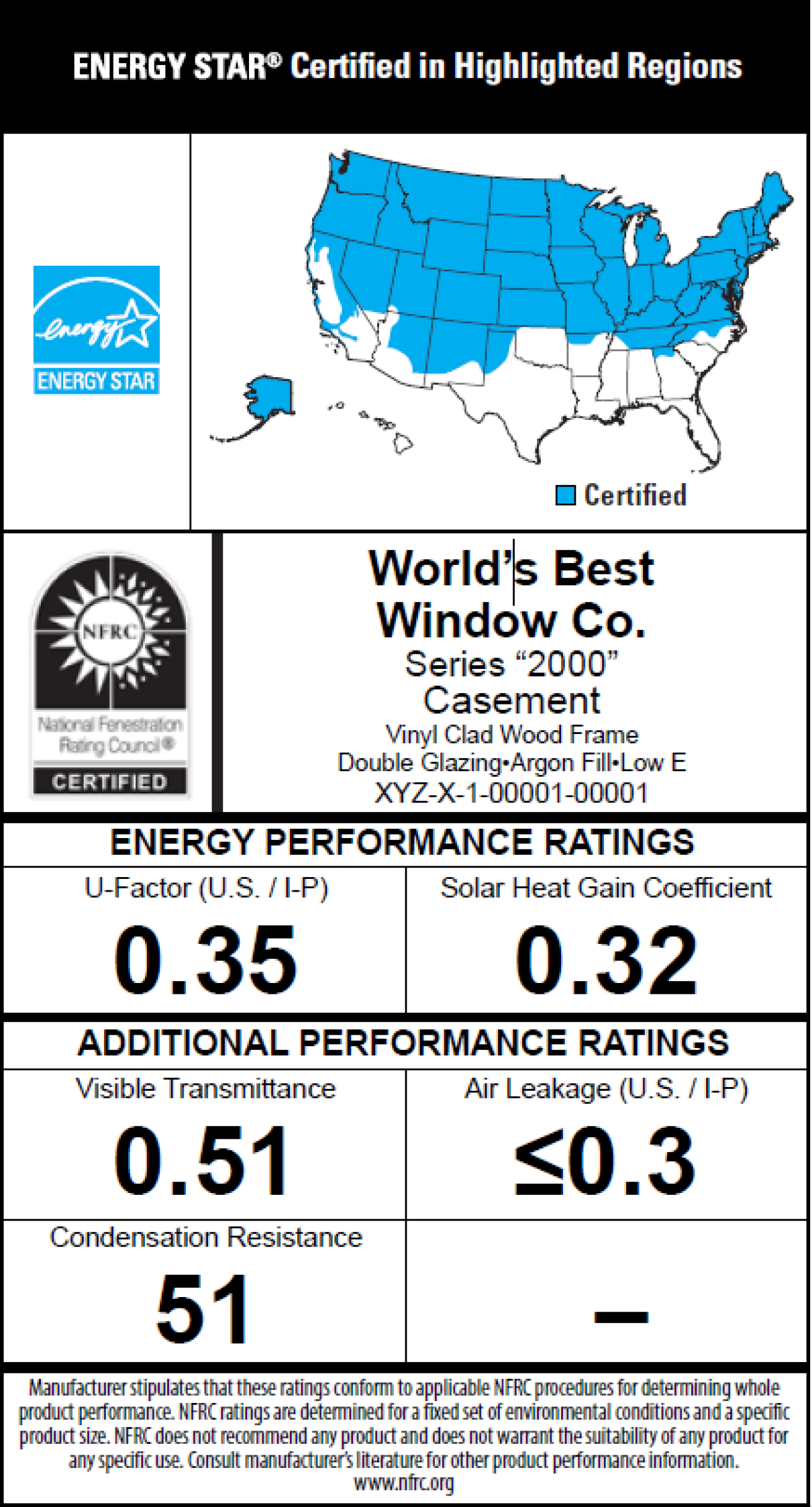
The National Fenestration Rating Council (NFRC) operates a voluntary program that tests, certifies, and labels windows, doors, and skylights based on their energy performance ratings. The NFRC label provides a reliable way to determine a window's energy properties and to compare products.
The NFRC label can be found on all ENERGY STAR® qualified window, door, and skylight products, but ENERGY STAR bases its qualification only on U-factor and solar heat gain coefficient ratings, which are described below.
Heat Gain and Loss
Windows, doors, skylights can gain and lose heat through:
- Direct conduction and convection heat transfer through the glass or multi-layer glazing and framing
- Thermal radiation into a house and out of a house from room-temperature objects, such as exterior walls and windows, people, equipment, furniture, and interior walls
- The solar radiation into a house, which is converted to heat when absorbed by building surfaces
- Air leakage through and around them.
U-factor is the rate at which a window, door, or skylight transmits non-solar heat flow. For windows, skylights, and glass doors, a U-factor may refer to just the glass or glazing alone. NFRC U-factor ratings, however, represent the entire window performance, including frame and spacer material. The lower the U-factor, the more energy-efficient the window, door, or skylight.
Solar heat gain coefficient (SHGC) is the fraction of solar radiation admitted through a window, door, or skylight -- either transmitted directly and/or absorbed, and subsequently released as heat inside a home. The lower the SHGC, the less solar heat it transmits and the greater its shading ability. A product with a high SHGC rating is more effective at collecting solar heat during the winter. A product with a low SHGC rating is more effective at reducing cooling loads during the summer by blocking heat gain from the sun. Your home’s climate, orientation, and external shading will determine the optimal SHGC for a particular window, door, or skylight. For more information about SHGC and windows, see passive solar window design.
Air leakage is the rate of air movement around a window, door, or skylight in the presence of a specific pressure difference across it. A product with a low air leakage rating is tighter than one with a high air leakage rating. Note that air leakage also depends on proper installation of a window, which is assumed in all ratings.
Sunlight Transmittance
The ability of glazing in a window, door, or skylight to transmit sunlight into a home can be measured and rated according to the following energy performance characteristics:
- Visible transmittance (VT) is a fraction of the visible spectrum of sunlight (380 to 720 nanometers), weighted by the sensitivity of the human eye, that is transmitted through the glazing of a window, door, or skylight. A product with a higher VT transmits more visible light. VT is expressed as a number between 0 and 1. The VT you need for a window, door, or skylight should be determined by your home's daylighting requirements and/or whether you need to reduce interior glare in a space.
- Light-to-solar gain (LSG)is the ratio between the VT and SHGC. It provides a gauge of the relative efficiency of different glass or glazing types in transmitting daylight while blocking heat gains. The higher the number, the more light transmitted without adding excessive amounts of heat. This energy performance rating isn't always provided.
Recommended Performance Ratings by Climate Zone
Use the window selection tool for new construction or existing homes from the Efficient Windows Collaborative to determine the desired performance ratings for your climate.
Subscribe to receive updates from Energy Saver, including new blogs, updated content, and seasonal energy saving tips for consumers and homeowners.