



Enhanced geothermal systems (EGS), or human-made geothermal energy, holds the potential to power American homes and businesses nationwide and is the next frontier for geothermal energy deployment
What is an Enhanced Geothermal System (EGS)?
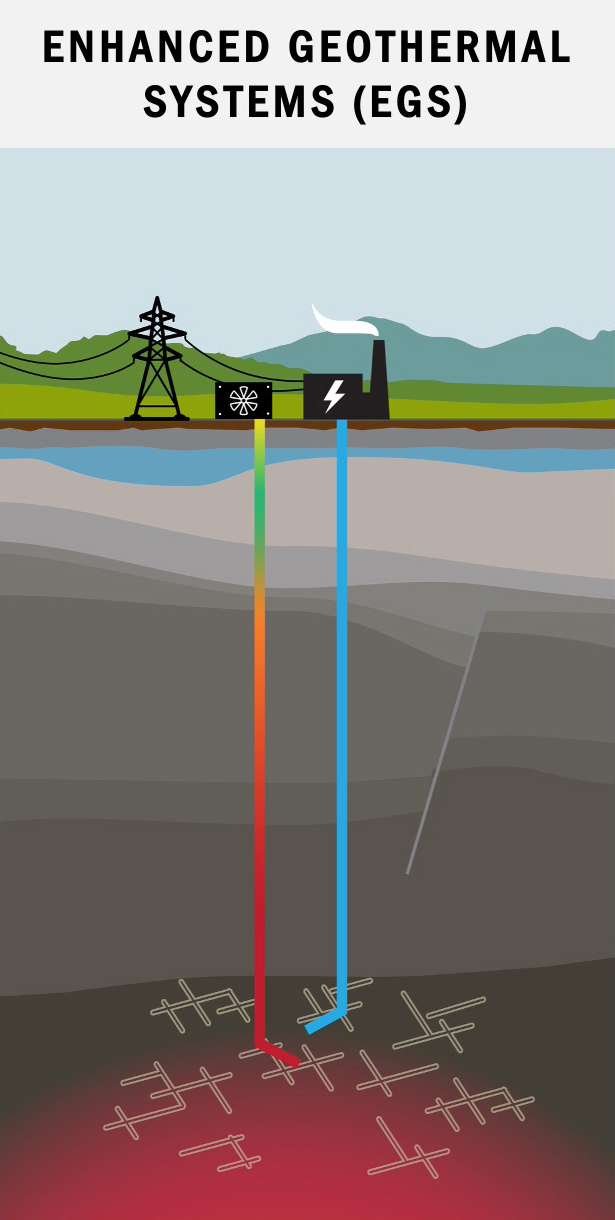
A naturally occurring geothermal system, known as a hydrothermal system, requires three key elements to generate electricity: heat, fluid, and permeability, which is when fluid can move freely through the underground rock.
In many areas, however, the underground rock is hot but there is not enough natural permeability or fluids present. In those cases, an enhanced geothermal system (EGS) can be used to create a human-made reservoir to tap that heat for energy.
In an EGS, fluid is injected deep underground under carefully controlled conditions to create new fractures and cause pre-existing fractures to re-open, creating permeability. Increased permeability allows fluid to circulate throughout the more fractured hot rock, and the fluid becomes hot as it circulates. Operators pump the hot water up to the surface, where it generates electricity for the grid. Watch a video to learn more about the steps and benefits in EGS development.
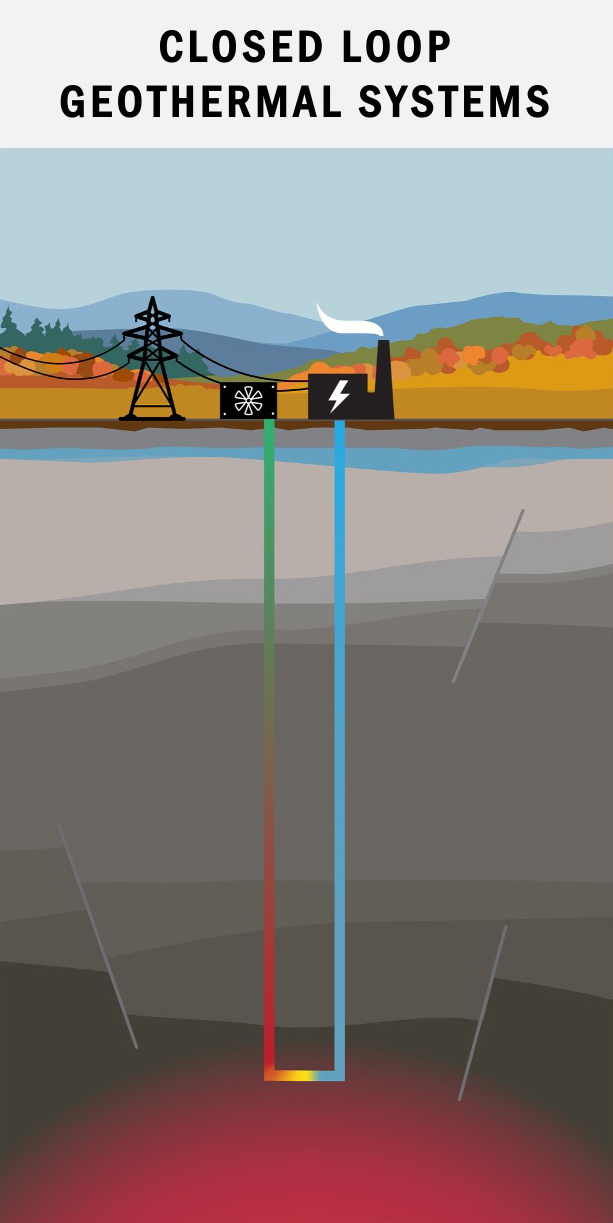
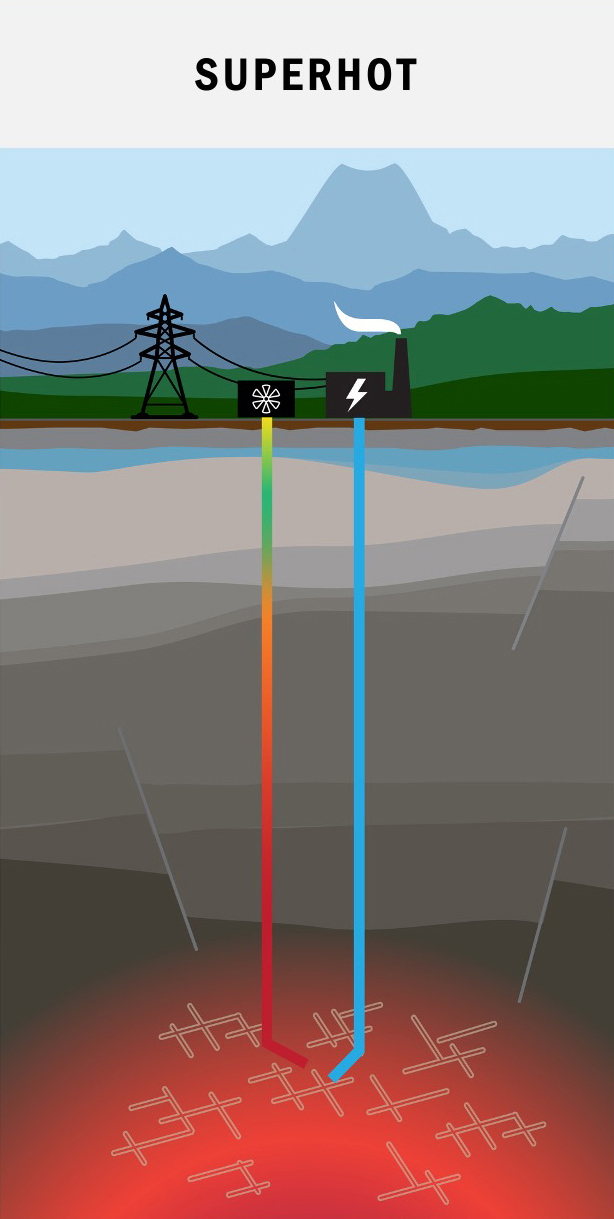
Other next-generation geothermal power generation technologies include closed loop geothermal systems and superhot geothermal systems. Closed loop geothermal systems do not rely on a fracture network. Instead, these systems are somewhat akin to a “radiator”—a series of closed pipes underground that circulate water and working fluids to absorb heat from the subsurface and bring it to the surface to produce power. Superhot geothermal systems tap resources at >375°C. Water injected into these extremely hot environments becomes so hot that it has the properties of both liquids and gases, allowing the superheated water to gather very large volumes of heat energy. At the surface, it can be used to produce power at several times the power density (amount of power per unit volume) than lower-temperature rock.
EGS and other next-generation geothermal technologies could facilitate geothermal development beyond traditional hydrothermal regions, thereby extending geothermal energy production nationwide. EGS advances are being demonstrated worldwide today, in both the public and private sectors.
To learn more, view the Office of Geothermal’s EGS Infographic, the Energy Everywhere: The Power of EGS video, and the Geothermal Electricity Generation page.
The Office of Geothermal's Research on Enhanced Geothermal Systems
The Office of Geothermal supports research, development, and demonstration projects that guide enhanced geothermal technologies towards commercial viability. The Office of Geothermal is currently supporting projects to conduct EGS pilot demonstration projects and demonstrate EGS in a variety of geographic locations, geologic formations, and subsurface conditions. This work will advance EGS and other next-generation geothermal technologies, bolster the U.S. geothermal industry, and help the nation realize the vast potential of geothermal energy to provide firm, flexible power and heat in more places around the country.
Initiatives
Frontier Observatory for Research in Geothermal Energy (FORGE)
Wellbore Construction and Evaluation
Geothermal Energy from Oil and Gas Demonstrated Engineering (GEODE)
Past Initiatives
Geothermal Manufacturing Prize
Frontier Observatory for Research in Geothermal Energy (FORGE)
The Office of Geothermal’s FORGE initiative is a dedicated field site where scientists and engineers can develop, test, and accelerate breakthroughs in EGS technologies and techniques. The site’s cutting-edge research, coupled with an innovative collaboration and management platform, helps scientists identify a replicable, commercial pathway to EGS. At the site, researchers have already demonstrated significant improvements in drilling rates and successful rock stimulation.
Learn more about the Office of Geothermal’s EGS demonstration projects.
EGS Pilot Demonstrations
The economic viability of EGS depends on developing and improving technologies and understanding of the subsurface, including geologic qualities, permeability, and other attributes. Through the EGS Pilot Demonstrations initiative, the Office of Geothermal is supporting pilot projects that collectively demonstrate EGS in different geologic settings, using a variety of development techniques and well orientations, in order to help spur further use of geothermal as a critical source of firm, flexible energy.
Wellbore Construction and Evaluation

A key requirement for expanding the use of EGS is reducing the costs and technical challenges associated with constructing wellbores. In particular, wellbore casing and cementing materials and operations represent around 30% to 40% or more of overall well costs. Reducing these costs requires finding better means by which to evaluate performance during construction and operation. Available off-the-shelf solutions for well cement and casing evaluation are suitable for the upper end of the oil and gas industry’s temperature needs, but not generally considered adequate for hotter geothermal systems. Improved methods to build wells and assess their performance can reduce costs for EGS and other geothermal power generation technologies, helping make geothermal electricity more cost-effective
Wells Of Opportunity

A key step to unlocking the full potential of reliable, domestic geothermal energy may lie inside millions of American oil and gas (O&G) wells. These wells can be used to harness geothermal energy in two ways: through the retrofitting of inactive or unproductive wells, or through co-production on active wells. The Office of Geothermal is exploring both methods with the Wells Of Opportunity (WOO) initiative, which will help establish the commercial viability of geothermal energy production from existing hydrocarbon fields.
Geothermal Energy from Oil and Gas Demonstrated Engineering (GEODE)
The GEODE initiative aims to leverage the extensive knowledge, technology, skill, and experience of the O&G sector to help access more of the nation’s vast geothermal resource. The O&G and geothermal industries have numerous similarities that provide new opportunities for geothermal expansion—from advances in drilling and well construction to co-production possibilities in existing oil and gas basins.
Hydraulic Properties
The Office of Geothermal’s Hydraulic Properties initiative supports advances in technologies and techniques to control the fluid flow within the fracture network in EGS reservoirs in order to optimize them for heat extraction. Projects under this initiative are developing targeted and reversible in-reservoir fracture permeability modification systems or methods, which can increase reservoir efficiency and longevity and ultimately help drive down EGS costs, reduce the risk of development, and accelerate the path towards widespread commercialization.
Geothermal Geophone Prize: Innovations to “Hear” the Subsurface
The Geothermal Geophone Prize is a three-phase, $3.65 million competition launched in April 2022 to address the challenges of operating seismic sensors in harsh geothermal environments. These sensors collect data about geothermal reservoirs and subsurface conditions, which is essential to develop successful and efficient human-made EGS, but traditional seismic monitoring tools cannot withstand the high temperatures, high rock strengths, and corrosive working fluids in geothermal wells. The prize received numerous promising geophone designs for high-temperature use in Phase 1 and Phase 2. At the end of the first phase of the competition, the quality of submissions was so high that the Office of Geothermal and prize administrators decided to select 10 semifinalists instead of the originally planned eight. In the second phase, in addition to receiving submissions from all the semifinalists, the Office of Geothermal also received two submissions from non-winning teams who wanted to continue pursuing work on their prototypes. The Office of Geothermal announced the finalists in the competition in March 2024 and anticipates announcing the winners of this competition in 2026.
Previous EGS Demonstrations
Information on the following completed EGS demonstration projects can be found on the EGS Demonstration Projects page:
- Newberry Volcano, OR
- The Geysers, CA
- Brady Geothermal Field, NV
- Desert Peak, NV
- Raft River, ID
EGS Collab
The Office of Geothermal-funded the EGS Collab initiative to test and verify computational models that could be used in EGS work broadly or at the Office of Geothermal’s FORGE EGS field laboratory. At the Collab field site, subsurface modelers and researchers conducted controlled, small-scale, in-situ experiments focused on rock fracture behavior and permeability enhancement in order to understand relationships among stress, seismicity, permeability, and other parameters.
Geothermal Manufacturing Prize
The Geothermal Manufacturing Prize was a $4.65 million competition launched in early 2020 to incentivize innovators to use 3D printing, or additive manufacturing, to address the challenges associated with operating sensitive equipment in harsh geothermal environments. One of the two winning teams of the prize, Team Ultra-High Temperature Logging Tool (Team UHTLT), flipped the concept of high-temperature tools on its head with their prototype design for this competition. Instead of pursuing new approaches to harden the electronics themselves, the team looked to use off-the-shelf electronics and design a completely new thermal insulation system that allows off-the-shelf equipment to thrive in environments where it previously could not. The team’s new design also cuts down the typical deployment innovation time for high-temperature electronics from five years or more to less than two years.
In August 2023, Team UHTLT successfully tested their winning prototype in a commercial partnership with power producer Calpine Corporation at The Geysers geothermal field in California, demonstrating the tool's ability to deploy at realistic temperatures (> 200◦C) and pressures, log important downhole information including well temperature profiles, and validate the heat sink design built as part of the prize competition. In fact, the team managed to log four successful temperature runs in three days on a testing well that the site operator had been unable to measure. This testing has proven Team UHTLT’s business case, and they are continuing to commercialize their technology in partnership with Calpine.

Additional EGS Resources
- Utah FORGE Data on the Geothermal Data Repository (GDR)
- EGS Collab Data on the GDR
- Enhanced Geothermal Shot Analysis
For more information, contact DOE.Geothermal@ee.doe.gov.
Office of Geothermal emails bring geothermal funding opportunities, events, publications, and activities directly to your inbox.