What Are Critical Minerals and Materials?
The Energy Act of 2020 defines a “critical mineral” as:
- Any mineral, element, substance, or material designated as critical by the Secretary of the Interior, acting through the director of the U.S. Geological Survey.
The Energy Act of 2020 defines a “critical material” as:
- Any non-fuel mineral, element, substance, or material that the Secretary of Energy determines:
- (i) has a high risk of supply chain disruption;
- and (ii) serves an essential function in one or more energy technologies, including technologies that produce, transmit, store, and conserve energy; or
- A critical mineral, as defined by the Secretary of the Interior.
How Are Energy Critical Materials Assessed?
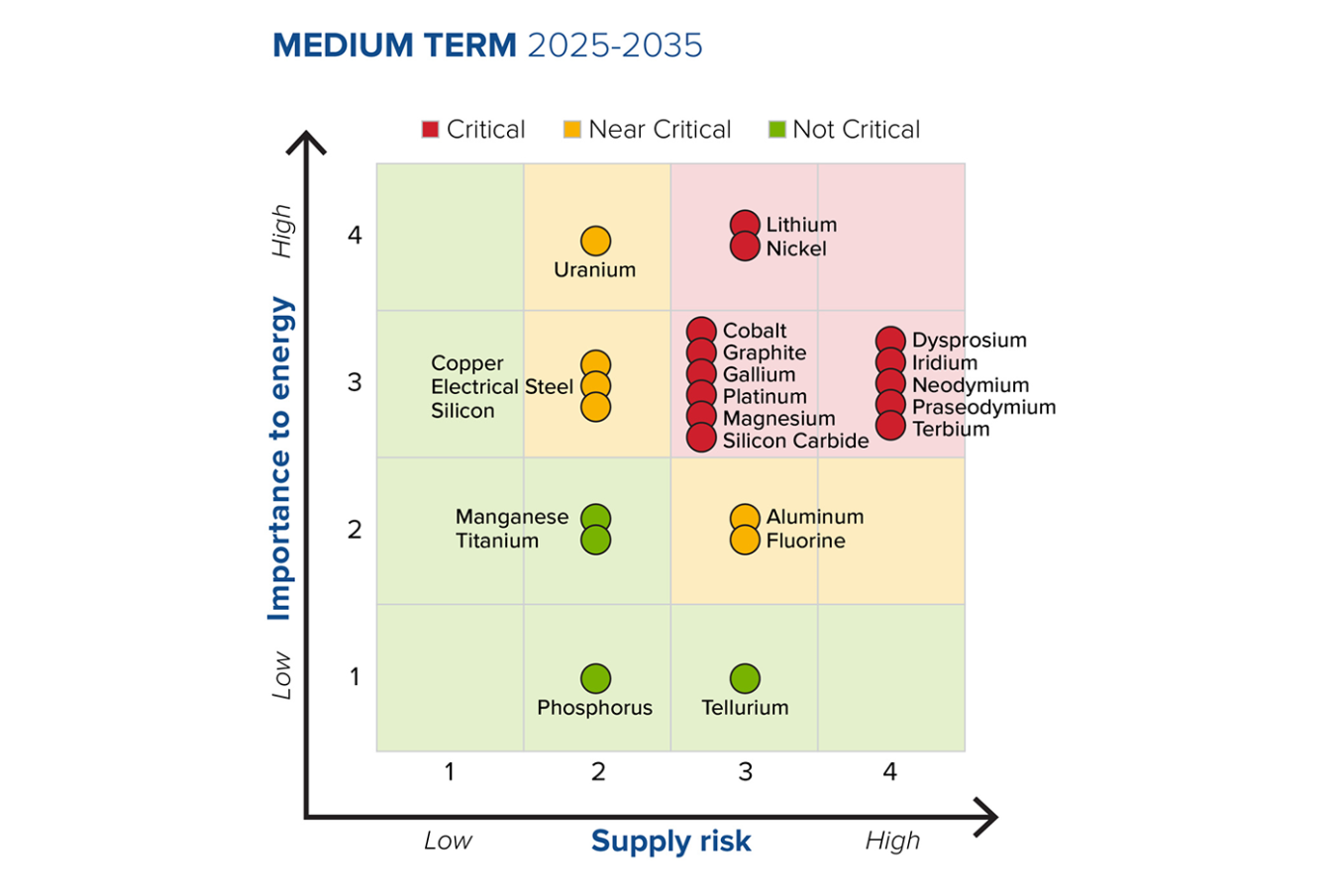
In 2023, the Department of Energy (DOE) published a comprehensive assessment of various materials for energy. This assessment looked at potential for supply risk and importance to energy technologies when evaluating each material. Supply risk considers several factors: basic availability; competing technology demand; political, regulatory, and social factors; codependence on other markets; and producer diversity. Importance to energy technologies considers two factors: energy demand and substitutability.
DOE’s assessment is forward-looking, reflects a global scope, is based on energy deployment scenarios, and includes some engineered materials (i.e., not naturally occurring materials such as electrical steel and silicon carbide). The assessment helps to inform DOE’s Critical Minerals and Materials Program and the determination of the Critical Materials List.
The methodology also incorporates material intensity of energy technologies (i.e., quantity of material per component, product, or system), both those currently widely deployed and innovative technologies that may reduce material requirements in the future.
What is on the Energy Critical Materials List?
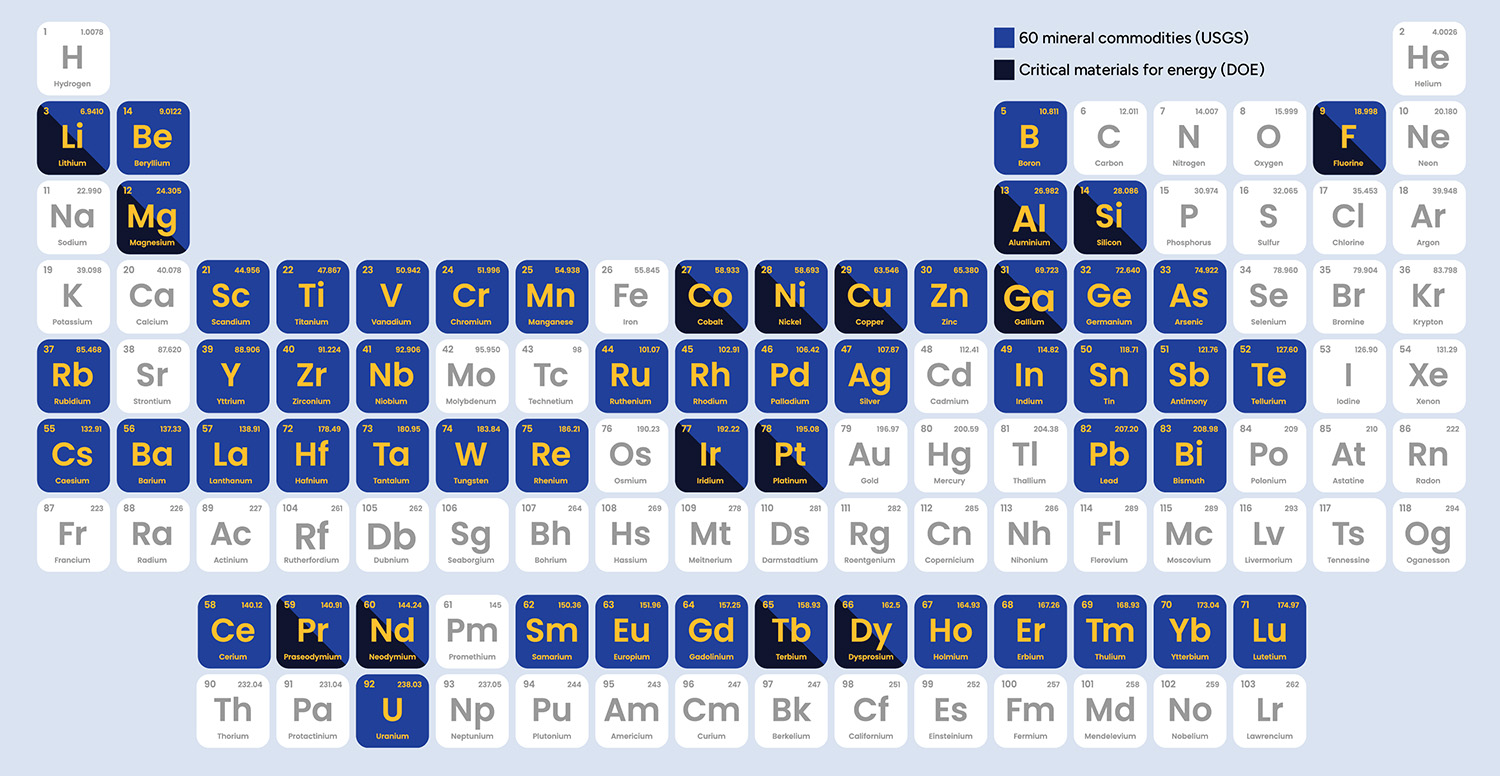
Pursuant to the authority under Section 7002(a) of the Energy Act of 2020, the Secretary of Energy determines the Critical Materials List. This current list includes critical materials for energy, in the Final 2023 Critical Materials List and May 2025 amendment of the Critical Materials List, as well as those critical minerals on the 2025 final list published by the Secretary of the Interior, acting through the director of the U.S. Geological Survey.
Metallurgical coal used for steelmaking was added based on an off-cycle analysis.
DOE Critical Materials List
| NON-ELEMENTAL CRITICAL MINERALS (USGS) | NON-ELEMENTAL CRITICAL MATERIALS (DOE) |
|---|---|
| Natural Graphite Metallurgical Coal Phosphate Potash Synthetic Graphite | Natural Graphite Metallurgical Coal Electrical Steel Silicon Carbide |

What Are the Energy Applications of Critical Minerals and Materials?
BATTERIES NUCLEAR ENERGY FUEL CELLS SOLAR CELLS Aluminum
Antimony
Cobalt
Copper
Fluorine
Graphite
Lanthanum
Lead
Lithium
Manganese
Nickel
Phosphate
Silver
VanadiumBoron
Europium
Graphite
Hafnium
Holmium
Lithium
Samarium
Thulium
Uranium
ZirconiumGraphite
Platinum
ScandiumAluminum
Gallium
Indium
Silicon
Silver
TelluriumDISPLAYS & OPTICS CATALYSTS SEMICONDUCTORS & MICROCONDUCTORS MAGNETS & MOTORS Erbium
Germanium
Indium
Terbium
YttriumCerium
Iridium
Lanthanum
Palladium
Rhenium
Rhodium
Ruthenium
YtterbiumArsenic
Boron
Copper
Fluorspar/Fluorine
Gallium
Germanium
Hafnium
Silicon
TerbiumAluminum
Copper
Dysprosium
Gadolinium
Gallium
Holmium
Neodymium
Praseodymium
Samarium
TerbiumSTEEL PRODUCTION & STRENGTHENING ALLOYS FOR AEROSPACE, DEFENSE, & HIGH PERFORMANCE Boron
Chromium
Fluorspar/Fluorine
Gadolinium
Manganese
Metallurgical coal
Nickel
Niobium
Silicon
VanadiumAluminum
Beryllium
Cobalt
Copper
Hafnium
Lead
Lithium
Magnesium
Nickel
Platinum
Praseodymium
Rhenium
Scandium
Tellurium
Thulium
Titanium
Tungsten
Yttrium
Zinc
ZirconiumLIGHTING GENERAL ELECTRONICS COMPONENTS LASERS ATOMIC CLOCKS & GPS Gallium
Scandium
YttriumAluminum
Copper
Lutetium
Magnesium
Palladium
Rhodium
Ruthenium
Silver
Tantalum
Tellurium
Terbium
TinDysprosium
Erbium
Holmium
Neodymium
Tellurium
Terbium
Thulium
YtterbiumCesium
Rubidium
How Critical is Each Material for the Future of Energy?
The results of the 2023 DOE Critical Materials Assessment are shown in the criticality matrix below.