



Learn more about OLED Basics.
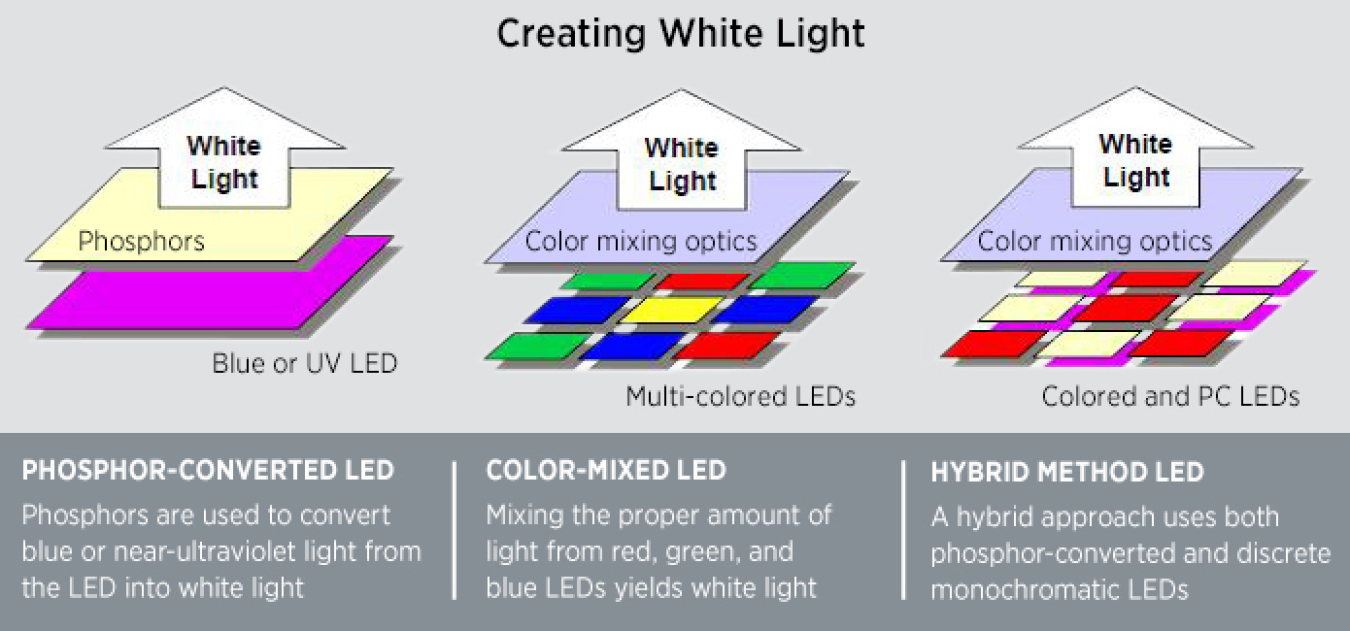
Unlike incandescent lamps, LEDs are not inherently white light sources. Instead, LEDs emit nearly monochromatic light, making them highly efficient for colored light applications such as traffic lights and exit signs. However, to be used as a general light source, white light is needed. White light can be achieved with LEDs in three ways:
- Phosphor conversion, in which a phosphor is used on or near the LED to convert the colored light to white light
- Color-mixed systems, in which light from multiple monochromatic LEDs (e.g., red, green, and blue) is mixed, resulting in white light
- A hybrid method, which uses both phosphor-converted (PC) and monochromatic LEDs.
The ability of LED technology to produce high-quality white light with unprecedented energy efficiency is the primary motivation for the intense level of research and development currently supported by the U.S. Department of Energy.
Future of LEDs
There are many white LED lighting products available on the market, and the number continues to grow, with new generations of devices constantly emerging. While many of these products perform quite well, their energy efficiency and color qualities can vary; but standards, test procedures, and resources such as ENERGY STAR® and the DesignLights Consortium™ Qualified Products List help buyers make informed choices.
LED lighting technology now offers the highest luminous efficacies (and efficiencies) of any light-source technology, and low prices have resulted in significant adoption. But despite this progress, further improvements are both possible and desirable. The technology can still be improved in efficiency, color attributes, light distribution, form factor, and building integration. There can also be improvements in new frontiers of lighting that include energy savings from more effective use of lighting, lighting that promotes health and productivity, and expanded use of controls to deliver just the right light at the right time. Manufacturing technology for LED lighting can also be improved to reduce cost, add value, and enable custom and on-demand manufacturing, resulting in the greatest possible energy savings along with health and productivity benefits for the nation.
- Learn more about advanced lighting R&D challenges and DOE-funded advanced lighting R&D projects
- Learn more about potential energy savings attributable to LED lighting
Frequently Asked Questions
LEDs offer the potential for cutting general lighting energy use nearly in half by 2030, improving resiliency of the grid, and saving energy dollars in the process. Their unique characteristics—including compact size, long life, resistance to breakage and vibration, good performance in cold temperatures, lack of infrared or ultraviolet emissions, and instant-on performance—are beneficial in many lighting applications. The ability to dim and provide color control are other benefits of the LED lighting technology platform.
One of the defining features of LEDs is that their small size and bright output enable good optical control. This reduces optical losses, which improves efficiency and can enable new, more effective form factors. In contrast, fluorescent and "bulb"-shaped incandescent lamps emit light in all directions, with the result that much of the light they produce is lost within the fixture or escapes in a direction not useful for the intended application, or requires pricey and bulky optics to get the light in the right place. With many fixture types, including recessed downlights, troffers, and undercabinet fixtures, it is not uncommon for only 50% to 60% of the total light produced to be emitted.
Since LED sources are inherently dimmable and instantaneously controllable, they can be readily integrated with sensor and control systems, thus enabling further energy savings through the use of occupancy sensing, daylight harvesting, and local control of light levels. What this all adds up to is the potential to improve the performance and value of lighting in totally new ways.
LED lighting is already the most energy-efficient lighting technology, with efficacies ranging up to 150 lumens per watt or more in some specialized instances. But there still remains considerable room for efficacy improvement and widespread deployment of more efficacious products. The DOE long-term R&D goal calls for cost-effective, warm-white LED packages producing 250 to 325 lumens per watt and resulting integrated lighting products of 250 to 275 lumens per watt.
Two aspects of energy efficiency are important to consider: the efficiency of the LED device itself (source efficacy), and how well the device and fixture work together in providing the necessary lighting (luminaire efficacy). How much electricity is consumed depends not only on the LED device, but also on the lighting fixture design, efficiency of the power supply, and the inclusion of features that may degrade source efficiency but have other benefits. Advancements in all aspects of fixture design are critical to achieving the full performance of LED technology.
Key aspects of high-quality light are the color appearance of the light itself, which is described by its color coordinates but is often condensed (with significant loss of information) to correlated color temperature (CCT), and how the light affects the color appearance of objects, which is referred to as color fidelity. Color fidelity can be quantified using the color rendering index (CRI), or with another color metric, the recently developed TM-30. LED light sources have demonstrated that they can achieve a wide range of color qualities, depending on the demands of the lighting application. However, to achieve high levels of color fidelity, there are typically cost and efficiency tradeoffs. In general, a minimum CRI of 80 is recommended for interior lighting, and LED products can readily achieve this performance. CRI of 90 or higher indicates excellent color fidelity; LEDs can also meet this threshold. CRI is far from a perfect metric and is especially poor at predicting the fidelity of saturated reds, for which the supplemental value R9 is often used. The fidelity index (Rf) and the gamut index (Rg), which are described in IES TM-30-15, can provide a more comprehensive evaluation of color rendering. Learn more about TM-30-15 and LED color characteristics.
LED lighting products typically last far longer than their conventional counterparts. The useful life of an LED luminaire or lamp is typically described by the number of operating hours until it is emitting 70% of its initial light output. Good-quality white LED lighting products are expected to have a useful life of 30,000 to 50,000 hours or even longer. A typical incandescent lamp lasts about 1,000 hours; a comparable CFL, 8,000 to 10,000 hours; and the best linear fluorescent lamps, more than 30,000 hours. Learn more about LED lifetime and reliability.
Other aspects of reliability should also be considered. Catastrophic failure describes the situation where a luminaire no longer emits light, typically due to an electronics failure. The long life of the LED means that there is ample opportunity for the electronics to fail before the LEDs go bad. Another type of failure is due to color shift. All light sources change color over time. The long expected life of an LED lighting product means that before the LED fails, the color of the light may shift to an unacceptable degree, depending on the application. In general, LED lighting lives up to its promise for long life, but all aspects of reliability should be considered when selecting a product.
The price of LED lighting products varies widely. Some LED lamps (bulbs) can cost as little as $1 to $2, or significantly more. Differences in price among LED lighting products typically correspond with differences in various lighting performance features, such as color quality, lifetime, optical performance, and dimmability. As with most products, consumers must balance price and performance. Consumers also must choose carefully to get the color qualities (CCT and color fidelity), dimmability, and lifetime they are looking for. The LED lighting platform can achieve a wide range of performance levels at a range of price points.