



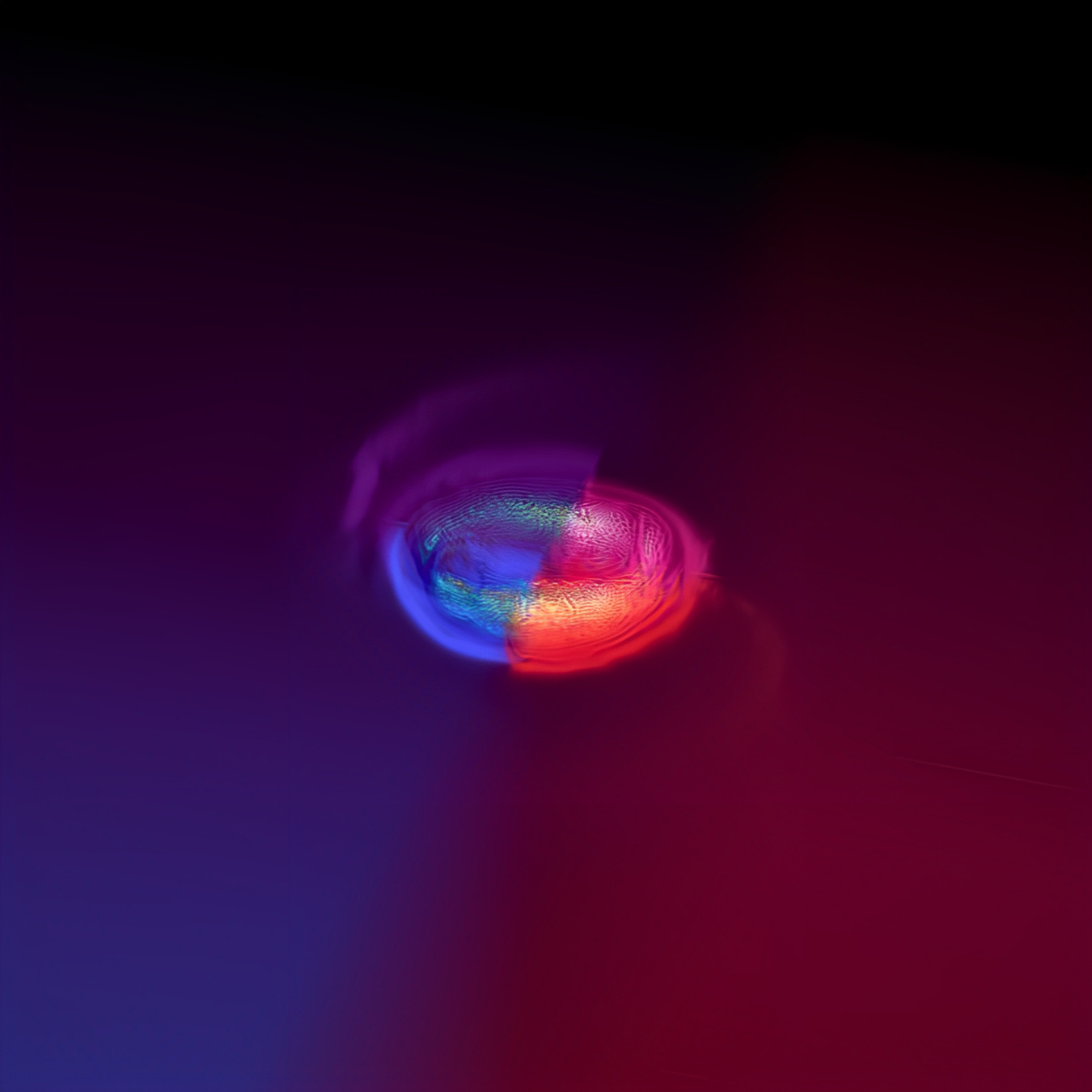
Scientists have developed a simulation of the merger of two neutron stars that includes the oscillation of different neutrino flavors into one another.
March 31, 2026 Estimated Read Time min
The Science
Neutron stars are among the densest objects in the universe. They are packed so tightly that a spoonful of their matter weighs more than a mountain. When two neutron stars collide, they release huge numbers of tiny particles called neutrinos. Neutrinos are fundamental particles that come in three types, or “flavors.” These flavors can change into one another as they travel, a process known as neutrino oscillation. This simulation shows that such changes affect the ratio of neutrons to protons in the matter thrown out of the crash. If the ejecta becomes richer in neutrons, it may produce more heavy elements such as gold and platinum.
The Impact
This work presents the first supercomputer simulations that include neutrino flavor transformations in neutron star mergers. The simulations show that as neutrinos change their flavor, neutron star mergers become an even more powerful factory for producing heavy elements, like gold. By influencing the mix of neutrons and protons, neutrinos play a hidden but vital role in shaping the origins of matter in the universe. The collisions also shake space itself. They create gravitational waves — ripples in the fabric of space and time that observatories on Earth can detect. Neutrinos changing their flavor in these collisions could also affect the gravitational waves resulting from the mergers. Adding neutrino oscillations to computer models will help scientists better analyze data from gravitational waves.
Summary
Neutron star mergers are key factories of heavy elements, via the rapid neutron capture process (the r-process). Neutrinos also play a central role in the production of heavy elements by setting the neutron-to-proton ratio in the matter these mergers eject. In this study, astrophysicists performed simulations in numerical relativity that included neutrino flavor mixing. This aspect had been neglected in most previous studies. The team employed a relaxation operator to model flavor equilibration, under different density thresholds, and compared these with the no-mixing case. They found that flavor mixing tends to reduce electron type neutrino abundances in low-density regions and make the ejecta more neutron rich. In some cases, there is neutron enhancement by more than a factor of five. This change produces increases in the yields of heavy elements (lanthanide and heavier) by orders of magnitude, compared to simulations which neglect neutrino mixing. The results also demonstrate that neutrino flavor transformations can potentially alter observable signatures of neutron star mergers, such as gravitational waves.
Contact
David Radice
The Pennsylvania State University
dur566@psu.edu
Yi Qiu
The Pennsylvania State University
yiqiu@psu.edu
Funding
This work was supported by the U.S. Department of Energy, Office of Science, Division of Nuclear Physics, National Science Foundation, and the Sloan Foundation. It used computational resources from the National Energy Research Scientific Computing Center, a DOE Office of Science User Facility, as well as institutions’ supercomputing centers.
Publications
Qiu, Y., Radice, D., Richers, S., & Bhattacharyya, M. “Neutrino flavor transformation in neutron star mergers.” Physical Review Letters, 135 091401 (2025). [DOI: 10.1103/h2q7-kn3v]