



RSS
Tools have evolved from pencil and paper to computers to supercomputers to AI as the theorists devise new ways to model fusion energy and branch out.
The PPU will increase accelerator power up to 2.8 megawatts of beam power so the future STS will have the world’s highest peak brightness of neutrons.
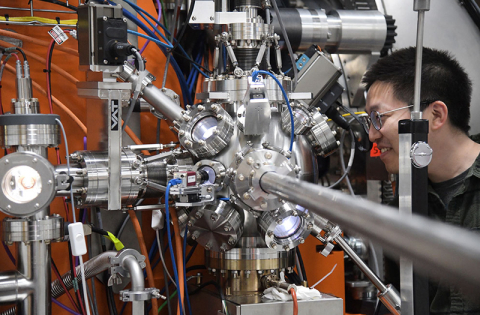
Using Argonne’s Advanced Photon Source, scientists have achieved the first observation of a state that was only theoretically predicted.
Jacob Lowell Cook has been selected for the U.S. Department of Energy’s (DOE’s) Office of Science Graduate Student Research (SCGSR) program.
Researchers at The Ohio State University played a major role in analyzing the first year of data from the survey into the history of the universe.
The workshop focused on identifying research priorities for the nation’s South Atlantic and Gulf of Mexico.
The U.S. Department of Energy’s Fermi National Accelerator Lab welcomes Greg Stephens as the lab’s new chief operating officer beginning May 6, 2024.
A team from ORNL and SLAC is establishing a data portal that will enable Frontier to process the results from experiments conducted by LCLS-II.
Using the NSLS-II, researchers explored what makes high-temperature superconducting materials different from conventional ones.
The work is a completely new way to create strange metals, of interest for their unusual physics and possible use in high-temperature superconductors.