



A new study integrates fire processes into an Earth system model to help scientists simulate and better understand the impacts of pyrocumulonimbus clouds.
Biological and Environmental Research
March 12, 2026 Estimated Read Time min
Science
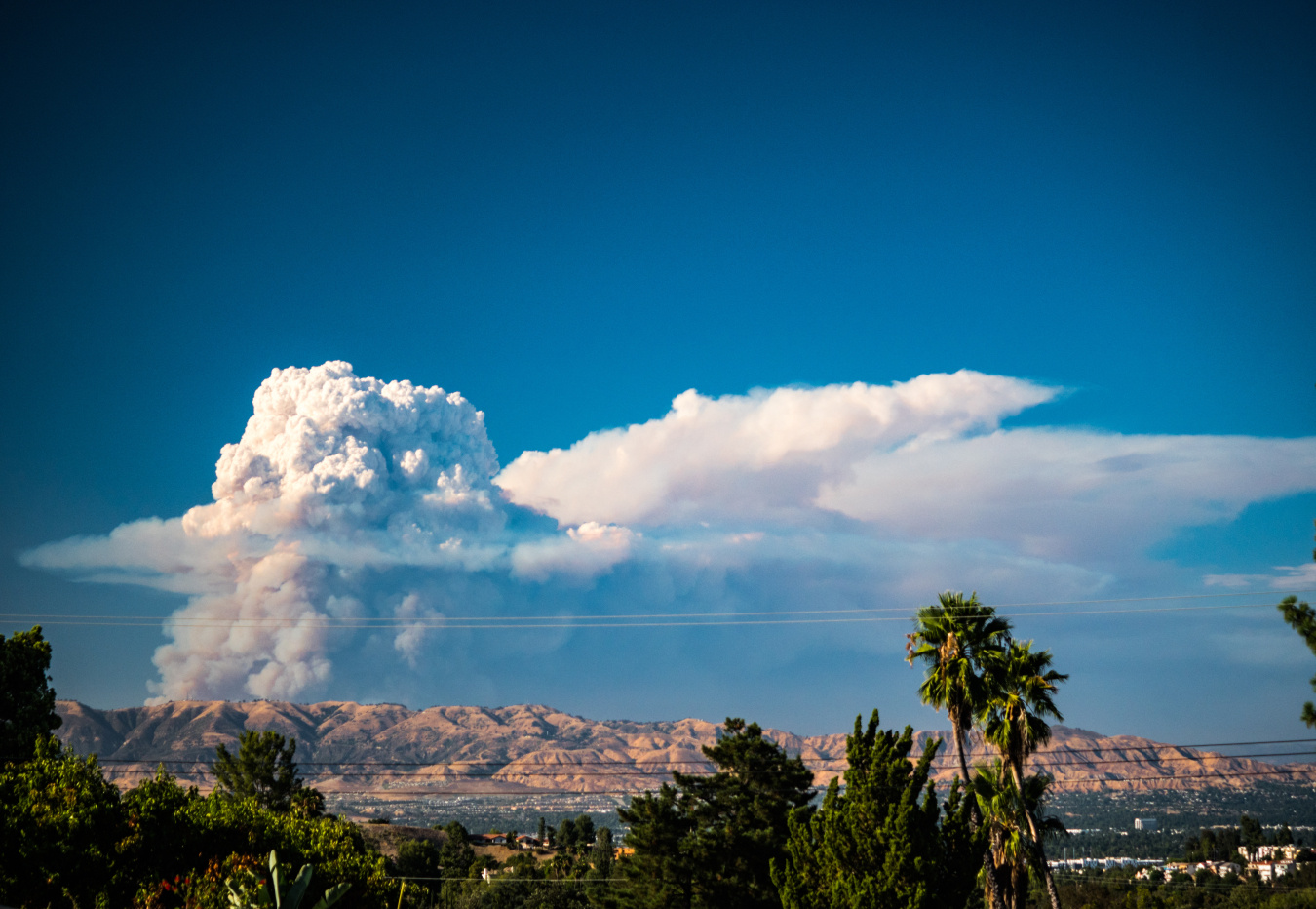
Pyrocumulonimbus (pyroCb) clouds are powerful storm clouds created by extreme wildfires. They can inject smoke and moisture high into the atmosphere. This can affect air quality, weather, and the Earth system. However, simulating pyroCb clouds is challenging in Earth system models. Researchers developed a first-of-its-kind framework to simulate the effects of pyroCb clouds. The simulation models the clouds’ effects on multiple scales (from 500 meters to globally, and hourly to 12 hour timeframes) in Department of Energy's (DOE) flagship Energy Exascale Earth System Model (E3SM). The simulation successfully captured key features of pyroCb clouds observed during the 2020 Creek Fire in California.
Impact
When extreme fires under favorable meteorological conditions drive PyroCb clouds, these clouds can inject as much smoke into the stratosphere as moderate volcanic eruptions. They can potentially alter the atmosphere’s composition as well as how much sunlight the Earth radiates back into space. Because most Earth system models lack detailed interactions between wildfires and the atmosphere, the models struggle to represent these events. This capability for E3SM to simulate wildfires provides a foundation for exploring the regional and global impacts of pyroCb clouds. This capability also supports many other E3SM applications. These applications focus on modeling extreme events that are characterized by physical processes similar to those in wildfires.
Summary
To develop this new framework, scientists built an approach within E3SM that uses a convection-permitting regionally refined mesh. This method combines high-resolution satellite fire data with a plume-rise model and a scheme that lifts near-surface moisture into the atmosphere. Together, these processes enable the model to generate deep wildfire-driven storms. Sensitivity tests show removing or simplifying any one of these processes greatly weakens or prevents pyroCb formation. The research team believes this framework enables the first realistic simulation of pyroCb events within a global Earth system model.
The model successfully reproduced the observed timing, height, and strength of explosive clouds from the 2020 Creek Fire in California. The approach was also applied to the 2021 Dixie Fire. This fire produced several pyroCb events under very different conditions, with similarly strong results. Findings show wildfire-driven vertical moisture transport is a key ingredient in these storms. This work is an important step toward understanding how extreme wildfires can change the atmosphere and potentially impact the stratosphere and Earth system.
Contact
Qi Tang
Lawrence Livermore National Laboratory
tang30@llnl.gov
Funding
This research was funded by the Laboratory Directed Research and Development program at DOE’s Lawrence Livermore National Laboratory. Additional support was provided by the Earth and Environmental Systems Sciences Division of the Biological and Environmental Research program in DOE’s Office of Science.
Publication
Ke, Z., et al. (2025). Simulating pyrocumulonimbus clouds using a multiscale wildfire simulation framework. Geophysical Research Letters 52, e2024GL114025. [DOI:10.1029/2024GL114025]