The Office of Electricity’s Microgrid Research and Development Program shows that well-designed microgrids can provide both the flexibility in deployment and usability through a “Microgrid Building Block” concept.
June 3, 2026 Estimated Read Time min
Dr. Chukwuemeka Obikwelu

Dr. Obikwelu serves as Director of Grid Systems within the U.S. Department of Energy’s (DOE) Office of Electricity, where he oversees a multi-year energy research and development portfolio focused on advancing grid affordability, reliability, resilience, and security. His work spans the intersections of technology, policy, and business, including advanced microgrid technologies, inverter-based-resources, hybrid energy systems (integrating small nuclear reactors, energy storage, etc.), advanced transmission and distribution (T&D) technologies, and emerging energy challenges associated with electrification, AI-driven load growth, and evolving power system demands.
Dr. Obikwelu's industry background spans electric utilities, engineering-procurement-construction (EPC) consulting, technology R&D, and academia. Prior to joining DOE, he held engineering and leadership roles supporting transmission and distribution systems, protection and control engineering, utility operations, compliance, and large-scale energy infrastructure and capital projects across the power sector. His experience also includes teaching power systems engineering courses in academic and professional settings and supporting workforce and technical training initiatives.
He holds a Ph.D. in Electrical Engineering (Energy Systems) from Georgia Institute of Technology, a Master of Science in Electrical Engineering (Power/Energy Systems) from Michigan Technological University, a Master of Education from Harvard University focused on higher education leadership, and a Bachelor of Science in Electrical and Computer Engineering from Wayne State University. He is currently pursuing a Master of Business Administration (MBA) from Indiana University-Bloomington Kelley School of Business, majoring in Business Strategy and Leadership. His hobbies of interest include lawn tennis, chess, a good read, mixed martial arts, running, and long walks.
Dan Ton

Dan Ton is Program Manager at the U.S. Department of Energy (DOE) Office of Electricity (OE), responsible for developing and managing the OE Microgrids R&D Program. He also serves as the OE lead for the Community Microgrid Assistance Partnership (C-MAP) program.
From May 2014 until July 2015, he served as Acting Deputy Assistant Secretary of OE’s Power Systems Engineering Division. Before joining OE, Dan managed the Renewable Systems Integration program within the DOE Solar Energy Technologies Program.
Dan holds a Bachelor of Science in Electrical Engineering and a Master of Science in Business Management, both from the University of Maryland.
Many of the conveniences and capabilities of modern society are enabled by wide-scale availability of cheap, reliable electricity in the United States. However, hurricanes, wildfires, and other natural events can often disrupt the ability of the electric grid to provide power to customers. Furthermore, many new technologies are being developed and deployed that require additional power production. To help alleviate these issues, solutions must have both flexibility in how they can be deployed, but also how they are utilized after deployment. Using research from industry and the U.S. Department of Energy Office of Electricity’s Microgrid Research and Development Program (the DOE-OE Microgrid Program), well-designed microgrids can provide both the flexibility in deployment and usability through a “Microgrid Building Block” concept.
Microgrid Building Blocks is an approach that connects individual modules (such as power conversion, communication, control, load components.) to form a microgrid, and then interconnects those microgrids to create larger power systems. The DOE-OE Microgrid Program has cultivated industry-driven standards and best practices to enhance grid reliability, resilience, security, and affordability – forming the foundation of the microgrid building block concept. Federally-funded research under the DOE-OE Microgrid Program identified key interface challenges and guided the development of standards to improve interoperability. Collaborating with industry has been central to this effort, enabling demonstration projects and lab testing of the concept. These activities help accelerate private sector innovation for advancing the grid reliability and resilience through modular microgrid architectures. The demonstrated flexibility of this modular approach also lays the groundwork for enhanced grid support for large load interconnections. In a fully modular grid, generation capacity can be rapidly added where large loads (such as AI data center) are deployed to allow them to begin operations more quickly.
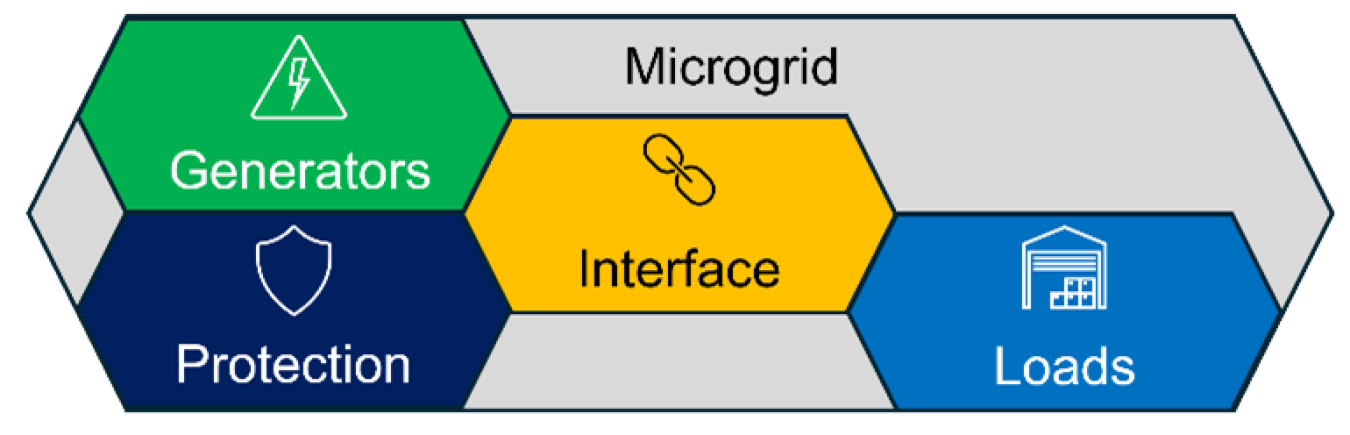
The Microgrid Building Block concept begins with the formation of Simple Microgrids. Generation sources are coordinated with loads requiring the power. In a Building Block deployment, a common interface provides plug-and-play capability for the different components, promoting the modularity of the system. Local generators, the local loads, and any protection and coordination equipment all connect electrically and communicate through the common interface. The result is an easier ability to scale the load and generation capabilities of the microgrid easily, without having to redesign the entire microgrid system. This flexibility allows more agile configurations and faster deployments to quickly accommodate increased load or additional grid service capabilities needed to support the bulk electric system.
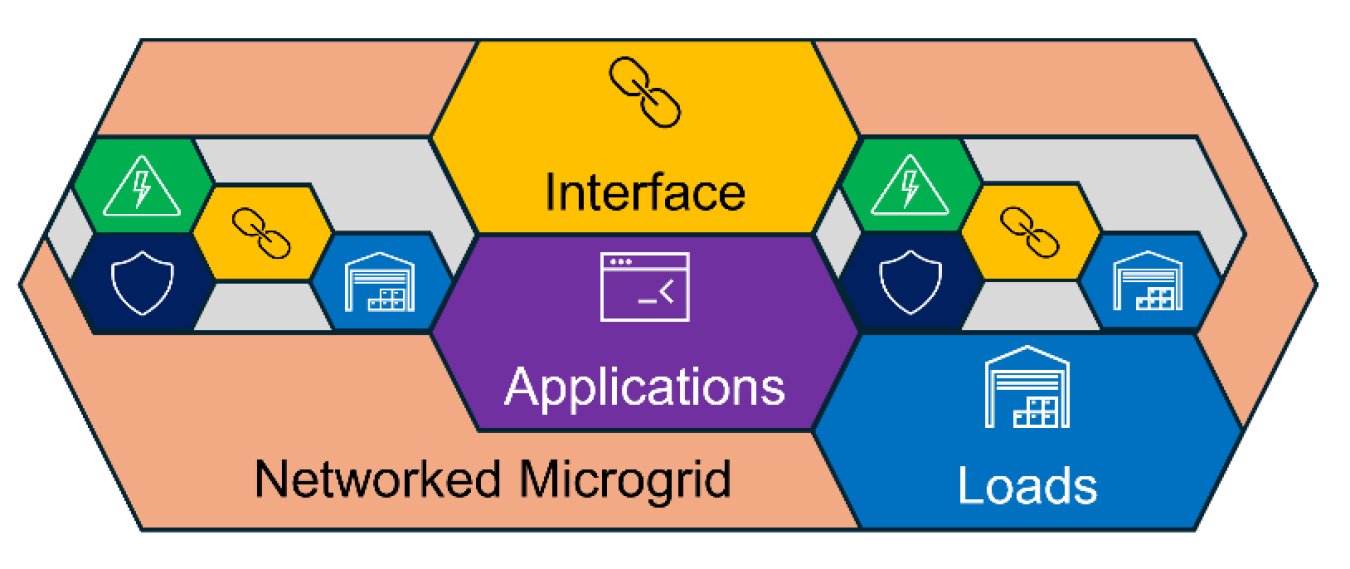
The Building Block concept can scale up to larger loads and more complex controls. Individual Simple Microgrids can integrate together with additional generators and loads to form Networked Microgrids. The greater resources of multiple microgrids combined allows advanced applications, such as reconfiguration and optimal dispatch of generator resources to occur. The flexibility allows generators to respond to changing conditions in ways that promote cost efficiency (by selecting the cheapest generation required) and reliability (by enabling redundant and extra generation to be on standby and ready if needed). The pooling of capabilities also enables large quantities of grid services to be available, providing additional support for accommodating large dynamic digital loads or other industries as their facilities expand.
At each of the levels described, the footprint of the system grows. Networked microgrids may cover significant portions of a local power system. Different areas of town, or even different counties, can aggregate to form larger networked microgrids, a concept known as the Fractal Grid. The whole system is built off the same fundamental modularity of the simple microgrid and expanded capabilities of networked microgrids, but pools together more resources. Resources can quickly be added or removed from the operations to accommodate new loads on the system, generator changes on the bulk electric grid, and potential outages in the main power system due to natural disasters.
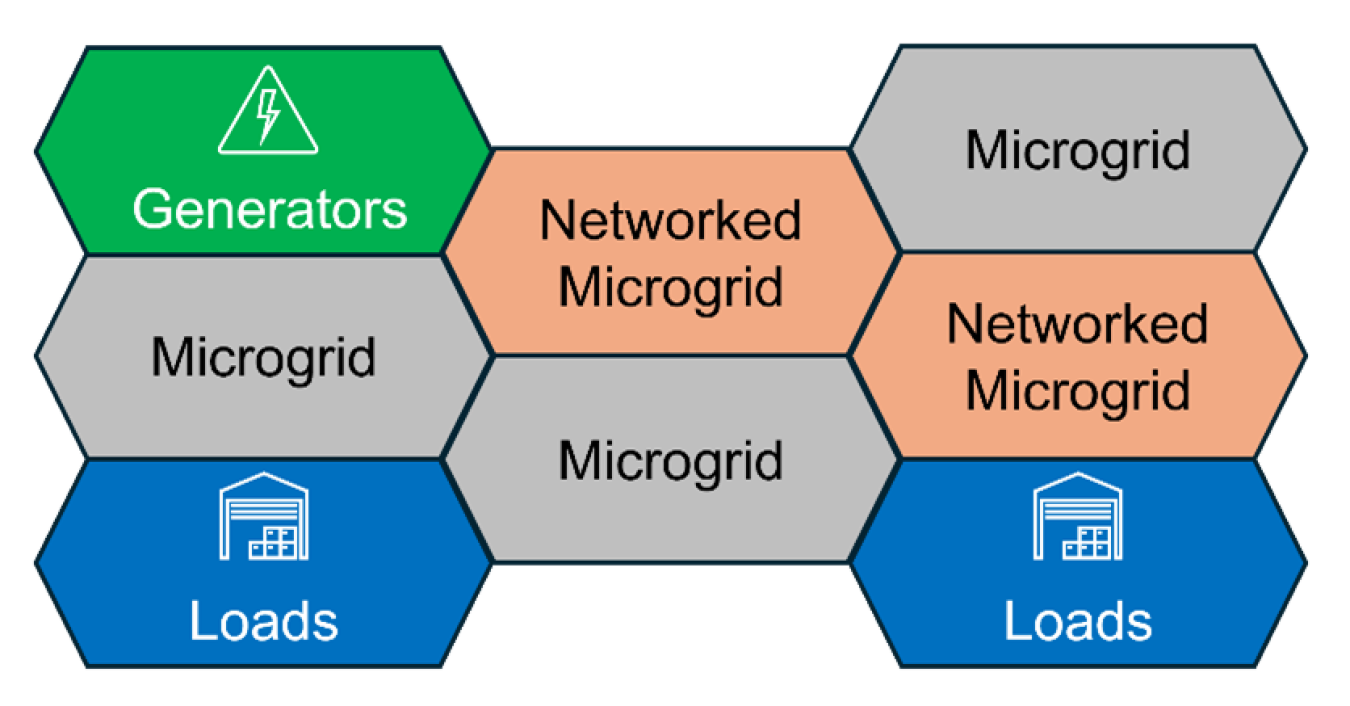
The flexibility and agility of the Microgrid Building Block approach provide some significant benefit to an ever-changing power landscape and the needs of advanced industry and businesses. Different levels of aggregation can be optimized for different load types, grid requirements, and changing conditions to help accommodate the ever-changing requirements of American industry and innovation. Expanding and validating the concept at larger scales could significantly improve the deployment speed of major loads, such as domestic manufacturing facilities and AI data centers. The DOE-OE Microgrid Program has demonstrated the basis for using the modularity to meet increasing power demands and is well-positioned to address the challenges and opportunities as associated with scaling the Microgrid Building Block and Fractal Grid concepts to the multi-megawatt and gigawatt levels.