The power grid needs innovative ways to add additional energy production and control capabilities to the power system. The Office of Electricity is advancing one such approach with microgrid systems.
June 3, 2026 Estimated Read Time min
Dr. Chukwuemeka Obikwelu

Dr. Obikwelu serves as Director of Grid Systems within the U.S. Department of Energy’s (DOE) Office of Electricity, where he oversees a multi-year energy research and development portfolio focused on advancing grid affordability, reliability, resilience, and security. His work spans the intersections of technology, policy, and business, including advanced microgrid technologies, inverter-based-resources, hybrid energy systems (integrating small nuclear reactors, energy storage, etc.), advanced transmission and distribution (T&D) technologies, and emerging energy challenges associated with electrification, AI-driven load growth, and evolving power system demands.
Dr. Obikwelu's industry background spans electric utilities, engineering-procurement-construction (EPC) consulting, technology R&D, and academia. Prior to joining DOE, he held engineering and leadership roles supporting transmission and distribution systems, protection and control engineering, utility operations, compliance, and large-scale energy infrastructure and capital projects across the power sector. His experience also includes teaching power systems engineering courses in academic and professional settings and supporting workforce and technical training initiatives.
He holds a Ph.D. in Electrical Engineering (Energy Systems) from Georgia Institute of Technology, a Master of Science in Electrical Engineering (Power/Energy Systems) from Michigan Technological University, a Master of Education from Harvard University focused on higher education leadership, and a Bachelor of Science in Electrical and Computer Engineering from Wayne State University. He is currently pursuing a Master of Business Administration (MBA) from Indiana University-Bloomington Kelley School of Business, majoring in Business Strategy and Leadership. His hobbies of interest include lawn tennis, chess, a good read, mixed martial arts, running, and long walks.
Dan Ton

Dan Ton is Program Manager at the U.S. Department of Energy (DOE) Office of Electricity (OE), responsible for developing and managing the OE Microgrids R&D Program. He also serves as the OE lead for the Community Microgrid Assistance Partnership (C-MAP) program.
From May 2014 until July 2015, he served as Acting Deputy Assistant Secretary of OE’s Power Systems Engineering Division. Before joining OE, Dan managed the Renewable Systems Integration program within the DOE Solar Energy Technologies Program.
Dan holds a Bachelor of Science in Electrical Engineering and a Master of Science in Business Management, both from the University of Maryland.
The U. S. electric power grid is experiencing increased energy demand, driven by the increase in domestic industry production and the deployment of large dynamic digital loads such as data centers providing artificial intelligence capabilities and cloud-based services. To ensure these commercial enterprises have the best chance at success, the power grid needs innovative ways to add additional energy production and control capabilities to the power system. One such approach is to leverage the capabilities of microgrid systems.
Microgrids are defined as “a localized energy system that can operate independently or in conjunction with the traditional grid.” Microgrid systems are often used to provide power and ensure a critical application (like a water treatment plant or radio station) can continue to operate through different events on the main power system—whether that is an outage due to a downed power line or just an energy constraint due to an unexpected heat wave. This is especially important for remote applications where only a single power line may provide power to a critical mineral extraction operation or large industrial customer—localized microgrid resources help ensure those customers can continue to function through changing conditions on the main power system.
The U.S. Department of Energy, Office of Electricity’s Microgrid Research and Development Program (the DOE-OE Microgrid Program) has helped enable the deployment and adoption of microgrids to meet these additional energy needs. The DOE-OE Microgrid Program collaborated with several major utilities and vendors to help accelerate private sector-led innovation for advancing grid reliability, resilience, security, and affordability. Demonstration projects and technical support on these projects helped accelerate deployment timelines and fully understand the operational characteristics of microgrids. The improved understanding also helped cultivate industry-driven standards and best practices to ensure seamless microgrid deployment and enable expedited deployments A key objective of the DOE-OE Microgrid Program’s standardization effort is to move away from many customized or vendor-specific approaches that limit microgrids’ ability to meet evolving demands, such as supporting large loads interconnected to the power grid.
The DOE-OE Microgrid Program has examined a range of applications and objectives for deploying microgrid systems. These include not only providing power and energy to the local grid but also responding to changing conditions on the larger electric grid and supporting overall system stability. Using a mix of local generation resources, advanced load control mechanisms, as well as forms of energy storage, the microgrid can augment the larger power system and help ensure reliable, affordable power to all customers. Microgrids are distributed through the system (as opposed to a central power plant), allowing them to not only provide support directly where needed (local resources), but also preventing a single abnormal event from bringing down the whole power system. This makes microgrids a unique asset to aid in providing additional energy needed to meet America’s increasing industrial and computing center energy needs.
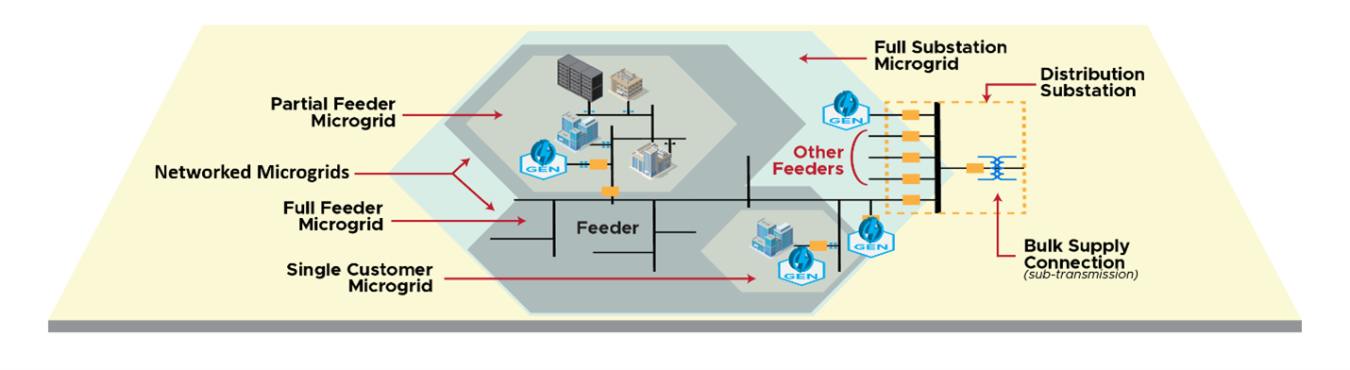
By locating the power generation and grid stabilizing features of microgrid systems near an end use (such as a large data center or refinery), several advantages are gained. Microgrid systems are often formed by smaller individual generators and devices, which can be connected to the power system very quickly. The microgrid components are also easier to tune to the specific requirements of the local power system, rather than having to accommodate larger impacts to the system like a traditional centralized power plant. This can quickly bring extra capacity to a location without needing to upgrade the existing bulk power grid infrastructure. For example, if a new data center needs 5 MW, but the existing power lines can only carry 4 MW to that location, a microgrid can be deployed to provide the additional 1 MW of needed capacity, often at a fraction of the time and cost to upgrade the existing transmission lines. The microgrid assistance augments the existing bulk power system and allows the data center to be deployed and come online much faster.
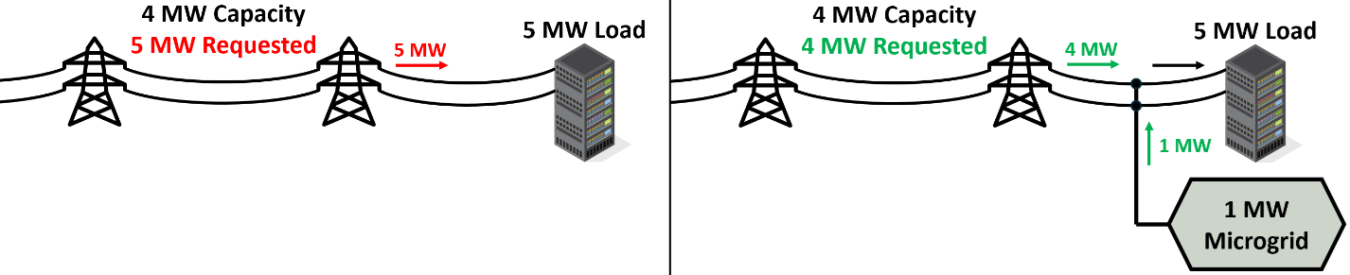
While the scenario described above enables a large load to be deployed more quickly, microgrid systems provide more value than just the raw power generating capability or optimized backup generation capabilities. Microgrids have the capability to provide grid services to the main electric grid to maintain reliable operation, helping maintain critical operating conditions like the proper voltage or proper frequency of the power grid.
Maintaining frequency (frequency regulation) was recently highlighted in a 2025 National Electric Reliability Corporation (NERC) “State of Reliability” report, which highlighted how battery energy storage deployed in Texas was able to provide 100% of this frequency regulating capacity. The battery energy storage and other microgrid assets can help support the bulk electric grid to keep reliable, affordable power available to its customers.
Whether providing local power directly to a customer load, augmenting the transmission system to deploy large dynamic digital loads faster—or providing grid services to ensure affordable and reliable power—microgrid systems bring numerous unique capabilities to the overall electric power system. The DOE-OE Microgrid Program continues to investigate these capabilities and how to enable their implementation across the nation. This includes promoting faster interconnection times for new technologies and industries. In cases like artificial intelligence/machine learning (AI/ML), unique controls to manage their complex loads can leverage the very AI/ML capabilities being run. Through the continued research and development of the U.S. Department of Energy’s Office of Electricity, the capabilities of microgrid systems will continue to help the power system support growing requirements of American innovation.