



RICHLAND, Wash. – EM Richland Operations Office (RL) contractor Mission Support Alliance (MSA) recently completed work to ensure continuous electrical power at a unique Hanford Site facility that detects gravitational waves predicted by Einstein’s ...
October 17, 2016 Estimated Read Time min
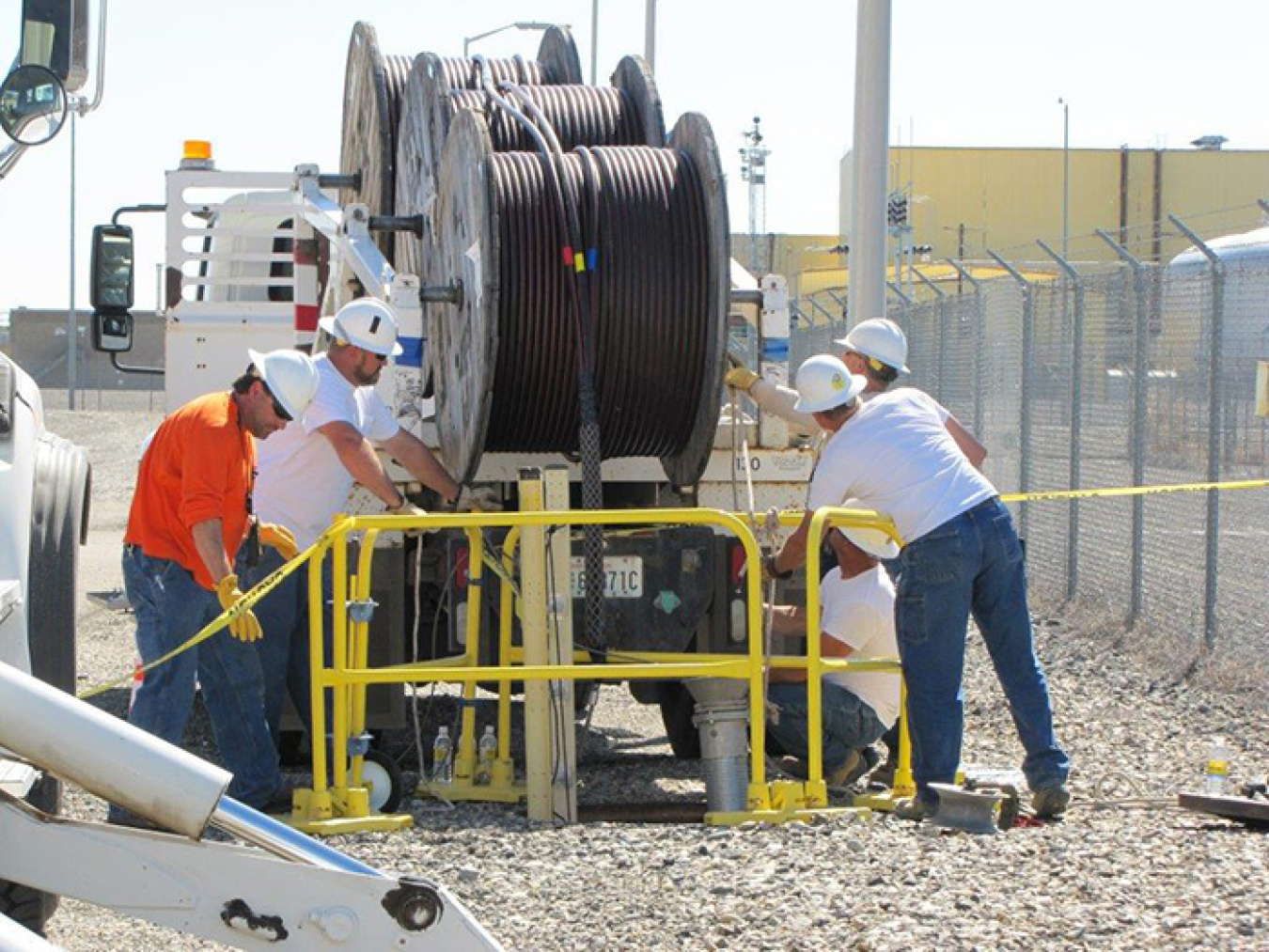
MSA and Benton Public Utilities District linemen set up the cables to be pulled into the vaults.
RICHLAND, Wash. – EM Richland Operations Office (RL) contractor Mission Support Alliance (MSA) recently completed work to ensure continuous electrical power at a unique Hanford Site facility that detects gravitational waves predicted by Einstein’s Theory of Relativity.
Using lasers to measure the minute ripples in space-time caused by passing gravitational waves, the Laser Interferometer Gravitational-Wave Observatory (LIGO) made headlines last year for detecting such waves 100 years after Einstein predicted their existence.
Since the late 1990s, LIGO has had a single power source from a substation on the site. Performing substation maintenance had become increasingly difficult for MSA’s Electrical Utilities (EU) division as required minimum four-to-six-hour outages had the potential to disrupt LIGO’s expanding scientific research. MSA provides site-wide services and integrated infrastructure.
LIGO proposed establishing a secondary power source. Tim Haddick, RL electrical utility program manager, reached out to MSA EU to begin planning. The project’s scope was wide and included several parties, including Bonneville Power Administration, the Benton Public Utilities District, other Hanford contractors, and several work groups within MSA.
“It took a lot of parties working together and that cooperation is what made this possible. MSA EU deserves the credit for overcoming a lot of obstacles to make this happen,” Haddick said.
The project included the installation of 600 feet of underground cable through 600 feet of conduit that had not been accessed in 20 years, and connecting them to the substation. Coordination between the 13 customers impacted by the project and those performing the work was essential.
On a recent Friday afternoon, power was shut down to all of the site’s 400 Area, parts of the 300 Area, and the 618-10 Burial Ground to allow the work. The project was safely completed in three days, and LIGO’s second power source was fully operational.
“Everyone in EU was involved. It was a lot of work to perform in a short period of time. Safety was our priority so communication was vital,” said Rob Johnson, MSA supervisor of substation electricians.
The observatory is funded by the U.S. National Science Foundation and operated on land leased from the Department of Energy by the California Institute of Technology and the Massachusetts Institute of Technology.