



A list of commonly misunderstood nuclear energy words and phrases
June 24, 2026 Estimated Read Time min
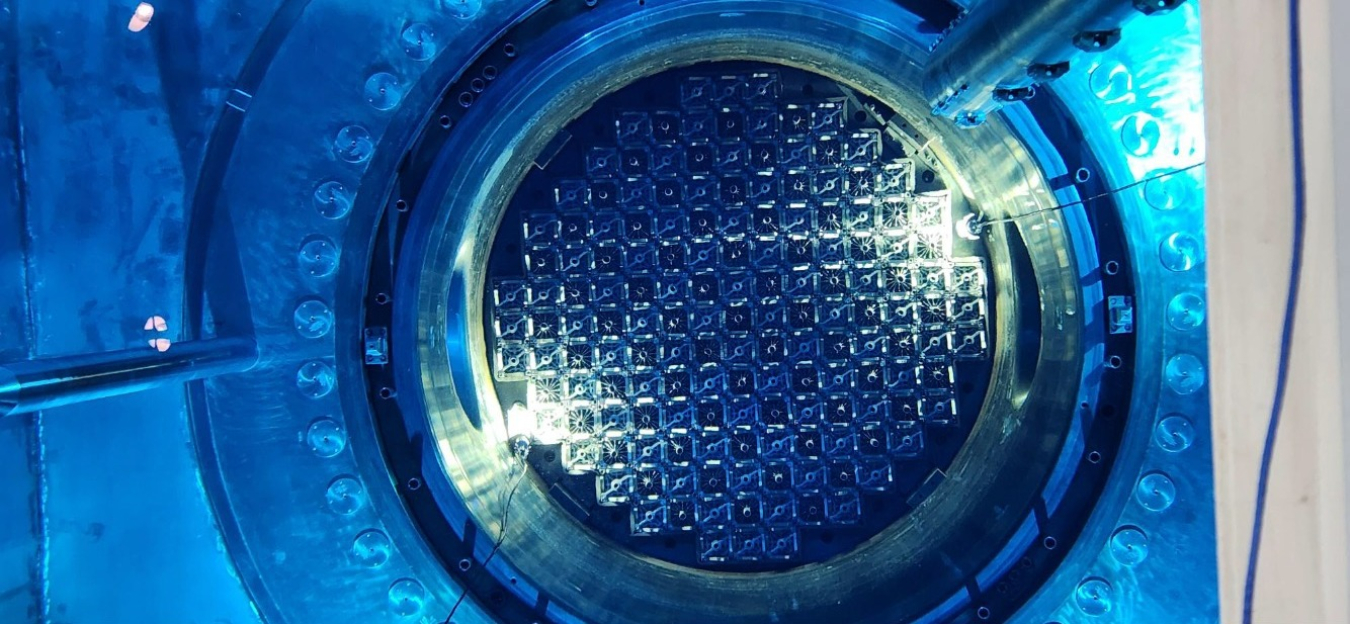
Reactor core of Vogtle Unit 4
Like any industry, nuclear energy has its share of confusing catchphrases, bewildering buzzwords, and mystifying mumbo-jumbo.
Is “going critical” a good thing?
How is “passive safety” better than active?
Do “accident tolerant fuels” really tolerate accidents?
Some of these terms can sound confusing if you aren’t a nuclear nerd.
But don’t worry. We’ve got your back.
Here are some common terms that may cause confusion about the nation’s most reliable source of 24/7 electricity:
1. Critical
“Criticality” might sound as serious as a heart attack, but in the nuclear energy world it’s a reason to celebrate.
We say a nuclear reactor is “critical” when it is perfectly stable. That happens when each uranium atom that splits via fission releases enough neutrons to cause one additional atom to split.
FUN FACT: This is where the term “critical mass” comes from. In nuclear terms, it is the smallest amount of nuclear material that can sustain a fission reaction.
That stable “chain reaction” is what keeps nuclear power plants generating electricity around the clock.
The world’s earliest manmade nuclear reactor to achieve sustained criticality was Chicago Pile-1 in December 1942.
On June 6, 2026, Antares Nuclear’s Mark-0 reactor became the first participant in the U.S. Department of Energy’s (DOE) Reactor Pilot Program to go critical — the first privately developed non-light-water reactor to reach this step in more than 40 years.
2. Passive Safety
“Passive” doesn’t mean reactor operators are resting on their laurels — quite the opposite.
Passive safety refers to the ability of advanced reactors like the AP1000 or newer designs under development to shut down and remove excess heat without human intervention.
In the unlikely event that a nuclear plant loses backup power, passive safety systems use the laws of physics to help keep a reactor cool. They take advantage of things like the natural circulation of water or other coolant to move heat away from the reactor core without the need for external power sources, pumps, or operator action.
So, if you see a reactor referred to as “walk-away safe,” rest assured that no one is checking out for lunch.
3. Accident Tolerant Fuels
Yes, you read that right.
DOE is working with companies like Westinghouse, General Electric, and Framatome to develop new fuels and claddings (the protective metal tube that surrounds the fuel pellets) to enhance the safety and performance of today's reactors.
These so-called “accident tolerant fuels” could endure worst-case conditions longer thanks to materials that are more resistant to radiation, corrosion, and higher temperatures.
They are also expected to perform even better than current nuclear fuels and could extend the time between refueling, which would reduce the amount of spent fuel generated over the lifetime of a reactor.
Many of the fuels are being tested in commercial reactors today and could be commercialized before the end of the decade.
Other advanced nuclear fuels like TRISO particles can withstand temps hotter than molten lava thanks to their triple-coated layers, which act like individual containment domes to retain all of their fission products. The ultra-robust design means they can’t melt in a commercial high-temperature gas reactor.
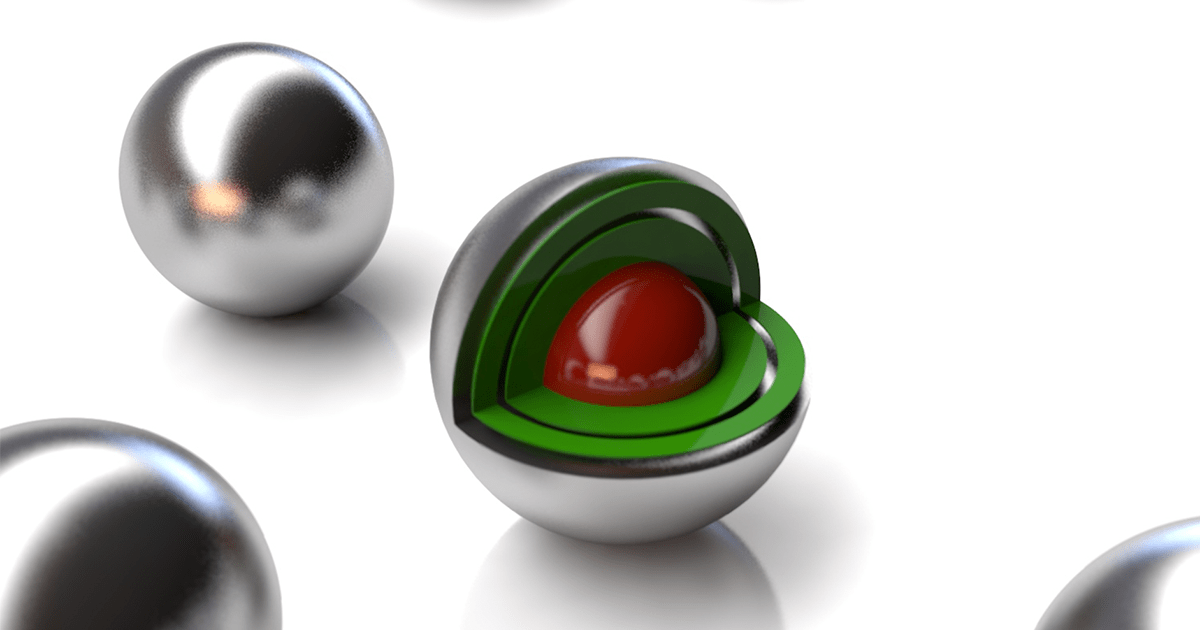
The Most Robust Nuclear Fuel on Earth
Several projects supported through DOE’s Advanced Reactor Demonstration Program plan to use TRISO fuel in their next-generation reactor designs. TRISO fuel qualification testing is currently underway at Idaho National Laboratory and Oak Ridge National Laboratory.
4. Burnup
Don’t let this one confuse you. Nothing is actually burning in a nuclear reactor.
“Fuel burnup” is nuclear industry shorthand for thermal energy produced via fission within the reactor fuel. As uranium undergoes fission, the reactive U-235 atoms split apart and the fuel gradually loses its potency.
When enough of the fuel has “burned up” the reactor needs to be refueled. And even then, only about one-third of the fuel needs to be replaced. Most commercial nuclear power plants operate on refueling cycles of 18 to 24 months, meaning the fuel will last up to six years!
New “high-burnup” fuels in development could extend that time even further.
The longer reactors can operate, the less time they need to be offline for costly refueling outages. So, high-burnup fuels would reduce the amount of fuel that needs to be purchased, reduce waste generated over the life of the reactor, and could also help increase power levels — making reactors more economical.
5. Enrichment
In the nuclear energy sector, enrichment is all about the isotopes.
Isotopes are atomic forms of an element — in this case, uranium — that have the same number of protons but different numbers of neutrons.
Natural uranium mined from the earth contains more than 99 percent uranium-238, which is more stable and slowly decays over billions of years. The other 0.7 percent is uranium-235, the isotope that’s “fissile” or capable of sustaining a nuclear chain reaction.
Uranium is enriched for use in nuclear reactors by increasing the concentration of uranium-235. This often involves using a centrifuge to remove some of the heavier U-238, leaving a more fission-friendly end product.
There are different levels of enrichment most frequently used today:
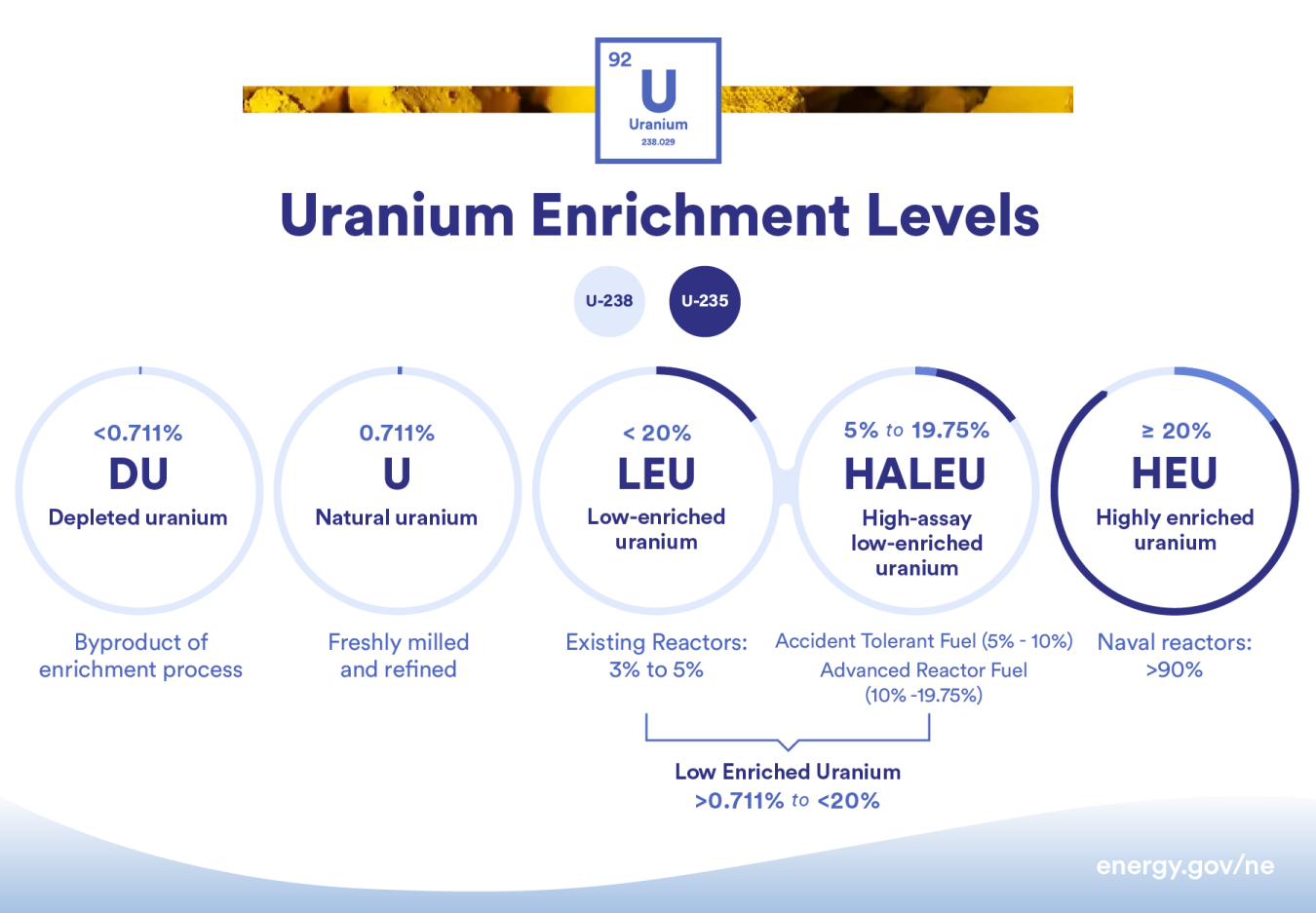
FUN FACT: Depleted uranium (DU) is a byproduct of enrichment containing low concentrations of U-235 (0.2-0.3 percent). It can be blended with highly enriched uranium to make reactor fuel.
Low-enriched uranium (LEU), sometimes called “reactor grade,” is enriched uranium containing less than 20 percent U-235. Nearly all commercial nuclear reactor fuel currently uses LEU enriched to between 3 percent and 5 percent U-235.
Most advanced reactors in development are designed for use with fuel enriched above 5 percent and less than 20 percent U-235 — called “high-assay low-enriched uranium” or HALEU.
The problem is that HALEU isn’t widely available to reactor developers just yet.
DOE is working to support next-generation nuclear technologies by bolstering the availability of HALEU with limited quantities of DOE uranium in the near-term and large quantities over the long-term that would be produced through new commercial U.S. enrichment.
Highly enriched uranium (HEU) is more than 20 percent U-235. It’s used in naval propulsion reactors, nuclear weapons, and some research reactors. Most HEU applications involve uranium enriched to over 90 percent U-235.
6. Nuclear Waste
The phrase “nuclear waste” comes with a lot of baggage. But what you imagine in your head when you hear it may not match up with the reality of nuclear energy.
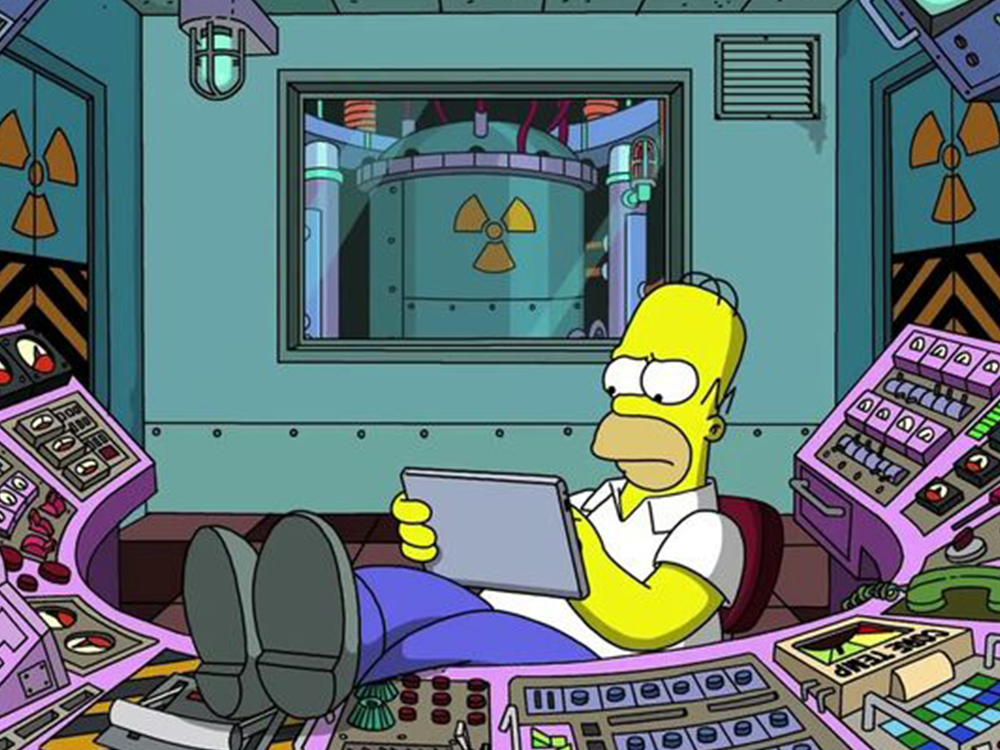
7 Things The Simpsons Got Wrong About Nuclear
Picture this: after nuclear fuel rods are used in a reactor, they are taken out and set aside to cool in a steel-lined pool of water, typically for a few years. They look basically the same as they did when they went in — a bundle of metal tubes filled with solid ceramic pellets of uranium.
They don't glow, and they aren’t dumped into ponds full of three-eyed fish.
In fact, the nation’s used nuclear fuel is stored safely and securely in wet storage or dry concrete casks at and away from nuclear reactor sites.
By the way, those fuel rods? They don’t have to be “wasted.”
Used nuclear fuel retains approximately 95 percent of its energy potential when it comes out of the reactor, and some reprocessing/recycling technologies in development could one day make use of that used fuel.
In early 2026, DOE took the historic step of awarding $19 million to five U.S. companies to research and develop used nuclear fuel recycling/reprocessing technologies.
The Department is advancing efforts to make use of this untapped resource in order to maximize reliable power production, end U.S. reliance on foreign sources of enriched uranium, and drastically reduce the volume of used fuel stored across the country.
7. Fission vs. Fusion
Fission and fusion both involve the nucleus, the core of protons and neutrons that give an atom its mass.
Fission happens when a neutron collides with a nucleus of a larger atom, causing it to split into two smaller atoms called “fission products.” Tremendous energy is released in the form of heat as well as additional neutrons that can initiate a chain reaction.
Fission is currently used in every nuclear power reactor on earth, usually with uranium or plutonium fuel.
Fusion works the opposite way. Two smaller atoms slam together and “fuse” their nuclei to form a heavier atom, like when two hydrogen atoms fuse to form one helium atom. This is the same process that powers the sun and creates huge amounts of energy without generating highly radioactive fission products.
Scientists are still working on harnessing the power of fusion, which is far more difficult to control and sustain than fission. In 2022, Lawrence Livermore National Laboratory achieved the first-ever fusion ignition — a key first step in the quest for limitless energy.
8. Advanced Reactor
So, what even is an advanced reactor? The term gets thrown around a lot these days, so let’s try to define it.
“Advanced reactors” refers to a broad suite of designs that come in an incredible variety of shapes, sizes, coolant types, and even use different types of fuels.
One thing they share in common is the ability to achieve enhanced efficiency, safety, and versatility over conventional reactor designs.
They can be large (like the AP1000 advanced light water reactors at Plant Vogtle) or tiny (microreactors), or somewhere in between (small modular reactors). Types of advanced reactors currently in development include:
Advanced nuclear energy systems hold enormous potential to create new jobs, enhance our nation’s energy security, and deliver more affordable, reliable and resilient electricity than ever before.
DOE’s Advanced Reactor Demonstration Program and Reactor Pilot Program are working to enable the next generation of reactors that will accelerate America’s nuclear energy renaissance and secure our position as the global leader in nuclear power generation.