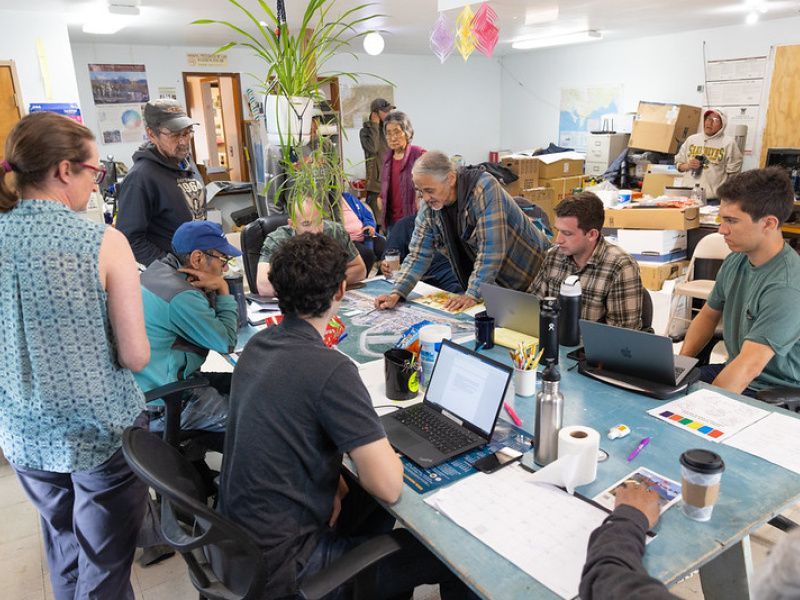
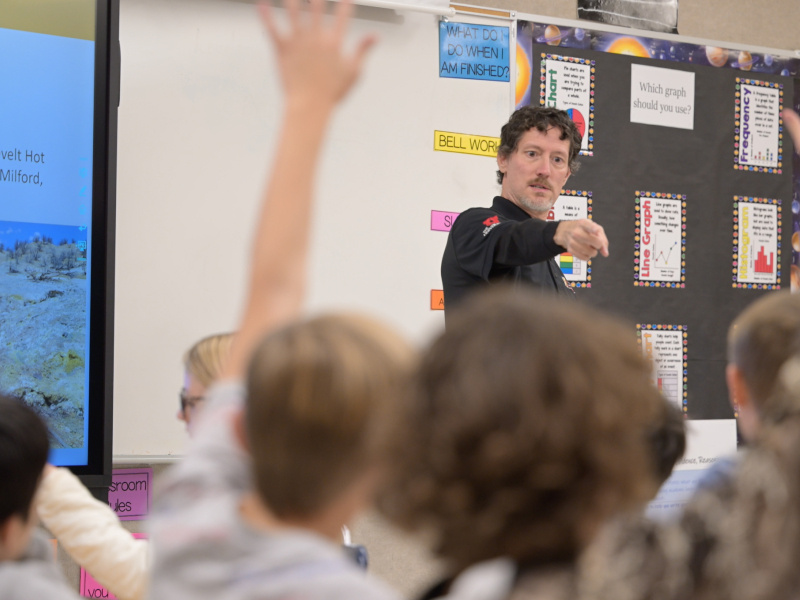
The Office of Geothermal in the Hydrocarbons and Geothermal Energy Office (HGEO) engages with community members to learn about their knowledge and awareness of geothermal energy, answer questions, and provide educational resources to help communities understand how geothermal might support their energy needs.
These engagement efforts aim to help communities learn about geothermal energy and empower them in making decisions that support their local needs. This work also builds on the HGEO Office of Geothermal’s GeoVision analysis roadmap, which outlined the importance of community engagement to expand geothermal energy.
The U.S. Department of Energy's (DOE) national laboratories are supporting the HGEO Office of Geothermal efforts to engage directly with communities.
Fostering Statewide Collaboration in Colorado
The HGEO Office of Geothermal launched outreach efforts in Colorado in 2025 to support geothermal collaboration and identify 1) the current state of Colorado stakeholders’ relationships with geothermal energy, 2) the existing barriers to geothermal development, and 3) potential solutions to overcome those barriers and contribute to the deployment of geothermal energy. Led by the National Laboratory of the Rockies (NLR), these efforts have thus far engaged 51 community leaders, developers, agencies, NGOs, and utilities in the Colorado Geothermal Council (CGC).
Initial events across the four regions of the state revealed that stakeholders wanted regular regional meetings to spur collaboration and connections, particularly between the community representatives, which prompted the creation of multiple ongoing state working groups. CGC members also indicated a need for Colorado-specific educational resources, notably a presentation for their use. To meet this need, NLR created a Colorado-specific slide deck to aid in education, reduce jargon, and address community concerns. Additional plans for this statewide collaboration include an annual conference and a statewide market assessment report, both anticipated in late 2026.
Preserving Surface Thermal Features Across the Nation
Surface thermal features, such as hot springs and geysers, have importance ecologically, agriculturally, within Indigenous cultures, in recreation and tourism, and in geothermal development. Managing these features is both a technical and social challenge, yet there is no shared framework among developers, regulators, and other stakeholders (e.g., communities, Tribes, special interest groups, scientists) for understanding what poses risk to surface thermal features during exploration and operation.
To address this issue, the HGEO Office of Geothermal-funded and Pacific Northwest National Laboratory-led Surface Preservation and Regulatory Integration Network for Geothermal Systems (SPRINGS) project seeks to create a roadmap for streamlining permitting and regulation of surface thermal features in the context of geothermal development while simultaneously preserving their ecological, agricultural, cultural, and recreational value.
At the core of this project is a commitment to strengthening collaboration and building trusting relationships that can foster legitimacy, transparency, and collaboration among all stakeholders. To deliver on that, the project team is planning multiple forms of stakeholder engagement, including:
- Developing a comprehensive, state-by-state geothermal stakeholder map to ensure broad and meaningful engagement and representation.
- Conducting outreach and engagement with geothermal communities, Tribes, special interest groups, and communities considering geothermal development.
- Sharing findings and best practices to streamline permitting and regulation of surface thermal features while preserving and protecting their integrity.
Expanding States’ Geothermal Efforts
The Geothermal Power Accelerator is a 15-state effort to expand the use of firm, flexible geothermal power by working with states to set statewide geothermal goals, strengthen resource mapping, and advance policies and programs that reduce project costs and address regulatory barriers. Through this initiative, on which the Office of Geothermal and the National Association of State Energy Officials (NASEO) partner, State Energy Offices from Alaska, Arizona, California, Colorado, Hawai'i, Idaho, Louisiana, Montana, Nevada, New Mexico, Oregon, Pennsylvania, Utah, Washington, and West Virginia are collaborating with industry leaders, federal partners, and national laboratories to identify solutions that drive state-level geothermal investment and deployment.
Building Lasting Relationships in Alaska
Through its HGEO Office of Geothermal-funded Alaska project, NLR identified a large team of geothermal stakeholders in the state and developed relationships to enable future collaboration between DOE, its national laboratories, and Alaskan communities interested in geothermal energy development. The HGEO Office of Geothermal continues to build relationships with the Alaska Center for Energy and Power, the Alaska Energy Authority, DOE’s Arctic Energy Office, DOE’s Office of Indian Energy Policy and Programs, Homer Electric Association, and the Renewable Energy Alaska Project.
Through this stakeholder engagement work in Alaska, the Office of Geothermal discovered knowledge gaps within communities close to geothermal resources. In response to communities’ requests for materials, the Office of Geothermal created educational resources—which have also proven to be popular beyond Alaska. The What is Geothermal Energy? and What are Geothermal Heat Pumps? fact sheets developed based on this feedback have appeared at numerous roundtables and conferences since their publication.
Learn more about the HGEO Office of Geothermal's and NLR’s community engagement work in Alaska.
Listening to Communities in Hawai’i
The HGEO Office of Geothermal, NLR, and the Hawai’i Community Council collaborated on a series of listening sessions with communities across Hawai’i in 2024. Listening sessions are paramount to ensuring many local voices—including utilities and industry, community organizations, academia, state agencies, and nonprofits— are part of the conversation on Hawaiʻi’s energy future, and that the HGEO Office of Geothermal and NLR understands interests in and barriers to geothermal energy from a variety of unique perspectives. These listening sessions allowed NLR to convene local stakeholders, connect with Hawaiian residents, and glean sufficient input to create a Hawai’i-focused geothermal fact sheet. The listening session results were also pulled together in a final report: The Future of Energy in Hawai'i: Conversations on Culture, Community, and the Role of Geothermal.
In a separate effort, the University of Hawai’i at Manoa’s Hawai’i Groundwater and Geothermal Resources Center began a collaboration with scientists at Lawrence Berkeley National Laboratory through DOE’s Energy Technology Innovation Partnership Project (ETIPP) to investigate building cooling and energy efficiency options. Managed by NLR, ETIPP supports remote, coastal, and island communities with technical assistance and energy planning to help them build more reliable and affordableaffordable and reliable energy systems. Communities apply for up to 24 months of technical assistance, and those communities drive the scopes and focuses of their energy projects.
This project produced a report detailing the feasibility of developing shallow ground heat exchangers (GHEs) across Oahu and at a specific site on the island for cooling. The project team considered many factors in its analysis: geographic attributes (e.g. elevation, geology, soil permeability), restrictions on water quality mandating that groundwater must be left in its natural state, the economics of deploying a system versus energy savings, the age of buildings, and cultural considerations such as those explored in NLR’s report on Hawai’i communities’ perspectives. The site-specific feasibility analysis at the University of Hawai’i at Manoa’s Stan Sheriff Center used a model focused on groundwater movement and interaction with geological formations to analyze groundwater flow of a closed-loop GHE system at the site. Modeling that incorporated groundwater flow showed that heat would be effectively swept away from the borefield, enabling successful GHE operation for at least 10 years. The analysis also highlighted that cold seawater may be an option for cooling-source systems and that such a system already operates at the Natural Energy Laboratory of Hawai’i on the Big Island.