



The Federal Energy Management Program (FEMP) provides a two-to-three-day no-cost guided training program known as a treasure hunt. This program assists agencies in strategically meeting their energy efficiency and operation and maintenance goals—including energy and water reduction milestones—through low-to-no-cost measures.
A treasure hunt supports the goals and mandates put forth through:
- Energy Independence and Security Act of 2007 (EISA)
- Energy Act of 2020
| EISA (§ 432) | Energy Act of 2020 |
|---|---|
Energy and water evaluations of covered facilities every 4 years (25% per year). Estimated costs and savings for identified measures. Building energy conservation measures (ECMs) and water conservation measures (WCMs) benchmarking and reporting. | Agencies to implement all cost-effective ECMs identified within 2 years. Agencies to use performance contracting to address at least 50% of ECMs identified. FEMP to establish a Federal Smart Building Program. |
Benefits of a Treasure Hunt
During a treasure hunt, participants learn how to identify and quantify quick wins to support energy and water use reduction. Other benefits include:
- Learning how to perform and routinely conduct a treasure hunt at your site.
- Identifying the objectives and goals of energy and water reduction.
- Engaging with simple automated tools to quantify energy reduction and savings.
- Implementing logical incremental steps to align culture with new energy standards.
- Recognizing the environmental impact and earning up to 1.8 continuing education credits (CEUs).
- Providing leadership essential tools and information to make informed decisions.
When compared to Building Automation Systems (BAS) Re-tuning and Energy and Water ASHRAE Audits (levels 1, 2, or 3), a treasure hunt is a simple entry-level, zero- to low-cost method which can yield results in 1 to 2 months.
Treasure Hunt Re-tuning Audit Event Cost None Low to medium Medium to high ECM Implementation None to low Low to medium Medium to high Skill Level None Medium High Target ECMs Quick win BAS heating, ventilating, and air conditioning systems (HVAC) All systems Policy Driven Yes Yes Yes Impact Timeline 1 to 2 months 1 to 6 months 12 to 36 months A FEMP treasure hunt focuses on teaching all occupants concepts to normalize the identification of energy conservation measures on a day-to-day basis.
Your site mission and objectives impact the treasure hunt:
- Energy and water savings
- Support mission and occupant comfort and service
- Security and resilience
- Other site-specific activities that can be integrated into treasure hunt best practices.
FEMP treasure hunt support includes:
- Treasure hunt event and walk-through (on-site support)
- Opportunities for attendees to earn CEUs
- Reach-back support
- Introduction of site to other FEMP programs
- Sharing and documenting best practices.
A treasure hunt is not:
- An ASHRAE audit
- An inspection of operations and maintenance (O&M) compliance initiative
- An instruction on how to perform daily tasks
- A method to report unacceptable work performance to leadership.
FEMP's goal is to provide individual sites an open, free, and replicable avenue to identify low-to-no-cost ECMs and minor adjustments to facility infrastructure assets, such as BAS and HVAC systems, that can be quickly implemented. This allows for nearly instant savings recognition.
Additionally, the treasure hunt method is a Train-the-Trainer (TTT) approach, meaning the trained personnel can replicate the process across personnel, divisions, etc.
Other expected impacts include:
Annual Energy Savings
Recognize tangible annual energy savings:
- Treasure hunts (3–15%)
- Simple payback (0.3–3.5 years).
The average annual savings generated from a treasure hunt has historically been as much as 15%.
Facility Optimization
Increase building systems' operability and efficiency:
- Review critical equipment BAS sequence of operations, building/equipment schedules, and BAS variable-frequency drive functionality.
- Reduce energy and water consumption.
- Reduce O&M costs and increase reliability; support site O&M and energy agenda.
- Improve equipment energy efficiency.
- Implement no-cost to low-cost ECMs.
- Supplement energy security and resiliency.
Stakeholder Impacts
- Enhance site and agency energy culture to maximize energy and water conservation efforts.
- Increase occupant's comfort through BAS adjustments.
- Provide facility staff with viable conservation measures to present to leadership.
- Empower the site to replicate this training to an extended stakeholder pool (additional personnel, buildings, sites, etc.).
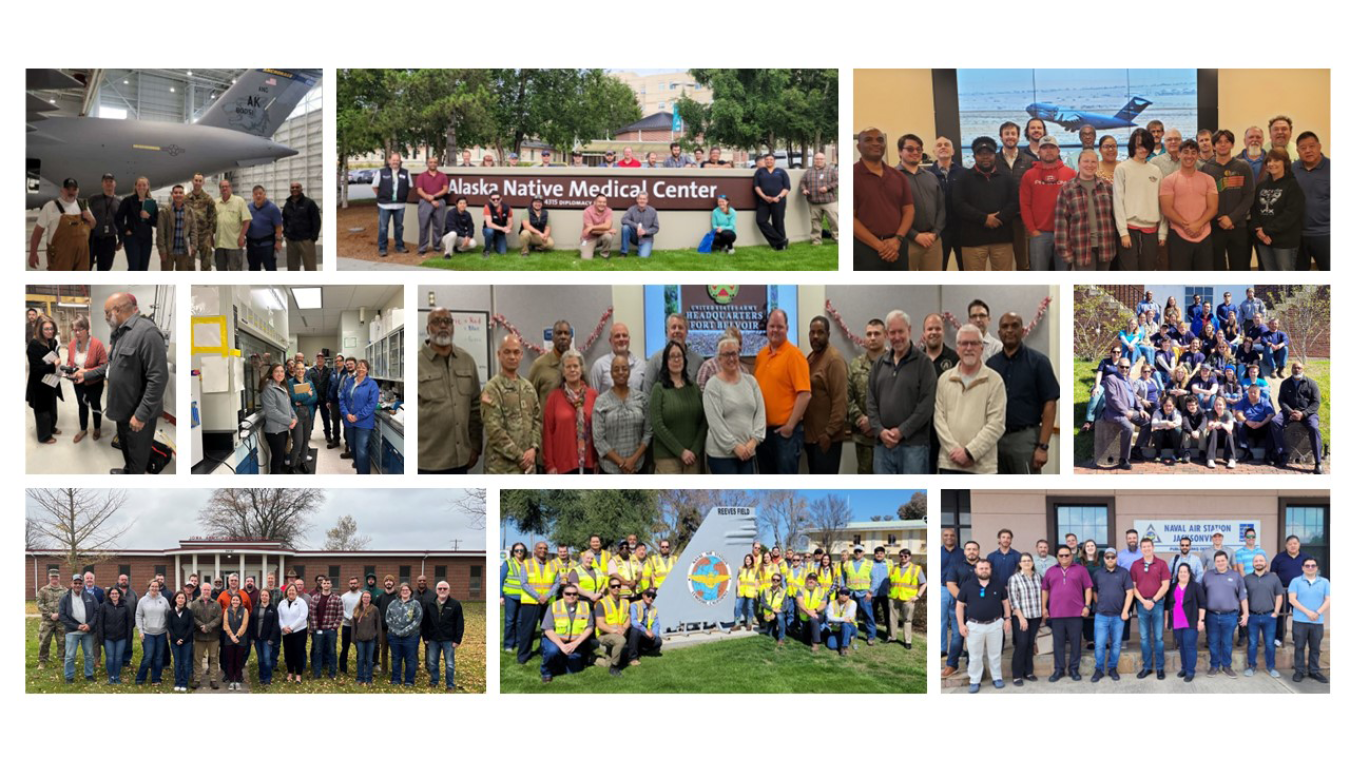
Treasure Hunt Success: Naval Station Newport
The two-day event provided energy related training and identified cost-effective ways to reduce water and energy consumption.
How To Prepare for a Treasure Hunt
To facilitate a successful treasure hunt at your site, you will need to have leadership buy-in and participants, as well as meet facility requirements. Participants should include a cross-section of team members at the site:

- O&M
- HVAC subject matter experts
- BAS subject matter experts
- Engineering
- Technicians
- Facility managers
- Facility occupants
- End users.
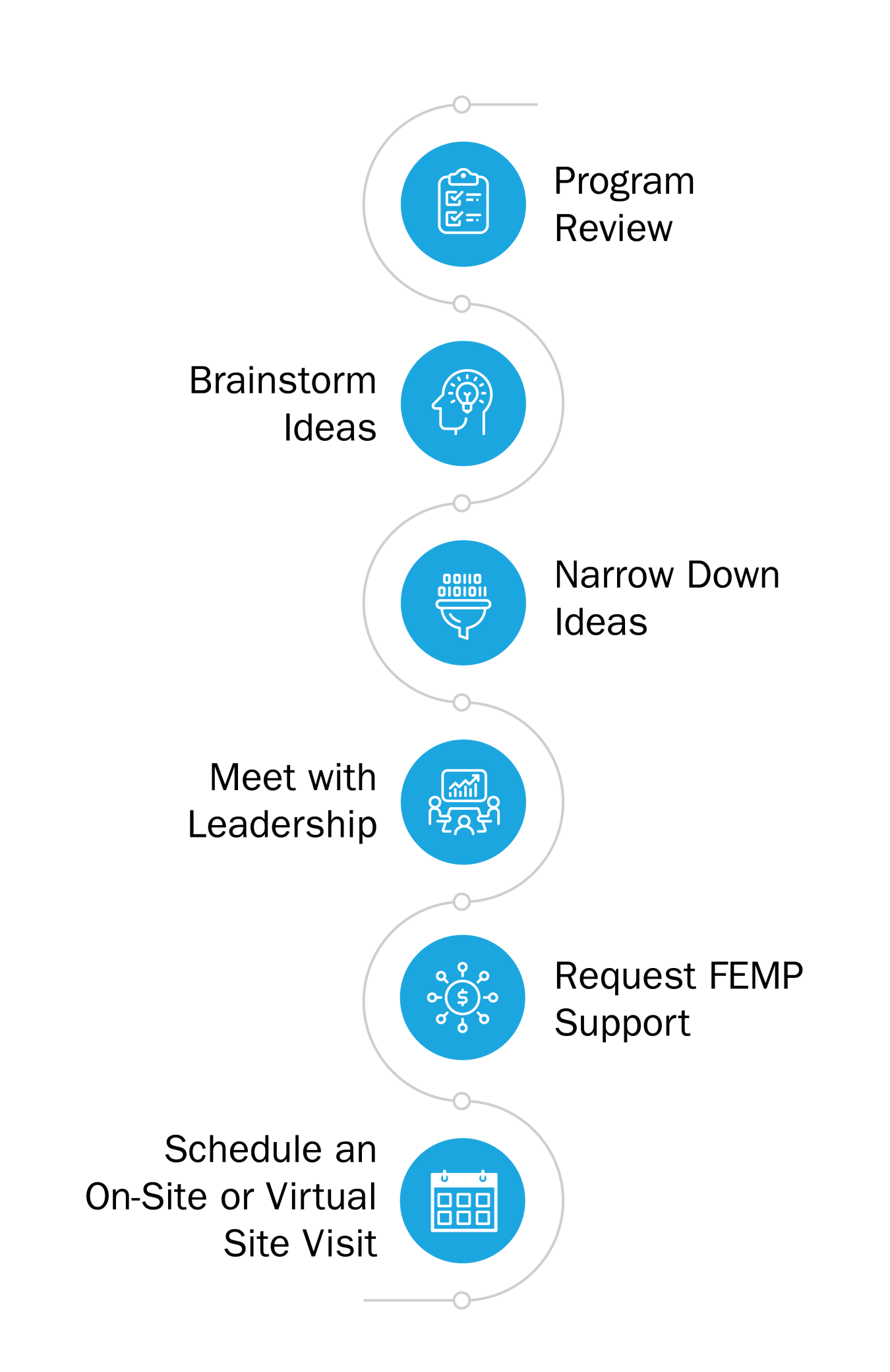
Before deciding to pursue a FEMP treasure hunt consider reviewing your agency's existing program. The timeline and process below may help determine if a treasure hunt is right for your organization.
-
Program Review
Review energy and water reduction guidance established in the goals and mandates outlined above, then compare with the existing energy plan and organizational goals.
-
Brainstorm Ideas
Think outside of the box to develop creative solutions to the pain points your team has identified. All ideas are good at this stage.
-
Narrow Down Ideas
Consider available funding sources, previous work performed, future projects, mission impacts, ease of implication, and time requirements.
-
Meet with Leadership
Schedule a meeting with leadership to discuss current or projected shortfalls. Propose a solution, including cost, timeline, impact on mission, and expected outcome.
-
Request FEMP Support
Contact FEMP to discuss O&M zero- and low-cost solutions such as:
- Treasure hunt
- Building Automation Re-tuning
- ASHRAE audit
- ISO 50001
- Assisting Federal Facilities with Energy Conservation Technologies (AFFECT) program.
Learn more at Operations and Maintenance in Federal Facilities.
-
Schedule an On-Site or Virtual Visit
Once leadership's 100% commitment has been received, it is time to move forward. A site visit can be coordinated to begin on-site or virtual FEMP support.
What To Expect During On-Site Training
The treasure hunt will follow a two-to-three-day agenda where participants can expect to spend 4 to 8 hours in interactive trainings. Below is a general outline of what can be expected each day.
Duration: 8 hours
Day one activities include observing the selected facility under operating conditions. After receiving FEMP-provided equipment and safety training, treasure hunt teams compiled from agency personnel will observe and record equipment operation focusing on lighting, water, and compressed air. The teams will determine if the equipment needs to be running or if run times and demand can be decreased. Energy consumption will be determined before and after adjustments to determine progress toward Energy Act of 2020 and EISA 2007 goals.
Duration: 8 hours
Day two is a deeper dive into more complex systems such as the BAS, HVAC, building envelope, and other building systems. With approval from local O&M leadership, treasure hunt participants may make gradual, minor adjustments to equipment to increase efficiency. Energy consumption will be determined before and after adjustments to determine progress toward identified goals.
A final report will be drafted by each team for presentation to leadership and implementation.
Duration: 4 hours
Day three consists of a recap with team leads and agency leadership to review projected savings, changes made, and pathways to implement identified improvements. The day will end with an out brief to leadership.
Train-the-Trainer
FEMP will also provide replicable TTT training on:
How to accurately measure:
- Lighting levels
- Amperage and voltage
- Boiler efficiency
- Chiller approach
- Condensing water and chilled water delta
- Facility thermography and analysis
- Much more.
The FEMP team will bring a tool and measurement kit with them; your site will need to secure these resources to perform your own treasure hunts in the future.
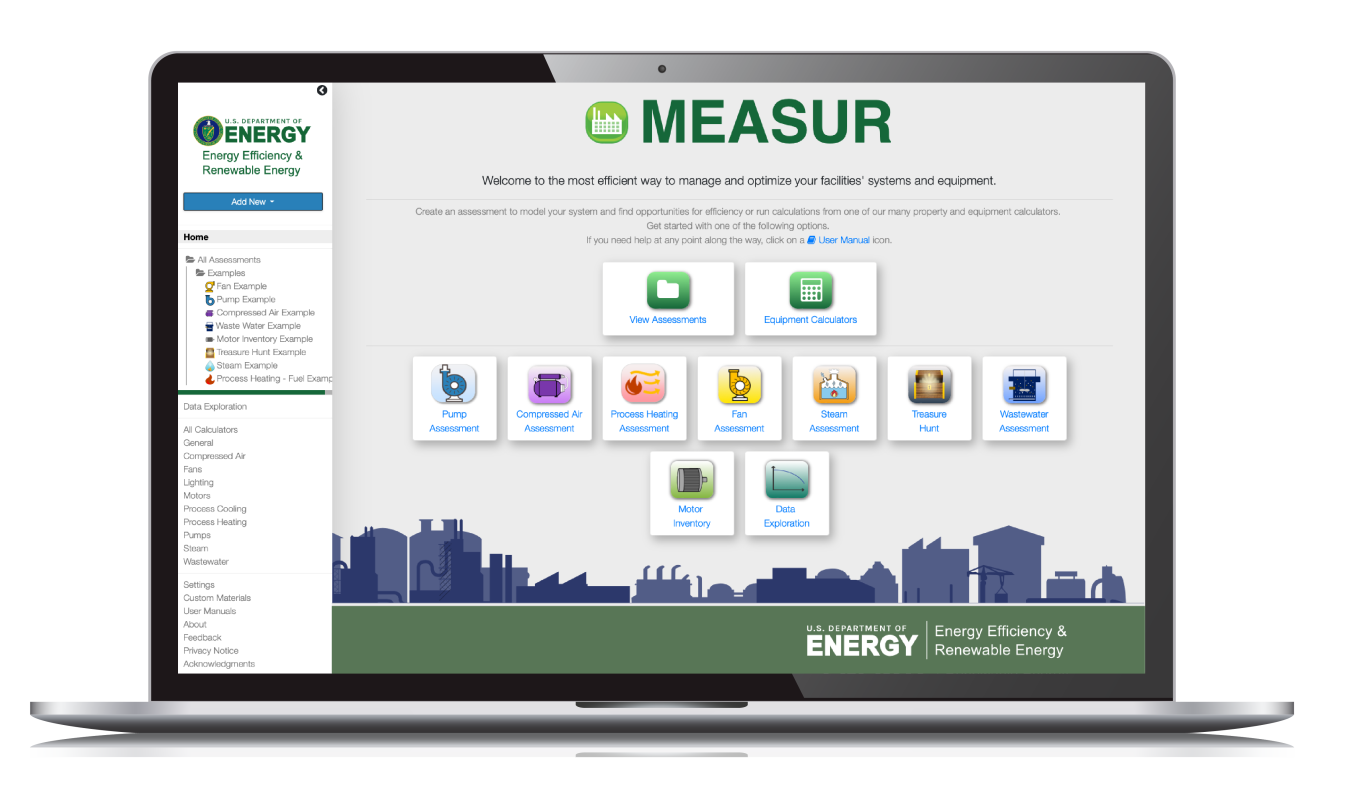
- Commonly used energy and water-saving tools, such as the U.S. Department of Energy tool, Manufacturing Energy Assessment Software for Utility Reduction (MEASUR).
Plan-Do-Check-Act
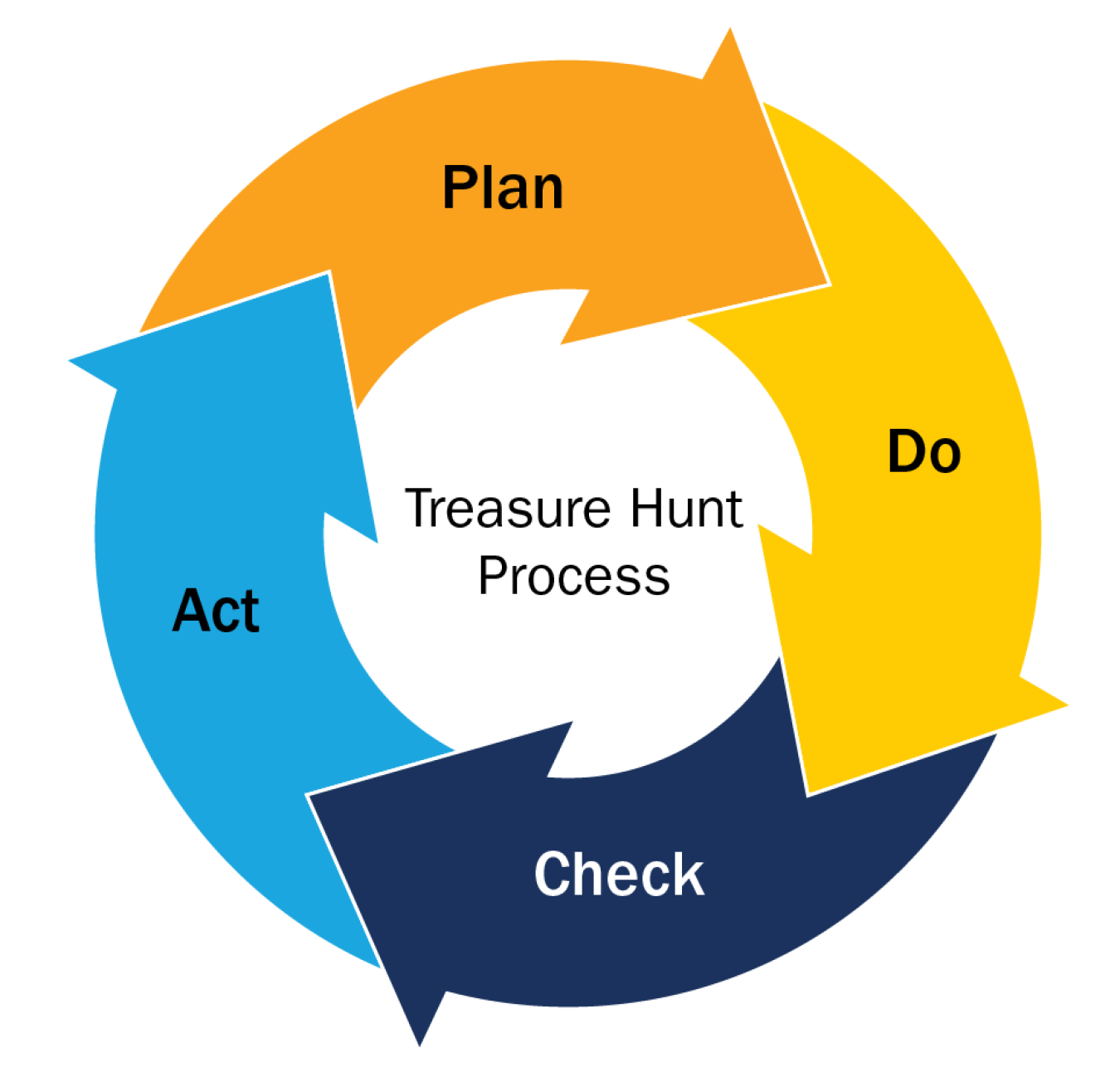
FEMP will walk agencies through Plan-Do-Check-Act, which is a cyclical process that allows agencies to meet specific efficiency requirements through continual treasure hunts.
Plan
Execute ongoing identification of non-essential energy and water consumption.
Do
Host a FEMP treasure hunt:
- Identify zero- and low-cost energy and water usage opportunities through an adaptive culture approach.
- Define essential versus optional equipment and equipment configuration.
- Research existing BAS and automated activity schedules and strategies.
Check
Review mission impact on proposed alternatives with site personnel:
- Zero-cost: Discuss available immediate actions at no cost to the site.
- Low-cost: Discuss ROM for low-cost ECM implementation/funding stream.
- Establish a timeline for ECM.
- Perform measurement and verification (M&V).
Act
Implement site-approved zero- and low-cost ECMs:
- Make gradual logical changes to HVAC and automated systems.
- Analyze impact with site.
- Provide training to site as needed.
- Work with site to develop an executable project for low-cost ECM implementation.
- Schedule and perform M&V.
What To Expect After a Treasure Hunt
After a treasure hunt, the FEMP team will continue to be available to the site for questions and additional support. Additionally, the FEMP team will introduce various resources that stretch across the energy spectrum and are available online, in-person, or remotely.
Below are several useful FEMP tools to assist teams during treasure hunts.
MEASUR: An open-source software suite for increasing the understanding of energy use and potential savings opportunities for industrial and commercial equipment.
Better Buildings Initiative: This U.S. Department of Energy (DOE) initiative aims to make the nation's homes, commercial buildings, and industrial plants more energy-efficient by accelerating investment and sharing successful best practices.
Need Assistance?
Need energy management guidance? Can't find a document or tool? FEMP can help. Ask FEMP a question.