



Window attachments are products that can be attached to a window either internally or externally to improve energy performance, create a more comfortable environment, reduce glare, provide privacy and enhance the appearance and value of your home.
Why use Energy-efficient Window Attachments?
Energy-efficient window attachments are important for both new and existing homes. About 30% of a home's heating energy is lost through windows. In cooling seasons, about 76% of sunlight that falls on standard double-pane windows enters to become heat.
Window coverings can help with this loss of energy by providing comfort, regulating temperatures, and lowering energy bills. The exact savings will depend on the type of attachment, the season, the climate, and how the attachment is used.
In addition to the window coverings, storm windows with low-e coatings and/or multi-layer glazing are effective at improving thermal performance of windows and reducing solar heat gain.
Key Benefits of Window Attachments
- Comfort improvement
- Control daylight and glare
- Energy savings
- Reduce cold drafts near windows
- Provide privacy
- Temperature control
- Reduce day and nighttime heat loss through windows when it’s cold
- Reduce unwanted solar heat gain through windows when it’s hot
Energy Performance Ratings for Window Attachments
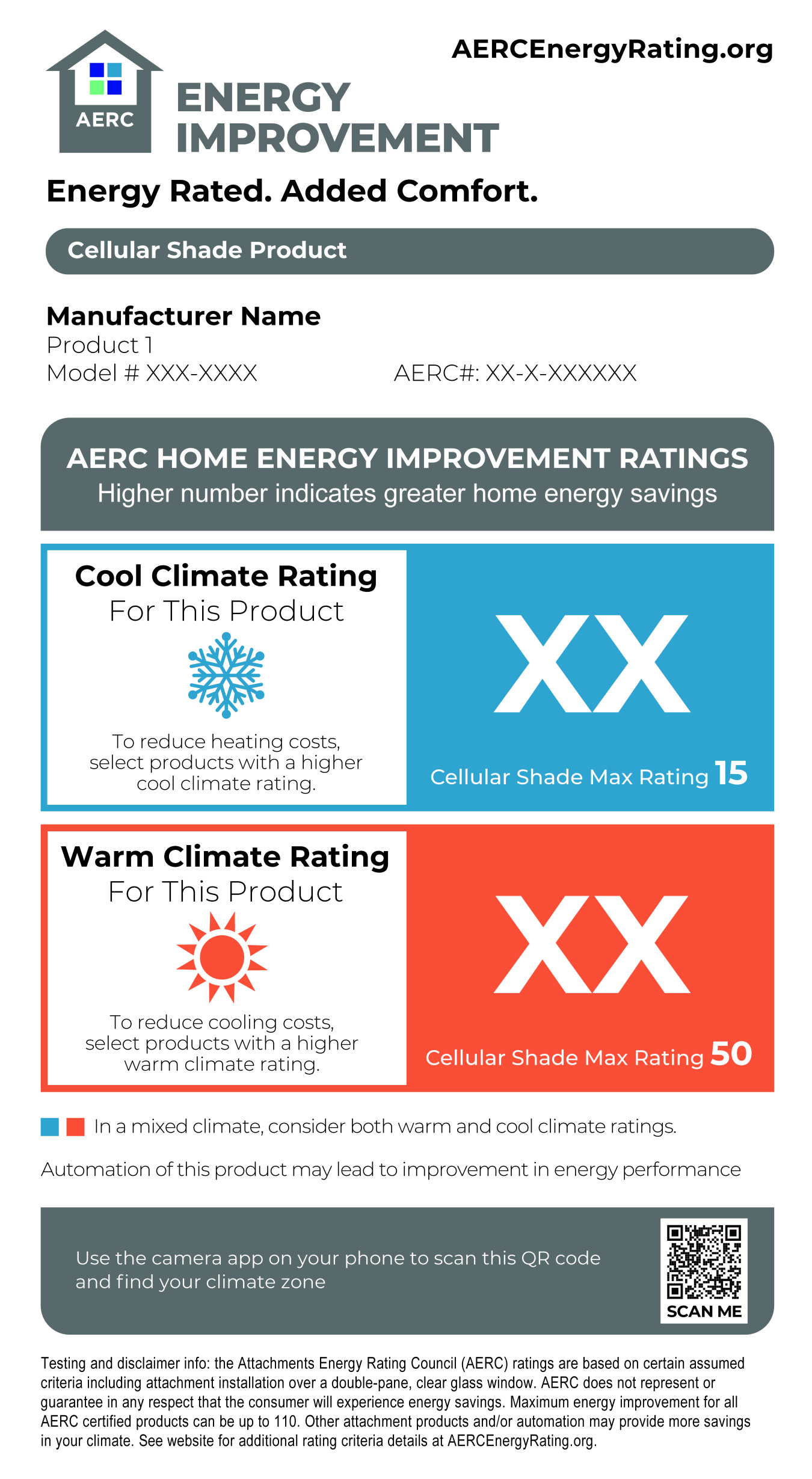
When choosing window attachments, look for products certified with the Attachments Energy Rating Council (AERC) Energy Improvement rating for increased energy savings and added comfort.
The AERC energy rating indicates that the product has been certified according to strict standards set forth by the AERC. AERC is an independent, public interest, non-profit organization whose mission is to rate, label and certify the energy performance of window attachment products.
The AERC Certified Product Search allows you to browse through the current window attachment products that have received AERC certification. Get started in your search for the energy-efficient window attachment product that’s right for you.
Operable Window Coverings
Operable window coverings give you the flexibility to choose whether to keep your window coverings open or closed for privacy, and to maximize natural light, take advantage of heat from the sun in the winter, and reduce heat gain in the summer. Options include shades, blinds, screens, awnings, draperies or curtains, and shutters.
Operation of Window Attachments and Tips
Most window coverings are operable, and yet 75% of residential window coverings remain in the same position every day, according to a study by the U.S. Department of Energy. Don't fall into this habit - be strategic about which coverings you open and close throughout the day.
If it’s winter and likely to be sunny, open the window coverings in the morning to allow the sun to heat your home through the day—especially those that receive direct sunlight.
In the summer, you may want to keep window coverings closed to reduce heat gain. For natural light, open those window coverings that don’t get direct sunlight.
You may also want to try switching the ones that are opened and closed through the day to maximize light and heat from the sun when you want it.
Some companies offer window coverings with automated options, which make them easier to operate, especially those located in hard to reach places. They can also offer optimized energy performance. Learn more about the benefits, drawbacks, and installation of automated window coverings.
Window Films
Window films (applied to the glazing surface) help block against solar heat gain and protect against glare and ultraviolet exposure. They are best used in climates with long cooling seasons, because they also block the sun's heat in the winter.
They can be useful for homeowners who don’t want to block views with other window treatments, but who have issues with glare and solar heat gain. They can also be a good choice on windows that are difficult to fit with other window treatments, or in places where artwork, furniture, or carpeting could be faded by UV exposure.
Films typically have three layers: an adhesive layer that sits against the glass, a polyester film layer, and a scratch-resistant coating. You may also choose options such as tints, UV blockers, or thicker films that offer security. Low-e films are also emerging as an energy-saving option.
Window films are rated by the National Fenestration Rating Council (NFRC), which also created window labeling and ratings for consumers. The NFRC’s Window Film Energy Performance Label looks like this:
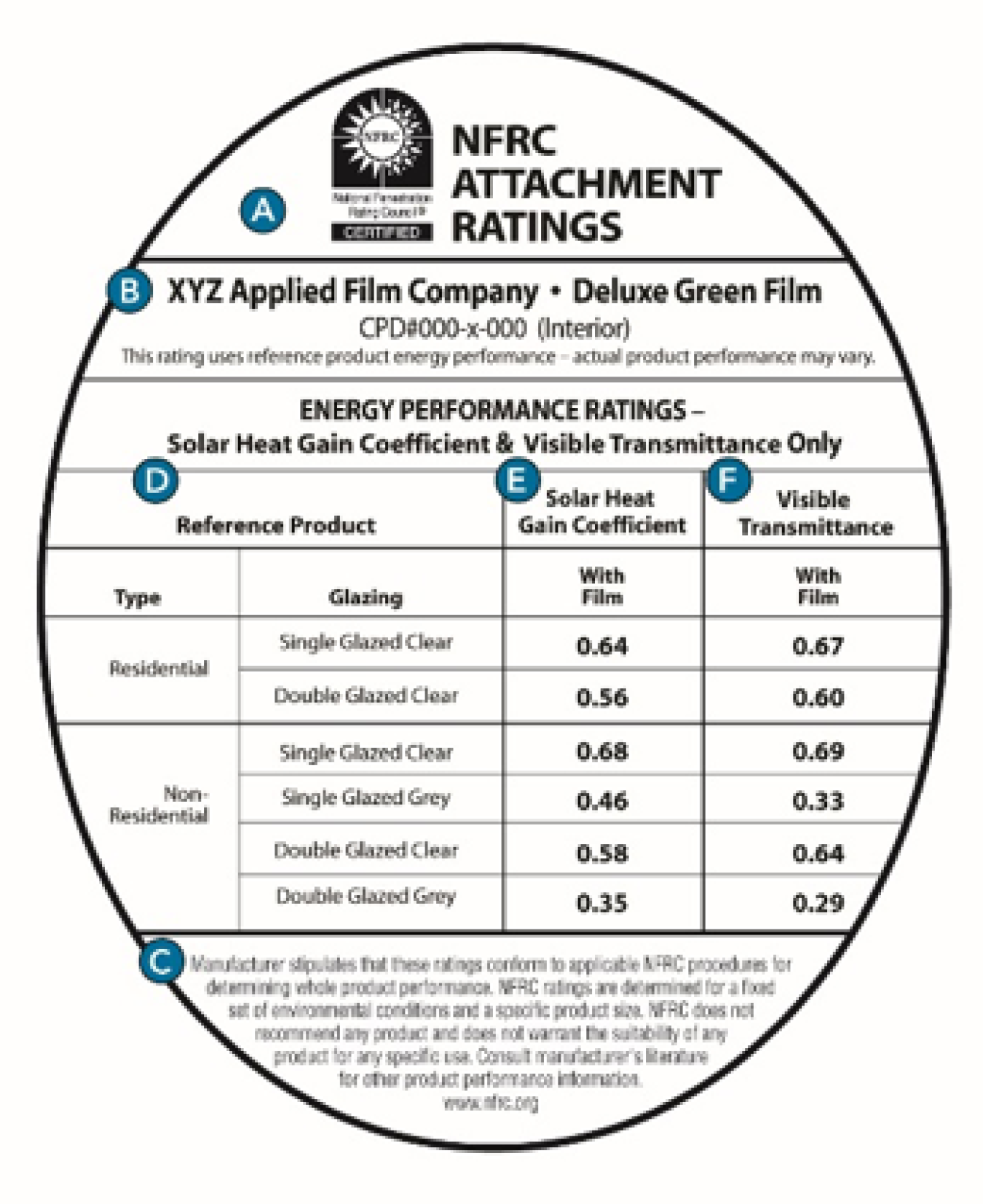
A) Rated by NFRC.
B) Manufacturer and product name.
C) Details on NFRC rating procedures.
D) Reference Product column shows what type of glazing works best with the film.
E) Solar Heat Gain Coefficient (SHGC).
F) Visible Transmittance (VT).
It includes the solar heat gain coefficient (SHGC) and visible transmittance (VT) of the window film, both numbers between 0 and 1. The lower the SHGC, the better the film is at blocking heat gain. The higher the VT, the more potential for daylighting. Read more about energy performance ratings.
The effectiveness of these reflective films depends on:
- Size of window glazing area
- Window orientation
- Climate
- Building orientation
- Whether the window has interior insulation.
Silver, mirror-like films typically are more effective than the colored, more transparent ones. More recently, there are solar control films that have a more neutral appearance and are effective at blocking near IR solar radiation in the summer. East- and west-facing windows, because of their greater potential for heat gain, can benefit more from these films. North-facing windows won't benefit from them, and south-facing windows may benefit somewhat, but the benefit could be offset by the reduction of heat from the winter sun.
There are also window films that have low-e coatings, which can also be effective in reducing winter heat loss and increasing thermal comfort of occupants. They also typically are effective at reducing near IR solar radiation.
Window films can be professionally applied by a skilled installer or are available for do-it-yourself projects at home improvement stores.
Window films require extra care for cleaning. If they are primarily absorbing solar radiation (tinted films), they can damage insulated glazing unit (IGU) seals. Most window manufacturers will void their warranties if the film is installed on an IGU.
Read more about window films at the Efficient Window Coverings Collaborative.
Exterior Window Treatments
Exterior shutters and shades are usually made of a variety of materials, including fabric, wood, steel, aluminum, or vinyl. They are most effective at reducing solar heat gain.
Shades are typically fabric or vinyl and the material may have openings that allow some visibility through the window. The larger the openings, the less protection from solar gain. They are usually manually operated, though some can be opened or closed with a crank inside the home.
Roller shutters are usually mounted above the window and side channels guide them as they're lowered and raised. When you lower these blinds completely, their slats meet and provide shade, privacy, security, and protection from storms. If partially raised, the blinds allow some air and daylight to enter through windows.
Most exterior shutter systems include a mechanical crank, rod, or motor to allow operation from indoors. This can help encourage daily use of the shutters, and may be required by local fire codes.
Learn more about exterior shutters and shades from the Efficient Window Coverings Collaborative.
An awning is a roof-like shelter installed on a home’s exterior that shades windows from the sun’s heat and glare. Awnings can also shade outdoor living spaces. Awnings can be fixed or retractable.
Window awnings can reduce solar heat gain in the summer by up to 65% on south-facing windows and 77% on west-facing windows. You can use an awning to shade one window or have an awning custom-made to shade the entire side of your house.
In the past, most awnings were made of metal or canvas, which need to be re-covered every five to seven years. Today, awnings are made from synthetic fabrics such as acrylic and polyvinyl laminates that are water-repellent and treated to resist mildew and fading. Whatever the fabric, you should choose one that is opaque and tightly woven. A light-colored awning will reflect more sunlight.
Awnings require ventilation to keep hot air from becoming trapped around the window. Grommets (eyelets) or other openings along the tops and sides of an awning can provide ventilation. The awning may also open to the sides or top to vent hot air.
While awnings can save energy during the cooling seasons, they can increase energy used for heating, so keep this in mind when deciding whether awnings are right for you. You can also adjust your use depending on the season: keep awnings installed or closed in the summer and remove or open awnings in the winter. Fixed awnings can sometimes be installed to allow the lower-angle winter sunlight to reach windows.
You can roll up adjustable or retractable awnings in the winter to let the sun warm the house. New hardware, such as lateral arms, makes the rolling up process quite easy. Some awnings can also be motorized for easy operation.
Solar screens can reduce solar heat gain, UV damage, and glare. They can be installed on the interior or exterior as roller shades or fixed panels, and they typically allow for a view out the window and light transmission. They look similar to regular insect screens but provide more efficiency benefits.
The openness factor on solar screens varies and affects the efficiency benefits; greater openness reduces the protection against glare and solar heat gain but increases visibility and light transmission.
Read more about solar screens from the Efficient Window Coverings Collaborative.