



Workers safely and successfully replaced 36 filters in a ventilation system for an underground waste-tank vault at the West Valley Demonstration Project, ensuring continued removal of airborne contaminants. April 28, 2026
Office of Environmental Management
April 28, 2026 Estimated Read Time min
WEST VALLEY, N.Y. — Workers safely and successfully replaced 36 filters in a ventilation system for an underground waste-tank vault at the West Valley Demonstration Project, ensuring continued removal of airborne contaminants.
The ventilation system, made of mostly high-efficiency particulate air filters each 4 square feet in size and weighing up to 60 pounds, controls moisture and works in concert with a drying system to reduce humidity and corrosion.
U.S. Department of Energy Office of Environmental Management crews have removed more than 98% of persistent radioactivity from the two 760,000-gallon tanks and two 14,300-gallon tanks, which once held high-level waste from commercial used fuel recycling operations decades ago. Workers vitrified that waste, or solidified it in glass, into 278 canisters for permanent disposal. They processed most residual liquid, and about 4,000 gallons of liquid and sludge remain in one of the tanks, targeted for removal in upcoming years. West Valley is also evaluating tank closure alternatives.
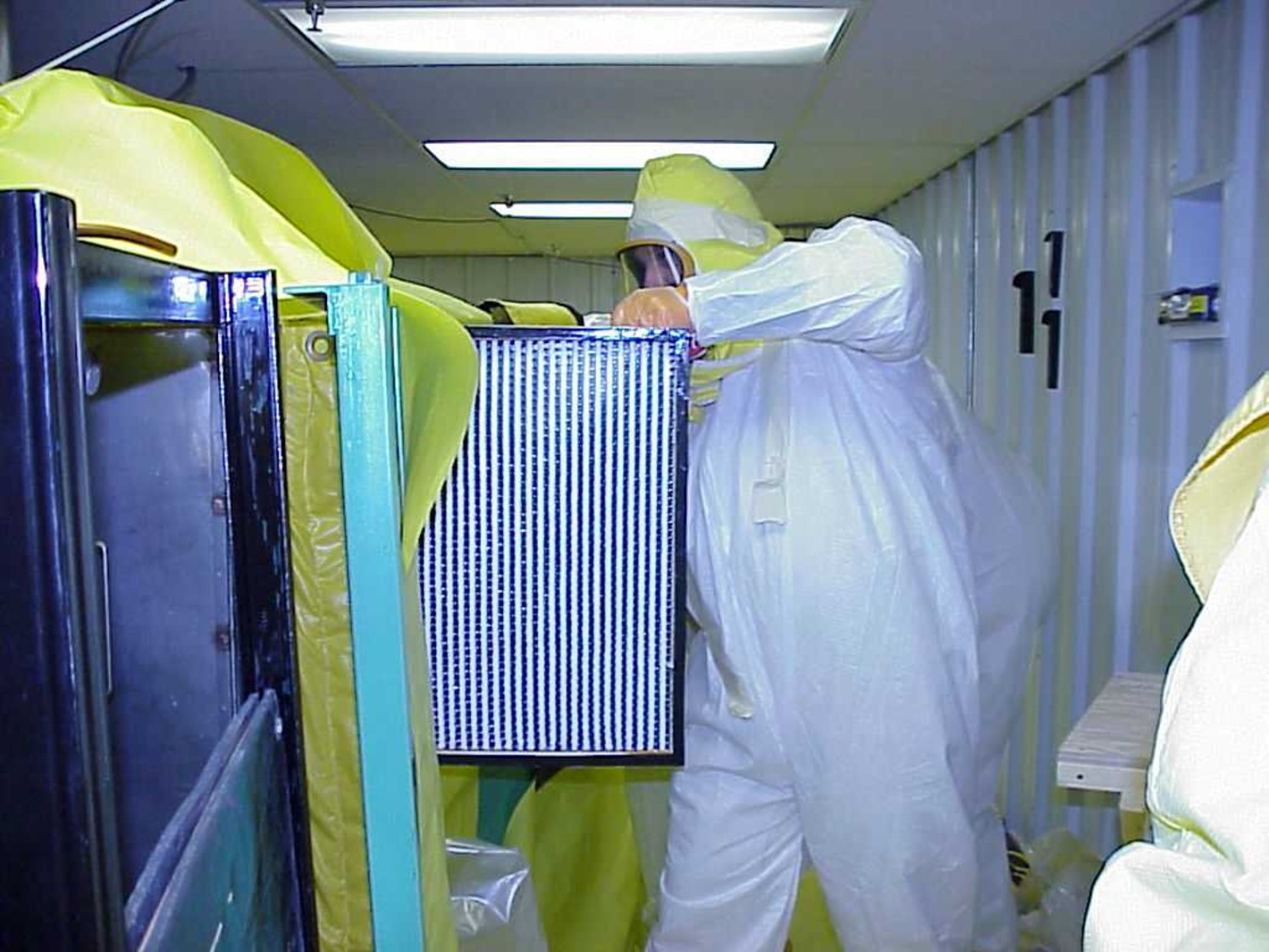
Workers remove one of 36 filters for a ventilation system in the underground waste-tank vault at West Valley Demonstration Project. The system provides ventilation to reduce humidity and corrosion in the four tanks.

Workers safely placed a filter for the ventilation system in a box and transported it on a cart to a location where it was packaged inside a waste container for disposal.
Before beginning the filter changeout, employees built a mock-up to identify hazards, refine techniques, determine equipment needs and strengthen safety measures.
“The mock-up allowed us to practice the removal and replacement of filters to gain insight and experience,” said Bill Freaney, Waste and Site Operations supervisor. “Time spent practicing helped us design the tools, develop a strong work instruction package, and determine the safest and most effective techniques.”
To complete the project, crews used a specially designed tool to pull each filter into a box, which they sealed. A radiation control technician checked for contamination. If none was detected, workers packaged the filters for offsite disposal with the help of a forklift.
“The preplanning for this work activity was excellent,” said Stephen Bousquet, assistant director for West Valley’s Office of Project Management. “This is how the U.S. Department of Energy Office of Environmental Management will continue to advance safe, compliant progress at the site — by applying lessons learned to enhance safety, improve efficiency and reduce exposure to potential hazards.”
-Contributor: Joseph Pillittere
To receive the latest news and updates about the Office of Environmental Management, submit your e-mail address.