



The Department of Energy’s Hanford Field Office is applying scientific innovation to accelerate cleanup progress. April 21, 2026
Office of Environmental Management
April 21, 2026 Estimated Read Time min
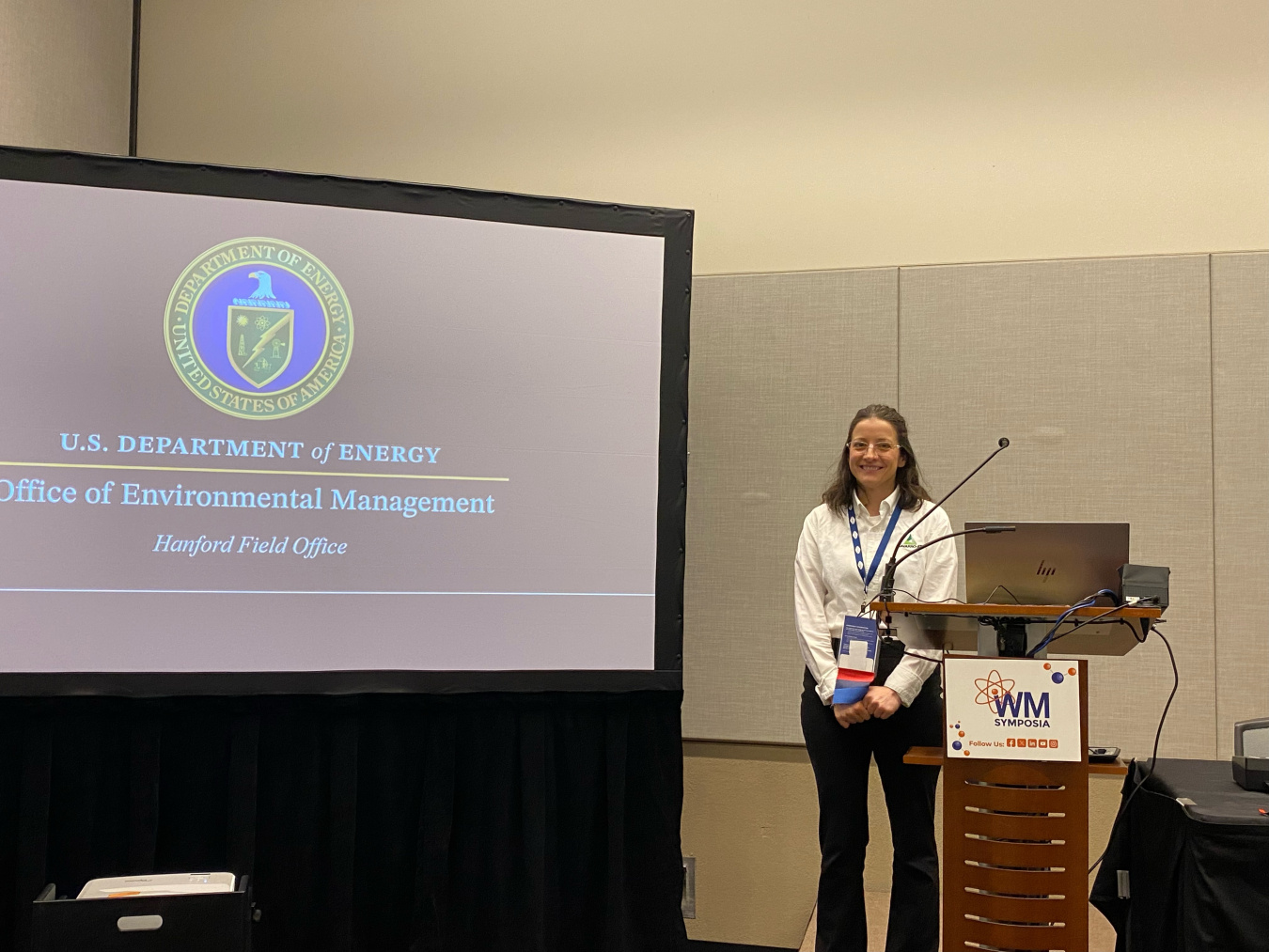
Chemist Bojana Leonard presents her iodine-129 research at Waste Management Symposia earlier this year.
Advancing Cleanup, Protecting the Environment and Building the Lab of the Future
RICHLAND, Wash. — The Department of Energy’s (DOE) Hanford Field Office (HFO) is applying scientific innovation to accelerate cleanup progress.
At the Hanford 222-S Laboratory, scientists with contractor Navarro-ATL are tackling some of the site’s most complex chemistry challenges, helping improve cleanup safety, efficiency and predictability.
Their work — from advancing radioactive iodine analysis to preventing chemical conditions that slow tank waste retrieval — supports the DOE’s Office of Environmental Management mission to reduce risks and protect the environment.
Two recent research efforts highlight the impact of this innovation. One focuses on improving the detection of iodine-129 in tank by-product, while the other helps prevent phosphate gelling during saltcake retrieval. Together, they demonstrate the high caliber of scientific capabilities within the laboratory.
“Innovation is a big part of how we keep the lab relevant and help move the cleanup mission forward,” said Mark Hughey, general manager for Navarro-ATL. “Our team is always looking for smarter, more precise, and more efficient ways to deliver the data the Hanford Site depends on.”
Understanding Iodine-129
Iodine-129 is a long-lasting radioactive by-product from past plutonium production at Hanford. It exists in underground tanks and moves easily through the environment, creating unique treatment challenges.
Shortly after chemist Bojana Leonard joined the laboratory, she was asked to help improve understanding of iodine quantities and chemical forms in tank by-product — information essential for predicting its behavior during treatment and ensuring effective disposal and emissions management.
Leonard developed a more precise method that gives operators clearer insight into how iodine behaves during filtration, evaporation and vitrification. Her work strengthens the laboratory’s ability to support a faster pace of by-product treatment at Hanford and reflects the lab’s technical expertise.
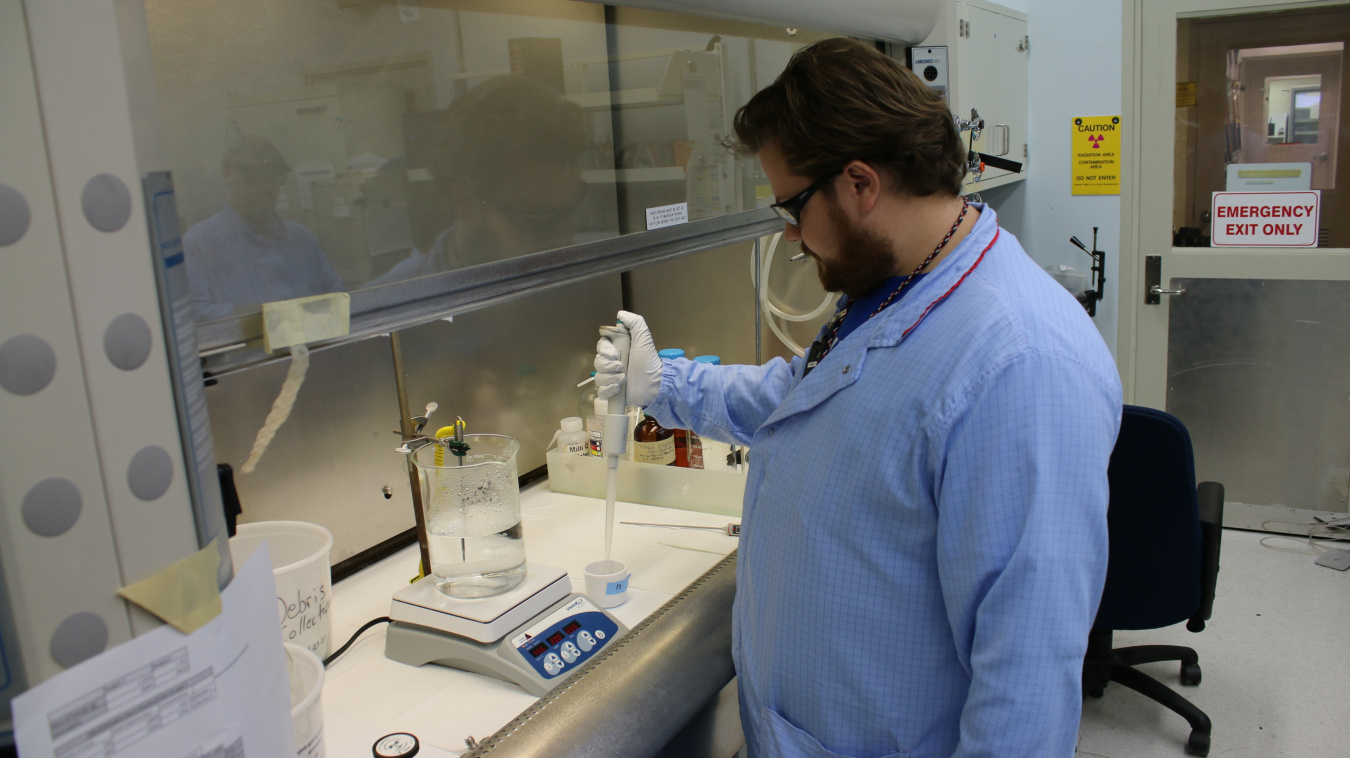
Scientist Caleb Mortensen conducts saltcake retrieval testing at 222-S Laboratory.
Preventing Gel Formation During Retrieval
Tank waste retrieval depends on the chemicals remaining flowable. In some older single-shell tanks, certain chemicals can form a thick gel-like mass during saltcake retrieval, clogging pumps, interrupting operations and prolonging time hazardous materials remain in aging tanks.
Navarro-ATL chemists Caleb Mortensen and Thomas Ely are leading a multiphase study to identify chemicals that prevent this gel formation. Early laboratory results show strong potential to reduce retrieval interruptions, limit worker risk and decrease water use, which supports cost savings.
Why It Matters
As Hanford accelerates by-product retrieval and treatment for long-term disposal, Navarro-ATL’s research enhances the predictability, efficiency and safety of operations. More accurate and timely measurements help avoid costly downtime, reduce by-product-handling uncertainties and strengthen stewardship of public resources, proving that stronger science leads to better cleanup outcomes.
To receive the latest news and updates about the Office of Environmental Management, submit your e-mail address.