



Offshore wind energy has emerged as a promising source of renewable power and is likely to ramp up along the United States’ coastlines in the coming years, providing energy to the U.S. grid and to population centers (located mostly on shorelines) and islanded or isolated communities.
Offshore wind energy is also beneficial in other ways. Moving them offshore distances turbines from most humans, decreasing some of the local impacts, such as concerns about noise, shadows, views, and safety. Efforts are underway to standardize and improve workforce training and safety for maintenance and operations personnel who navigate the turbines at sea. Researchers and regulations offices are also working with other marine entities, such as the fishing industry, to coordinate use of space.
Offshore wind turbines are less restrained by their surroundings, which means they can be bigger, leading to fewer turbines that generate as much energy as a larger number of land-based ones can. However, offshore wind energy expansion raises understandable concerns about the impact on marine wildlife and ecosystems, including fish, invertebrates, birds, bats, and marine mammals.
How Can We Minimize Impact?
One question, for example, is whether the noise from underwater surveying activities and turbine service vessels may confuse whales and lead them to become stranded on beaches.
However, there is no evidence for whale strandings being caused by noise from offshore wind energy development, according to the Bureau of Ocean Energy Management and the National Oceanic and Atmospheric Administration (NOAA), in accordance with the Marine Mammal Commission and New Jersey Department of Environmental Protection.
Instead, the greatest human threats to large whales in the United States are vessel strikes and entanglement in fishing gear. To learn more, listen to NOAA’s recording of a media briefing on recent East Coast whale strandings, or refer to NOAA’s interactive map, which shows locations of 2016–2023 humpback whale strandings. To learn more about the Bureau of Ocean Energy Management’s work on offshore wind activities and marine mammal protection, read their Renewable Energy Fact Sheet or contact BOEMPublicAffairs@boem.gov.
The U.S. Department of Energy continues to partner with federal agencies and partners to monitor and gather data on whale mortality events and work to better research and improve offshore wind energy coexistence with wildlife and the environment. These federal agencies also work with partners to advance technologies that minimize turbine installation noise and better detect when whales are in the area so that crews can pause construction activities. These technologies show great promise and many are already being tested by the wind industry.
To help offshore wind energy facilities coexist with marine wildlife, offshore wind energy developers must prioritize comprehensive planning, technological advancements, collaboration with scientists, and effective mitigation strategies.
With the support of the U.S. Department of Energy Wind Energy Technologies Office, national labs, partners, collaborators, and other project contributors are working to identify and improve those strategies, while other government agencies like the Bureau of Ocean Energy Management create guidelines and standards to regulate offshore wind energy development.
Before and while an offshore wind energy facility is installed, experts perform surveys of the environment. They can check underwater, using, for example, vessel-towed habitat surveys, acoustic monitoring or biomass gliders, or autonomous underwater vehicle-towed hydrophone arrays. They can also perform aerial surveys to identify and track the presence of wildlife above the ocean surface. While an offshore wind power plant is operating, wildlife can be monitored using radars, radio telemetry receivers, thermal cameras, acoustic bat detectors, satellites, and real-time buoy-mounted sound monitors. Those tools help operators determine mitigation strategies.
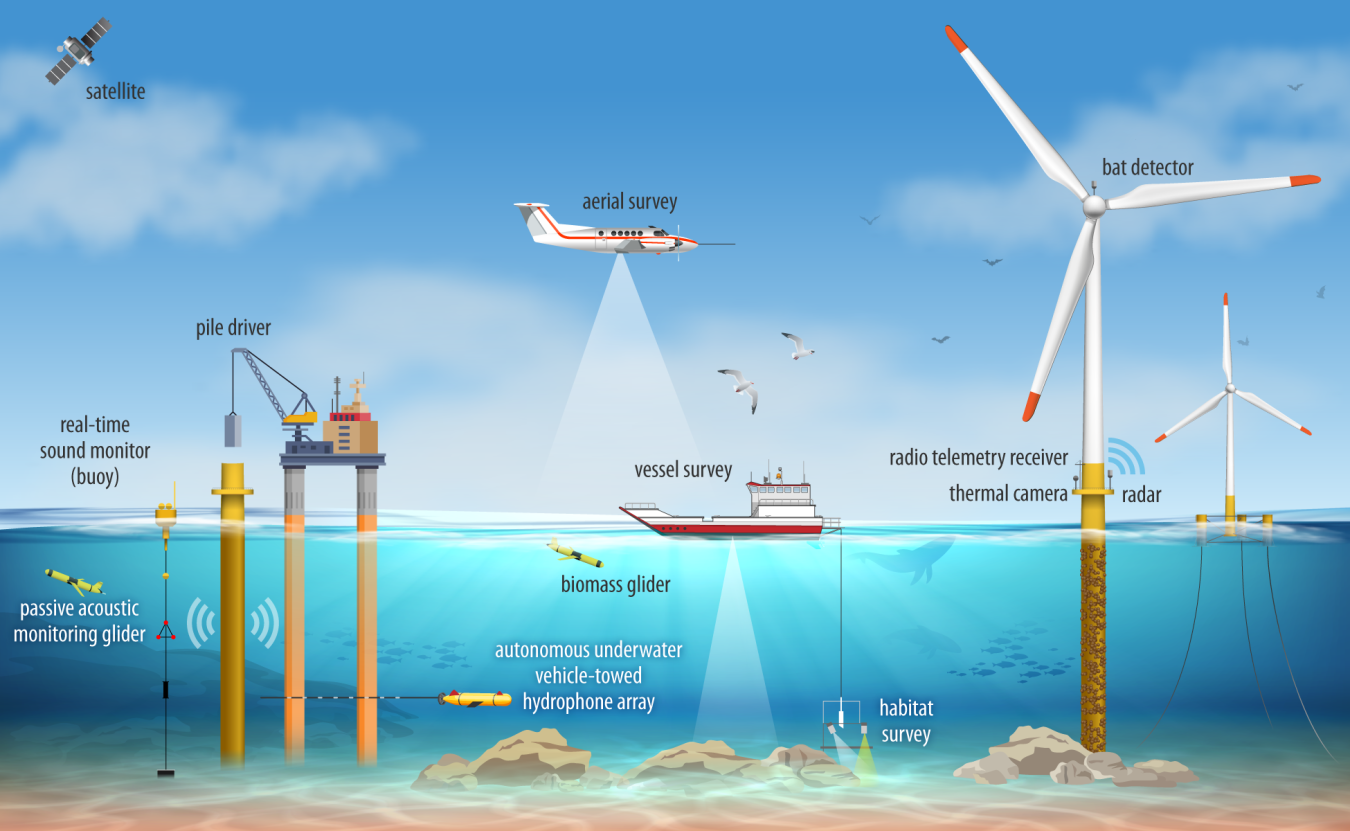 Before and while an offshore wind energy facility is installed, experts perform surveys of the environment. Tools help operators determine mitigation strategies. (This graphic is not to scale.)Photo from Al Hicks, NREL
What Steps Are Taken at Each Stage of a Project?
-
Development
For example, before construction, developers should employ a comprehensive planning approach when considering a site for offshore wind energy. This entails conducting thorough environmental impact assessments prior to the construction of wind farms. These assessments should include:
- Aerial and underwater surveys of marine species
- Wildlife habitats
- Wildlife migration patterns.
Developers should also account for the cumulative effects of multiple offshore wind energy projects. This approach ensures that wind farms are sited in areas with minimal ecological sensitivity, avoiding critical habitats and migration routes.
-
Construction
During construction, developers can enact mitigation practices to avoid disturbing marine environments.
Operators, according to Bureau of Ocean Energy Management requirements, must ensure that the area around vessels is clear of any marine mammals and sea turtles before operating any acoustic surveying devices and prior to installing turbine foundations.
Wind turbine installation activities like pile driving—which is when workers drive steel tubes into the seabed to create a foundation for a fixed-bottom offshore wind turbine—can pause when wildlife is nearby.
Bubble columns that wrap around construction sites can also prevent sound from traveling as far though water and disorienting animals.
-
Operation
Researchers also work to understand how marine wildlife interact with installed infrastructure, such as mooring lines that hold floating offshore wind turbines in place, by monitoring their behavior and movement.
Once a wind farm is up and running, wind farms can pause operations when wildlife is nearby as well.
The Bureau of Ocean Energy Management requires entities that conduct offshore activities to practice strict protective measures.
Under these measures, independent protected species observers monitor the area around vessels for marine mammals and shut down any sound sources if they spot marine mammals within a certain distance of the vessel. This practice also helps minimize vessel strikes.
Independent protected species observers also report any interactions with protected species during geophysical surveys to NOAA Fisheries and BOEM.
-
Decommission
Offshore wind energy is a relatively new application of wind energy, but the Wind Energy Technologies Office and members of the wind energy industry are researching, evaluating, and standardizing the best options for retiring (decommissioning) or revitalizing (repowering) wind farm infrastructure with environmental impacts in mind. Usually, decommissioning plans include efforts to address environmental restoration.
Sign up to receive updates on WINDExchange resources.
Related Topics
-
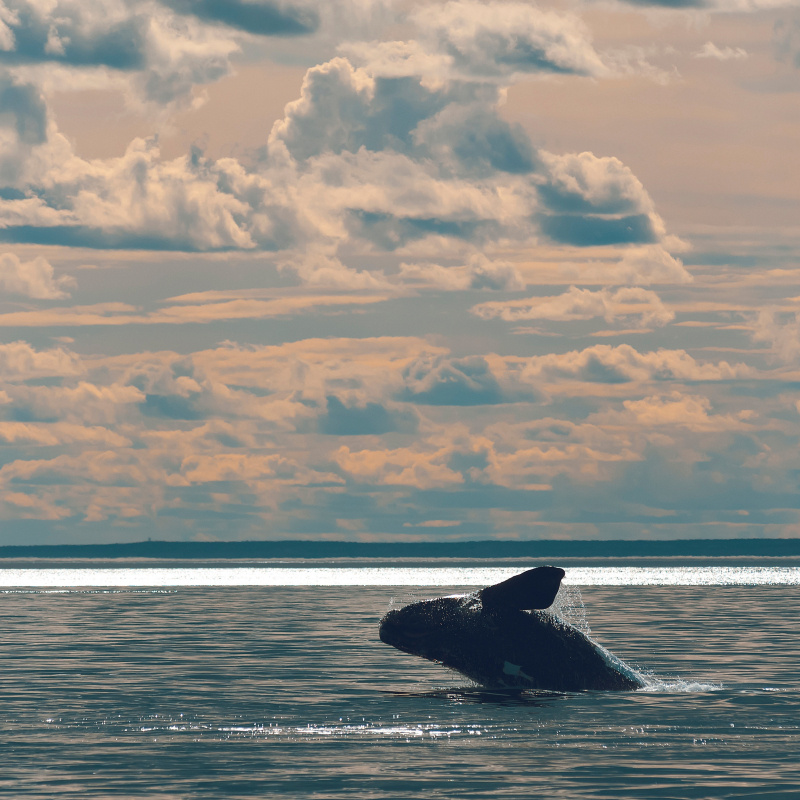 The Wind Energy Technologies Office is exploring the relationship between wildlife and wind turbines.
 -
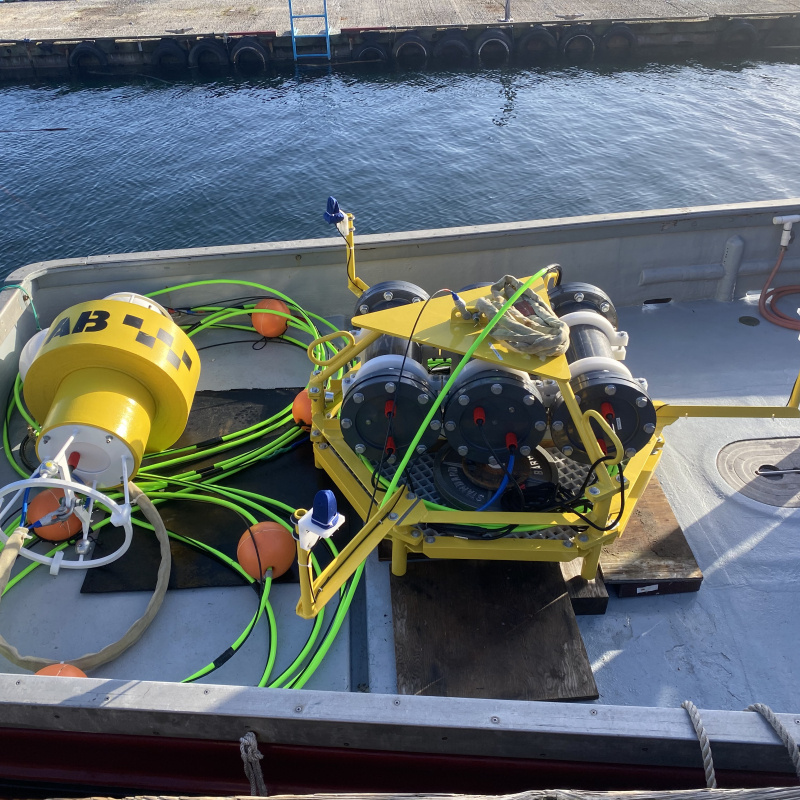 Innovative technology mitigates the negative impacts of offshore wind energy development on this endangered species.