



RSS





We are witnessing a renaissance of innovation in renewable fuels. Established corporations and small startups around the world are proposing novel solutions for turning abundant renewable carbon resources into energy-dense, low-carbon fuels that are key
The U.S. Department of Energy Bioenergy Technologies Office (BETO) is committed to strengthening its relationships with aviation industry partners, including fuel producers, biofuel crop growers, researchers, academia, state/local/tribal government...
The U.S. Department of Energy’s (DOE) Bioenergy Technologies Office (BETO) today announced $2.5 million in funding, with an industry match of $2.5 million, for four projects selected from the Base Annual Appropriations Technology Commercialization Fund...
To address the goals reducing emissions of the global shipping industry the U.S. Department of Energy, with support by the U.S. Department of State and the U.S. Department of Transportation, and the United Kingdom (UK) government’s Department for Transport..
The U.S. Department of Energy (DOE) Bioenergy Technologies Office (BETO) awarded $2.18 million in funding to three projects as part of the 2023 Cooperative Research and Development Agreement (CRADA) Call by the Feedstock-Conversion Interface Consortium...
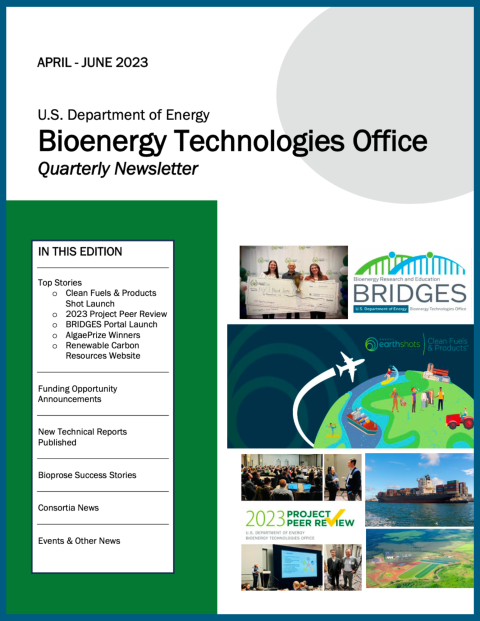
The U.S. Department of Energy (DOE) Bioenergy Technologies Office (BETO) has released its latest quarterly newsletter, containing program updates, funding opportunities, success stories, new reports for download, and event highlights from April through Ju
The U.S. Department of Energy (DOE) Bioenergy Technologies Office (BETO) Feedstock-Conversion Interface Consortium (FCIC) recently published eight new technical report case studies. The reports examine the environmental and economic impacts of a variety..
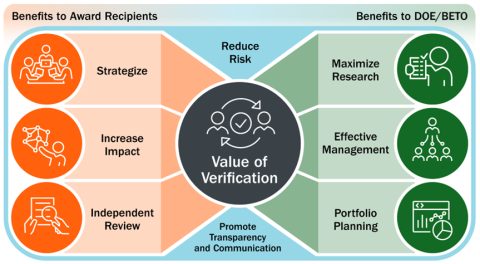
The U.S. Department of Energy (DOE) Bioenergy Technologies Office (BETO) often requires funding opportunity announcement (FOA) project awardees to comply with technical and economic validation of novel chemical, biological, and thermochemical technologies
Join this month's H2IQ Hour on July 25 at 12 p.m. ET for an overview of H2Rescue, a collaborative interagency effort of the U.S. Department of Energy's Office of Energy Efficiency and Renewable Energy and U.S. Departments of Defense and Homeland Security.
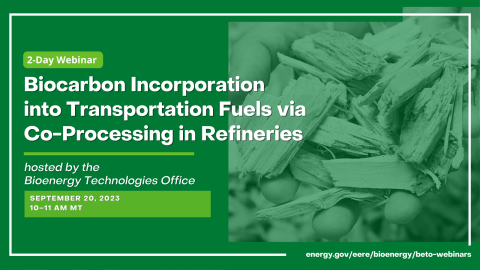
The U.S. Department of Energy’s (DOE) Bioenergy Technologies Office (BETO) will host a two-day webinar series, Biocarbon Incorporation into Transportation Fuels via Co-processing in Refineries, to highlight the key takeaways from the Bio-oil Co-processing