



The Community Microgrid Assistance Partnership (C-MAP) provides funding and technical assistance to energy providers and partners to build, operate, and enhance microgrid systems that improve the affordability, reliability, and security of electricity in remote areas of the United States.
C‑MAP is a program of the U.S. Department of Energy’s Office of Electricity (OE).
Get Microgrid Support and Access C‑MAP Resources
The latest C-MAP 2026 Funding Opportunity is now closed. Awardees will be announced in Fall 2026.
Apply for on‑demand Microgrid Support Services ranging from a one‑hour consultation with a national laboratory expert to up to 60 hours of tailored support.
Visit C-MAP’s Community Microgrid Innovation Exchange (C‑MIX) to register for upcoming microgrid webinars or browse more than 500 microgrid resources.
Subscribe to the OE Microgrids Updates email list to receive updates and information on future funding opportunities.
Improving Electricity Service in Remote Areas
Remote and electrically isolated communities often face power outages and fluctuating costs due to their reliance on long-distance grid connections and imported fuel. Many are turning to microgrids as a solution.
Microgrids are local networks of electricity resources that can operate independently and can be tailored to local conditions to meet residential, commercial, and industrial electricity demand.
Participating in C-MAP can lead to outcomes such as:
- Improved operation of existing microgrids
- Construction-ready engineering plans for microgrid development
- Lower or stabilized energy costs
- Workforce capacity for long-term operations
- Solutions to address poor power quality and outages
- Relationships with local development organizations, colleges and universities, and other sources of technical support.
The microgrids developed in partnership with C-MAP will demonstrate technology solutions and operational improvements that can be replicated nationwide.
Access Microgrid Assistance
C-MAP issues periodic requests for funding proposals and offers on-demand, short-term Microgrid Support Services that range from brief, high-level guidance sessions to as many as sixty hours of tailored technical support from national laboratory subject-matter experts.
Eligible applicants include nonprofit organizations such as energy cooperatives, industry, state and local governments, and federally recognized American Indian and Alaska Native Tribes and villages.
C-MAP also convenes individuals and organizations for knowledge sharing under the Community Microgrid Innovation Exchange (C-MIX). C-MIX offers a library of 500+ resources, peer-to-peer exchanges, and training and workshops. Anyone interested in microgrids—including vendors, energy providers, researchers, academics, policymakers, and government officials—is encouraged to participate. All open C-MAP opportunities and public resources are available on the C-MIX.
News and Events
Partner Organizations
C-MAP participants can rely on project officers and regionally based program partners as they build, operate, and enhance microgrid systems. Some examples of program partners include:
- The Alaska Center for Energy and Power
- Alliance for Tribal Clean Energy
- Arctic Energy Office, Arctic Energy Ambassadors
- Hawai‘i State Energy Office
- The Island Institute
- Office of Indian Energy
- Renewable Energy Alaska Project
- Sundance Consultants
C-MAP partners play a key role in fostering innovation and sharing practical knowledge to advance microgrid adoption.
FAQs
The goal of C-MAP is to improve electrical service to residents and businesses while advancing microgrid innovation as a driver of energy and economic independence in remote and isolated parts of the country. Directed technical support and funding will empower participants to improve the operational efficiency of microgrids and harness a variety of energy resources.
C-MAP participants can use funds to identify technical needs for improving or expanding an existing microgrid system. For example, participants could complete a general feasibility study for a microgrid or develop a detailed conceptual design.
Each funding solicitation will specify the topic areas and eligibility requirements, including population size and geographic criteria.
Yes, C-MAP can support capacity building for microgrid operations or maintenance through direct technical assistance or workforce development programs led or coordinated by a regional partner organization.
C-MAP provides a range of technical assistance. On-demand Microgrid Support Services range from a one-hour consultation with an expert to 60 hours of tailored technical assistance. The technical assistance that complements awarded projects is expected to be completed within 18 to 24 months. Once a project is concluded, communities may continue to participate in the knowledge sharing and resources offered by their peers in the Community Microgrid Innovation Exchange (C-MIX).
C-MIX connects individuals and organizations to compile and exchange microgrid knowledge. Through C-MIX, communities that face similar challenges or conditions can share best practices, and researchers and developers can advance proven solutions. C-MIX offers a library of data and resources, peer-to-peer exchanges, and training and workshops. Anyone interested in microgrids—including vendors, energy providers, researchers, academics, policymakers, and government officials—is encouraged to participate.
Yes. Communities are encouraged to apply to C-MAP for focused microgrid assistance that can complement support received from other federal programs, such as the Energy Technology Innovation Partnership Project, the Energy to Communities program, or the Office of Indian Energy.
Competitiveness depends on the total number of applicants. When a proposal is not selected, C-MAP will notify the applicant, and a program partner may be able to provide support by revising the proposal and/or identifying other resources or funding opportunities that can better address the community’s specific challenges. Technical assistance through the on-demand Microgrid Support Services is provided on a rolling basis and is not competitive. Applicants can submit a request using the online form.
C-MAP follows the Department of Energy’s definition of a microgrid: “a group of interconnected loads and distributed energy resources within clearly defined electrical boundaries that acts as a single controllable entity with respect to the grid.” Community microgrids are often designed to operate primarily in grid-connected mode, with a point of connection to the bulk system. These systems may be eligible for C-MAP, but the microgrid is expected to operate independently or in island mode for long periods of time.
C-MAP Funding
C‑MAP provides competitively awarded funding paired with 18 to 24 months of technical and administrative support from partner organizations to help local governments, utilities, and other energy providers strengthen microgrid energy systems. All supported projects are expected to advance replicable microgrid solutions for remote, rural, and islanded communities.
Through C-MAP, OE selected 14 projects for $5.5 million in funding in June 2025. In addition, C-MAP will provide more than $2.6 million for microgrid technical expertise through the Department of Energy ’s national laboratories and local partners.
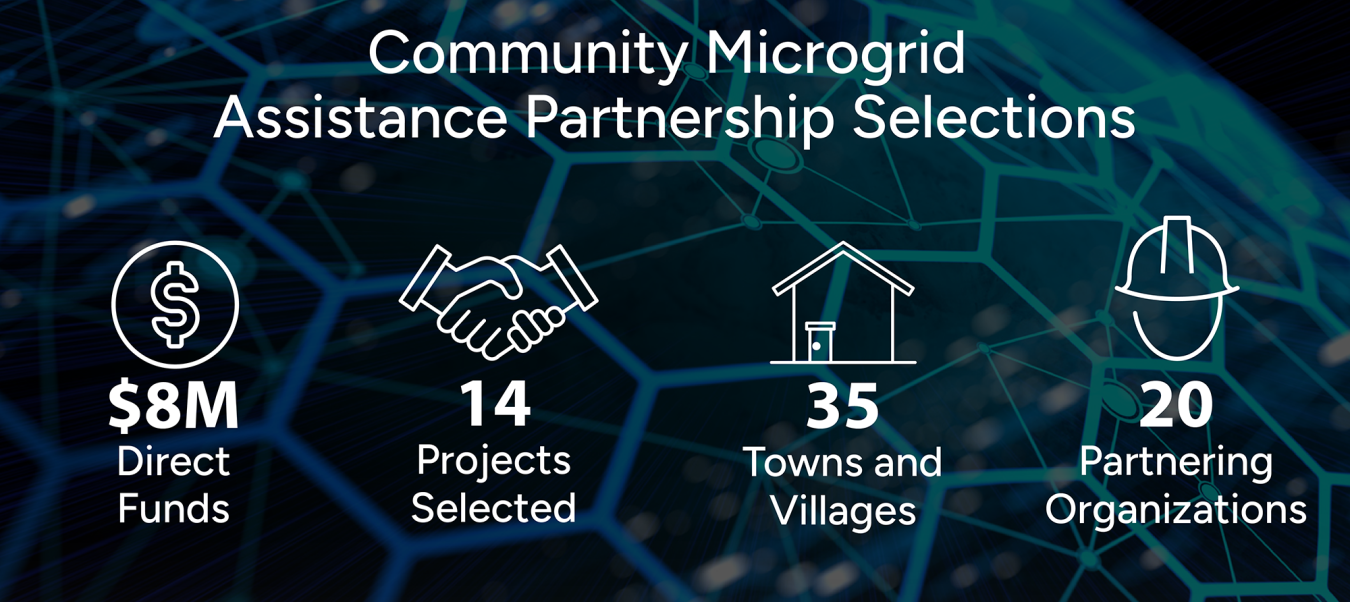
Learn more about the first cohort of selected projects. (The funding amount reflects direct funding to the communities and does not include additional technical support or cost share provided by the recipients.)
Alaska Municipal League – Alaska: Five microgrid-powered communities will investigate operational, development, workforce, and operations and maintenance strategies that serve isolated and islanded areas with diverse conditions and energy technologies. (Amount: $574,459)
- Partners: Alaska Municipal League, cities of St. Paul, Sitka, King Cove, Galena, and Ouzinkie
Choggiung Limited – Alaska: In Dillingham, the project partners will complete feasibility assessments and construction-ready designs for a microgrid with battery energy storage, on-site generation to reduce fuel imports, and distribution network enhancements for improved reliability, and a feasibility assessment for the replacement of the current supervisory control and data acquisition system. The project will support an important port and save an estimated $290,000 per year for residents who are paying high electricity costs of $0.56/kWh. (Amount: $299,925)
- Partners: City of Dillingham, with Nushagak Electric & Telephone Cooperative Inc. and DeerStone Consulting
Kawerak Inc. – Alaska: Five Bering Strait villages seek to build capacity to manage their stand-alone diesel microgrids with the addition of solar energy and storage systems provided through a planned grant from the U.S. Environmental Protection Agency. With the C-MAP award, the village members will develop governance frameworks, operational plans, and maintenance strategies for long-term system sustainability. (Amount: $575,000)
- Partners: Villages of Brevig Mission, Teller, Koyuk, Elim, and Savoonga, with the Alaska Village Electric Cooperative, Alaska Native Tribal Health Consortium, and DeerStone Consulting
Kwig Power Company – Alaska: Six microgrid-powered villages across the Calista and Lower Kuskokwim region will leverage shared cultural knowledge, technical experience, and workforce to develop strong utility models for microgrid operational and development efficiencies in the face of challenges, such as coastal erosion and land loss, permafrost thawing, and high energy costs. (Amount: $650,000)
- Partners: Villages of Atmautluak, Chefornak, Kipnuk, Kongiganak, Kwigillingok, and Tunututuliak, and Intelligent Energy Systems LLC
Metlakatla Indian Community – Alaska: Metlakatla Power & Light has been modernizing and refurbishing assets across the islanded energy system and recognizes the need for a microgrid operating system to effectively incorporate the new infrastructure. The project will result in a 100% construction-ready engineering design of a microgrid controls system and capacity building for utility staff. (Amount: $315,932)
- Partners: Metlakatla, Metlakatla Power & Light, Baker Tilly Advisory, and RESPEC
Naknek Electric Association – Alaska: Naknek, a coastal fishing community and the host of several seasonal fish processing centers, has a load that ranges between 2 and 15 megawatts. Key upgrades to the controls on the diesel-based microgrid will allow for direct efficiency gains, the incorporation of a battery for reserve power, and the future addition of local generation to meet fluctuating demand. (Amount: $393,184)
- Partners: Naknek, Electrical Power Systems, and the International Brotherhood of Electrical Workers
Native Village of Kluti-Kaah – Alaska: Facing poor power quality and frequent power disruptions, the Kluti-Kaah Tribe seeks to analyze the costs, benefits, and feasibility of implementing a grid-connected microgrid with local energy production compared to upgrading long distribution lines to meet increasing loads. (Amount: $279,100)
- Partners: Copper Center, Copper Valley Electric Cooperative, Electric Power Systems, and DeerStone Consulting
Nome Joint Utility Systems – Alaska: Nome’s project focuses on system upgrades to their diesel-powered microgrid with expected direct efficiency gains while also priming for the future integration of additional on-site generation. Upgrading the supervisory controls system, the microgrid controls, and the feeder and transformer relays should reduce energy costs by 20% to 30%. (Amount: $398,918)
- Partners: City of Nome, Electrical Power Systems, Kawerak Inc., and Village of Soloman
Oceti Sakowin Power Authority – South Dakota: Five Sioux Tribes are collaborating to improve reliable energy services for key Tribal businesses and adjacent Tribal housing. Developing a common approach will improve the sustained stewardship of the existing energy infrastructure and the incorporation of assets that have been acquired but are not effectively integrated. (Amount: $546,425)
- Partners: Cheyenne River, Crow Creek, Oglala, Rosebud, and Yankton Sioux, South Dakota; and Colusa Indian Energy Corp
Organized Village of Kwethluk – Alaska: Four villages will address low energy reliability by developing standardized microgrid configurations that balance regional scalability with community-specific flexibility. The team will explore how to increase Tribal revenues and offset fuel imports with electrification for power generation, heating, and transportation as well as a model for collaborative operations and maintenance between neighbors. (Amount: $500,000)
- Partners: Villages of Kwethluk, Akiachak, Akiak, and Tuluksak, and Intelligent Energy Systems LLC
Tanadgusix Corporation (TDX) Power LLC – Alaska: The utility of an Aleutian fishing community will revitalize an existing microgrid, remedying efficiency and functionality issues across several assets, in collaboration with the community and major businesses. The goal is to reduce fuel consumption by up to 100,000 gallons per year and reduce energy costs by upwards of $450,000 per year. (Amount: $221,123)
- Partners: Town of Sand Point, Tanadgusix Corporation, Alpine Energy Group, DeerStone Consulting, and Trident Seafoods
Tanana Chiefs Conference – Alaska: Tanana Chiefs Conference will use C-MAP funding and technical assistance to solve persistent operational challenges in the Hughes microgrid with a focus on the microgrid controller, power inverter, and improved integration and interoperability of diesel, photovoltaics, and battery assets for improved long-term system sustainability. (Amount: $400,000)
- Partners: Town of Hughes, Electrical Power Systems, and Generac Industrial Power (Ageto)
The Kuskokwim Corporation – Alaska: TThe Kuskokwim Corporation will complete a full design with implementation and maintenance plans for a microgrid integrating diesel, photovoltaics, and battery energy storage. The system is expected to reduce fuel consumption by 25% and save community members approximately $90,000 per year on energy costs. (Amount: $298,500)
- Partners: Villages of Upper and Lower Kalskag, DeerStone Consulting, and the Alaska Village Electric Cooperative
Washoe County – Nevada: Washoe County will assess the feasibility and economics of a community-scale multi-technology microgrid to provide backup power to the town of Gerlach, which is located at the outer reaches of the regional transmission lines and faces frequent winter power disruptions. (Amount: $295,000)
- Partners: Town of Gerlach, Gerlach General Improvement District, the Gerlach Citizen’s Advisory Board, Nevada Clean Energy Fund, and Nevada Energy
Contact Us
OE leads C-MAP with management and coordination by National Laboratory of the Rockies (NLR). Subscribe for NLR email updates about upcoming C-MAP technical assistance opportunities and events.
Dan Ton manages the OE Microgrid R&D Program and is the OE lead for C-MAP. Questions and comments can be submitted to cmap@nlr.gov.
Learn More
Keep up with the Office of Electricity’s work in advanced microgrid research, development, and demonstration.