



RSS
The team developed and tested an innovative gene-analysis method, focusing on RNA, that greatly boosts the ability to identify corn genes.
Researchers created the first topological quantum simulator device in the strong light-matter interaction regime that operates at room temperature.
Simulations show that neutrinos created during these cataclysmic events are out of thermodynamic equilibrium with the cold cores of the merging stars.
Incorporating new particle formation mechanisms improves aerosol and cloud simulations and quantifies distinct dominant mechanisms worldwide.
During her fellowship, Ji will continue research that aims to deepen our understanding of quantum materials.
Argonne and University Mohammed VI Polytechnic signed a MOU to collaborate on key areas of mutual interest related to green energy technology.
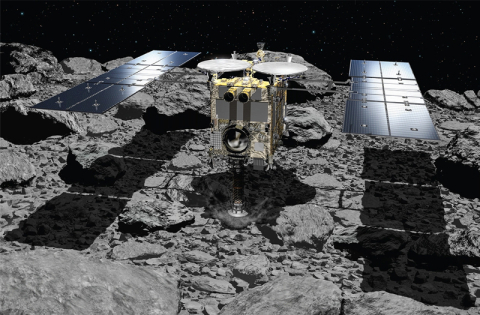
Researchers used the powerful X-rays at the Advanced Light Source to analyze a sample from the asteroid Ryugu.
Stony Brook professor Anatoly Frenkel is part of a team that has uncovered new details of the reversible assembly & disassembly of a platinum catalyst
Theoretical physicists and experimentalists worked together to measure the mass of a rare isotope expected to form a rare proton halo.
University of New Hampshire chemistry Ph.D. candidate Charles Wilson has been awarded funding to study at Brookhaven National Lab.