



RSS
Research focused on the quantum structure of elements under extreme conditions has implications for understanding Earth's evolution.
Scientists have shown that they can use neutrons to measure strain in a material as it evolves and track how atoms move in response to stress.
The U.S. Department of Energy (DOE) announced $11.4 million for six projects in quantum information science (QIS) with relevance to fusion and plasma science.
A new Northwestern University-led study is changing the way astrophysicists understand the eating habits of supermassive black holes.
An extensive computational study has introduced a novel concept to be used to identify molecules with targeted physical and/or chemical properties.
The grant is awarded to the institutes with the aim of recruiting students from diverse backgrounds into the science and technology fields.
Researchers are preparing to leverage Argonne’s exascale supercomputer to model the behavior of materials at an unprecedented level of detail.
Three Kavli Institute for Particle Astrophysics and Cosmology (KIPAC) researchers share what they’re most excited for in years to come.
Of all the factors affecting future snowpack, the biggest in the study were temperature and the effect of dark particles like pollution and dust.
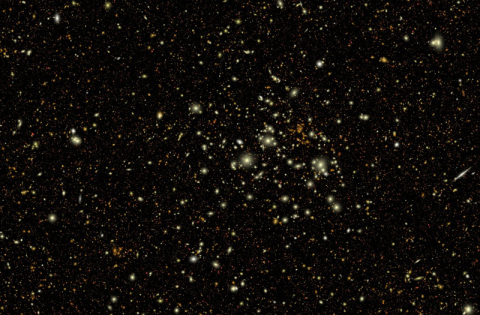
Scientists have developed simulations of millions of galaxies to help them accurately interpret data from future state-of-the-art telescopes.