



While carbon dioxide fluxes from microbial activity within shallow soils (< 1-m (3 ft) depth) are well studied, relatively little is known about
Biological and Environmental Research
July 28, 2016 Estimated Read Time min
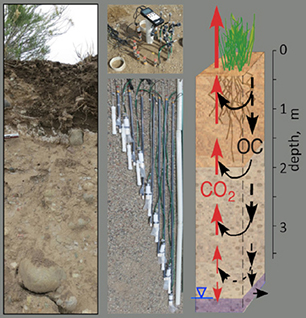
The Science
Most carbon dioxide emissions to the atmosphere come from plant roots and microbes that are found in the top 1 meter (approximately 3 feet) of the soil surface. However, deeper down, a large inventory of carbon supports an abundance of microorganisms that also release carbon dioxide. In this study, scientists built vertical profiles of carbon dioxide concentrations measured from the soil surface down to the water table in a semiarid floodplain. They determined microbes well below the rooting depth and above the water table contribute a significant amount of carbon dioxide to the total atmospheric emissions from the floodplain.
The Impact
Approximately 17% of the surface carbon dioxide flux originates from depths between 2 and 3.5 meters (approximately 7 to 11 feet). These contributions are not typically accounted for in Earth system models. Adding these contributions would allow scientists to better understand how the Earth system works.
Summary
While carbon dioxide fluxes from microbial activity within shallow soils (
Contact
BER PM Contact
David Lesmes, SC-23.1, 301-903-2977
PI Contact
Susan Hubbard
Lawrence Berkeley National Laboratory
sshubbard@lbl.gov
Funding
This work was supported by the U.S. Department of Energy, Office of Science, Office of Biological and Environmental Research, Subsurface Biogeochemical Research program.
Publications
T.K. Tokunaga, Y. Kim, M.E. Conrad, M. Bill, C. Hobson, K.H. Williams, W. Dong, J. Wan, M.J. Robbins, P.E. Long, B. Faybishenko, J.N. Christensen, and S.S. Hubbard, "Deep vadose zone respiration contributions to carbon dioxide fluxes from a semiarid floodplain ." Vadose Zone Journal 15(7) (2016). [DOI: 10.2136/vzj2016.02.0014]
Highlight Categories
Performer/Facility: DOE Laboratory