



This entry in the Basic to Breakthrough series describes how the Department of Energy has supported stellarator designs that could help harness the power of the stars here on Earth.
May 28, 2026 Estimated Read Time min
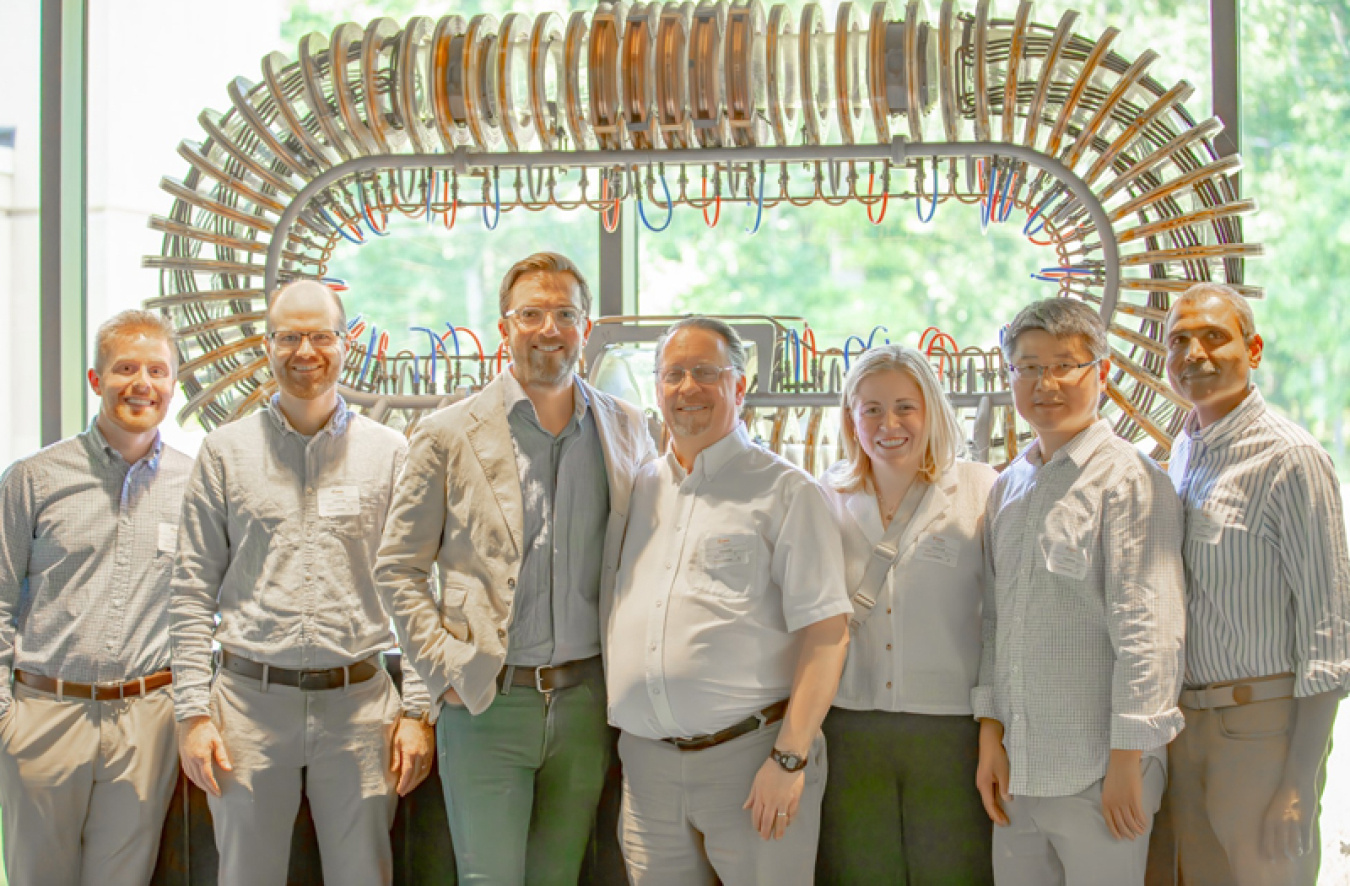
The Basic to Breakthrough series chronicles how investments from the Department of Energy’s (DOE) Office of Science at our National Laboratories have led to new technologies that are changing our world.
Fusion reactions power our sun and other stars. Studying those reactions and recreating them in the laboratory helps physicists understand the forces that shape our universe. That basic research may also lead to fusion energy technology that could generate limitless energy on Earth.
To create fusion reactions, physicists use several types of devices. Two of these — stellarators and tokamaks—mimic the stars. They use powerful magnetic fields to squeeze together light elements. These experiments turn light elements into plasma, the hot, charged state of matter filled with free electrons and atomic nuclei.
The DOE has been building the research foundations that support fusion technology for decades. The history of stellarators goes back to 1951 at Princeton University, when physicist Lyman Spitzer came up with the idea for them. He launched a laboratory to develop a device that would reproduce the same fusion process that drives the sun and stars. But stellarator development hit serious snags. It ended up taking a back seat to a magnetic invention called a tokamak, which was developed in the late 1960s. Tokamaks produce more energy than stellarators because their donut shape confines plasma more tightly. As a result, tokamaks have dominated most fusion-related experiments for decades.
However, tokamaks can experience internal disruptions that can damage the devices’ interior walls. With new improvements in technology, stellarators may offer a promising alternative.
Now, DOE’s Princeton Plasma Physics Laboratory (PPPL) and startup company Thea Energy (formerly Princeton Stellarators) are working to bring Spitzer’s vision for stellarators to reality.
One of the major barriers that this research team has faced is that building magnets for stellarators had previously been impractical. They require highly precise spaghetti-like coils that wrap around the plasma.
“The best performing stellarator coils since the 1980s have been extremely complicated,” said Charles Swanson, a former PPPL physicist who manages the design of Thea Energy’s devices. Such coils are by far the costliest and most difficult components in stellarators to produce.
At first, Thea Energy attempted an alternative approach using magnets, with the research supported by the DOE’s Advanced Research Projects Agency-Energy (ARPA-E) and the Office of Science’s Fusion Energy Sciences program. Unfortunately, that approach proved impractical and too expensive.
After analyzing what went wrong, the company is now pursuing a solution that simplifies these coils, with the support of the Fusion Energy Sciences program. “We’ve reinvented the stellarator with no more wiggly coils,” Gates said of the startup’s approach. “We can replace twisting coils with flat coils and vary their currents. So, we’ve taken the complexity out of the coils and put it into the control system.”
Other investments from the Fusion Energy Sciences program have also led to improvements in stellarator design. In particular, U.S. scientists have long contributed to research at the W7-X stellarator facility in Germany. The international team at that facility has found ways to improve the magnetic field that confines plasma in stellarators. As a result, this partnership has improved stellarators’ thermal confinement. It’s now on par with tokamak devices.
Researchers at PPPL are also using the lab’s computational science expertise and powerful supercomputers to fine-tune and test computer codes that explore the complexities of plasma.
Future collaborations between Thea Energy and PPPL will aim to investigate the use of machine learning and artificial intelligence algorithms for real-time control of the stellarator’s magnetic configurations. The startup – which is part of the Fusion Energy Science’s Milestone-Based Fusion Development Program – aims to put stellarator-generated electricity on the grid in the mid-2030s.
This article was created in partnership with Princeton Plasma Physics Laboratory – learn more about their work on PPPL’s website.