



The evolution of a sandstone’s texture, structure, and stress was measured during deformation for the first time.
March 10, 2026 Estimated Read Time min
The Science
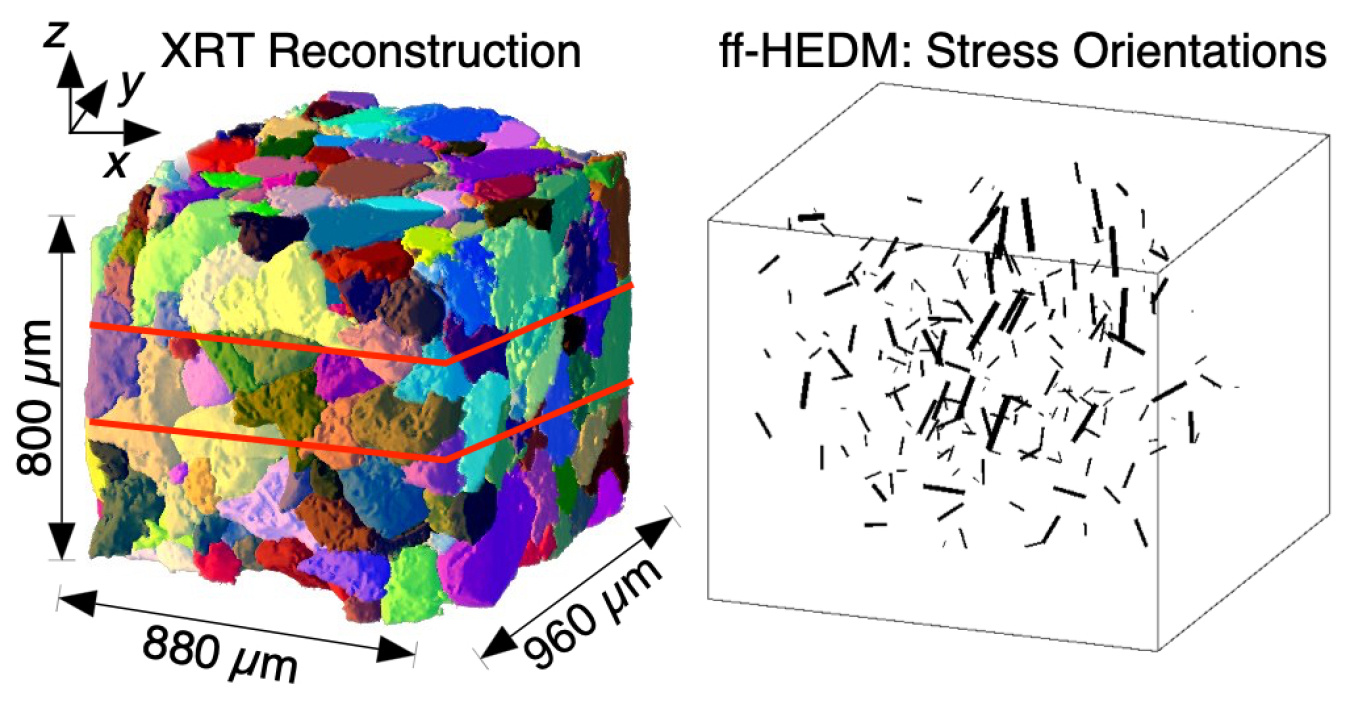
The researchers used a unique combination of X-ray tools to visualize exactly how rocks fracture in 3D. They measured the stresses in the sample as materials were loaded onto it. By making measurements over time as the sample compressed, the team determined exactly how stresses and structure evolve prior to and during the fracturing process. The results revealed that sandstone undergoes stresses like those in granular media, such as compressed sand. It also showed that pores closed in the direction of loading and opened in other directions. This information provides new ways of interpreting rock deformation and interactions between rocks and grains.
The Impact
How rocks fracture controls how fluid flows through them. In the case of sandstone, how it fractures influences a variety of applications that interact with sandstone, such as oil extraction and waste storage. Fractures also control geophysical processes like earthquakes. The tools the team used can be used by others to study how rocks fracture in specific applications. This work provides a blueprint for studying how a rock’s texture, structure, and stresses control and respond to compression and fracture events.
Summary
The researchers performed the experiment at the Advanced Photon Source (APS), a DOE Office of Science synchrotron User Facility. Before compressing the sandstone sample, the team used near-field high energy diffraction microscopy (nf-HEDM), far-field HEDM (ff-HEDM), and X-ray tomography (XRT). With these tools, the team fully characterized the sample’s crystal orientations, stress state, and microstructure. The researchers then mechanically compressed the sample while using ff-HEDM and XRT measurements to monitor changes in structure and stress state. nf-HEDM measurements revealed crystal misorientations in grains at an unprecedented level of detail. It highlighted that larger grains have more internal misorientation due to surface cements. ff-HEDM measurements (stress mapping) showed that compressive stresses throughout the sample progressively aligned with the loading direction. In contrast, tensile stresses aligned orthogonal to the loading direction to resist sample failure. Finally, XRT measurements revealed pores closed in the loading direction and opened normal to the loading direction.
Contact
Ryan Hurley
Johns Hopkins University
rhurley6@jhu.edu
Funding
The experiments and personnel effort were supported by the U.S. Department of Energy (DOE), Office of Science, Office of Basic Energy Sciences, Geosciences program. Development of some software used in data analysis was supported by a Johns Hopkins University Catalyst Award. Experiments were performed at the Advanced Photon Source (APS) beamline ID-1, a DOE Office of Science User Facility.
Publications
Hurley, R. C., Tian, Y., Thakur, M. M., et al. Crystallographic texture, structure, and stress transmission in Nugget sandstone examined with X-ray tomography and diffraction microscopy. Journal of Geophysical Research: Solid Earth, 130, e2025JB031690. (2025) [https://doi.org/10.1029/2025JB031690]
Related Links
- New insights into how rocks behave under stress, EOS Highlight
- 3D X-ray study reveals how rock grains move and stress builds, JHU HUB
- 3D X-ray methods reveal sandstone structure and behavior, Argonne National Laboratory news