




Program Overview
The U.S. Department of Energy’s Small Business Innovation Research (SBIR) and Small Business Technology Transfer (STTR) programs are competitive non-dilutive funding programs that support American small businesses in developing innovative technologies with strong commercial potential.
The DOE recently consolidated the management of the SBIR/STTR programs to the Office of Technology Commercialization (OTC), reflecting DOE’s focus on moving taxpayer-funded research toward real-world impact. The SBIR/STTR programs align directly with OTC’s mission to accelerate commercialization, streamline innovation pathways, and strengthen engagement between small businesses and the DOE National Laboratory system. This transition reinforces DOE’s commitment to improving operational efficiency and investing in technological advancements towards energy dominance. Additional resources and program information will be added to this site as program updates are finalized.
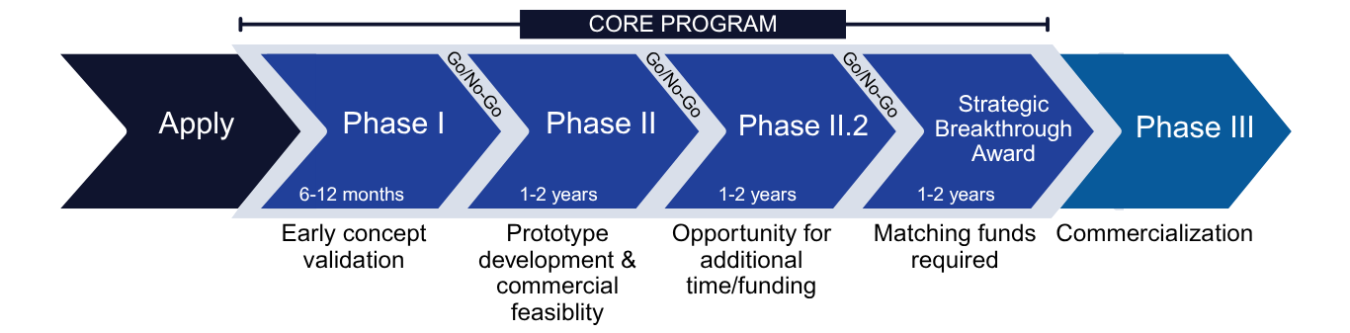
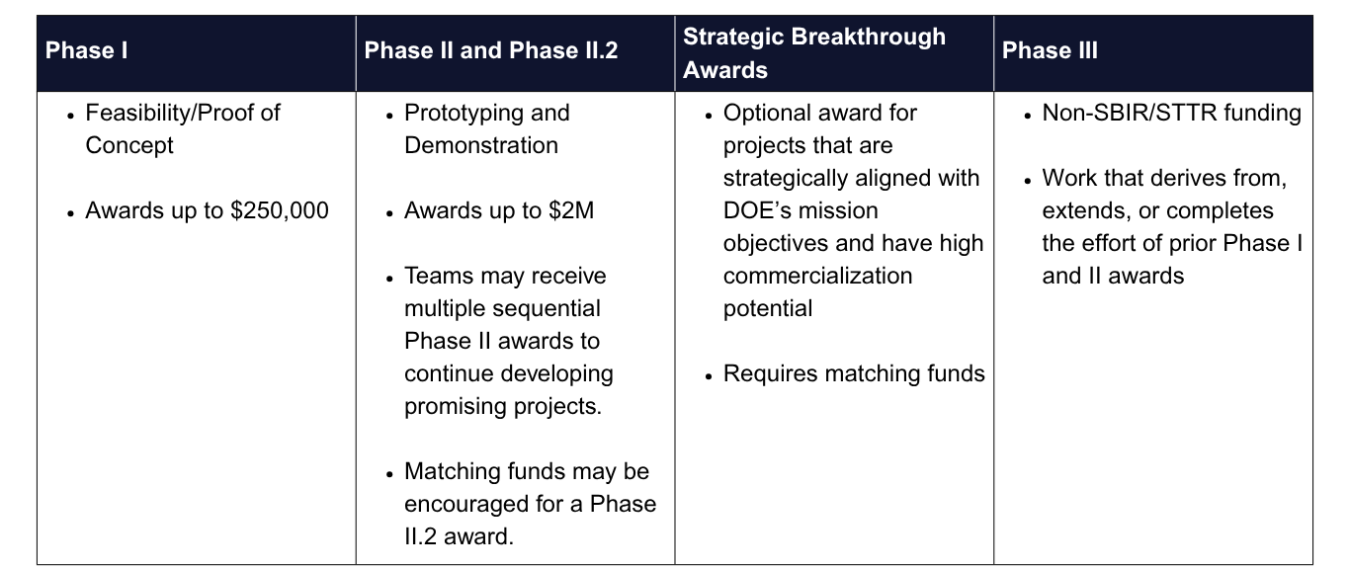
SBIR and STTR are congressionally authorized programs that reserve a portion of federal research funding for U.S. small businesses. Through a competitive, phased process, companies receive funding to establish technical feasibility (Phase I), further develop and prototype their technology (Phase II), and pursue commercialization and follow-on opportunities (Phase III). Participation is limited to for-profit U.S. small businesses that meet Small Business Administration eligibility requirements. DOE coordinates its SBIR/STTR implementation with the U.S. Small Business Administration.
The Small Business Innovation and Economic Security Act (S. 3971) was signed into law on April 13, 2026. This Act extends the SBIR/STTR Programs through Fiscal Year 2031.
Opportunities
FY26 Phase I Genesis Mission Opportunity
DOE announced the opening of the FY26 Phase I Genesis Mission SBIR/STTR opportunity on July 22, 2026. These projects will support an anticipated 40 awards across the following four Genesis Mission-focused topic areas:
- Scaling the Biotechnology Revolution
- Realizing Quantum Systems for Discovery: AI for Quantum Computing and Networking
- Designing Materials with Predictable Functionality
- Achieving AI-Driven Autonomous Laboratories
Submissions to this opportunity are now closed. This initial release precedes a broader Phase I funding opportunity expected later this fall.
FY25 Phase II Opportunity
DOE opened approximately $147 million in FY25 SBIR/STTR Phase II funding opportunities on July 22, 2026, supporting eligible small businesses as they continue advancing technologies toward commercialization. Eligible recipients of DOE SBIR/STTR Phase I, Phase II, and Follow-on Phase II awards from prior fiscal years will receive direct outreach with application requirements and timelines.
Program Structure
FAQs
DOE has several planned SBIR-STTR announcements this year:
- Opening for applications to Phase II topics
- Opening for applications to some Phase I topics
- Opening for applications to additional Phase I topics
No, currently active projects will not be impacted by this change. All projects awarded prior to March 2026 will continue under the same points of contact.
Yes, recipients of Phase I awards will be able to apply for Phase II awards. Stay tuned for updates by subscribing to the OTC SBIR/STTR newsletter.
DOE SBIR/STTR topics are drawn from the mission areas of the Department. DOE offers opportunities annually. Future SBIR/STTR opportunities will address national challenges in advanced manufacturing, biotechnology, critical materials, quantum information science, semiconductors, energy innovation, and more.
The SBIR program was established by Congress in 1982 [Public Law 97-219]. It major goals are to:
- Stimulate technological innovation
- Use small business to meet Federal R/R&D needs
- Increase private sector commercialization of innovations derived from Federal R/R&D, thereby increasing competition, productivity, and economic growth
The STTR program was established by Congress in 1992 [Public Law 102-564]. Its major goals are to:
- Stimulate and foster scientific and technological innovation through cooperative research and development carried out between small business concerns and research institutions
- Foster technology transfer between small business concerns and research institutions
DOE is committed to continuous program improvement. You can email SBIR and STTR program feedback and recommendations to sbir-sttr@hq.doe.gov.
Explore the links below to learn about other DOE funding opportunities.
- American Made Challenges incentivizes innovation through prizes, training, teaming, and mentoring, connecting the nation’s entrepreneurs and innovators to America’s national labs and the private sector.
- ConnectWerx administers critical energy opportunities to heighten energy security and strengthen national security ecosystems.
- EnergyWerx facilitates discovery, engagement, and acceleration of energy innovation to strengthen national security and energy resiliency.
- TechWerx is a hub that connects visionaries, researchers, industry and energy leaders with the opportunities for technological advancement.
Resources
-
 Key resources for applicants to the DOE SBIR/STTR programs.July 21, 2026
 -
 An overview on combating, understanding, and reporting SBIR/STTR fraud.July 20, 2026
 -
 There are three essential registrations that small businesses must complete to apply for an SBIR or STTR award.August 13, 2026
 -
 In the SBIR and STTR Extension Act of 2022 and the Small Business Innovation and Economic Security Act of 2026, Congress established requirements for Federal agencies to create a due diligence program to assess security risks in the SBIR/STTR programs.July 31, 2026
-
 Commercialization is a central goal of the DOE SBIR/STTR programs. This page lists resources to help foster success.July 31, 2026
 -
 Program policy factors may be considered in determining funding recipients, in addition to the expert scores and comments.July 21, 2026
 -
 The team that the small business assembles for their SBIR/STTR application is crucial and should demonstrate to the reviewers that the applicant has the necessary expertise, experience, and ability to carry out the proposed project.July 21, 2026
 -
 Phase III awards are fundamentally different from Phase I and II awards.July 21, 2026
Stay Connected!
DOE will continue to share updates, funding opportunities, and program announcements as the transition to the Office of Technology Commercialization progresses. Sign up to receive email updates and notifications about future funding opportunities and program resources.