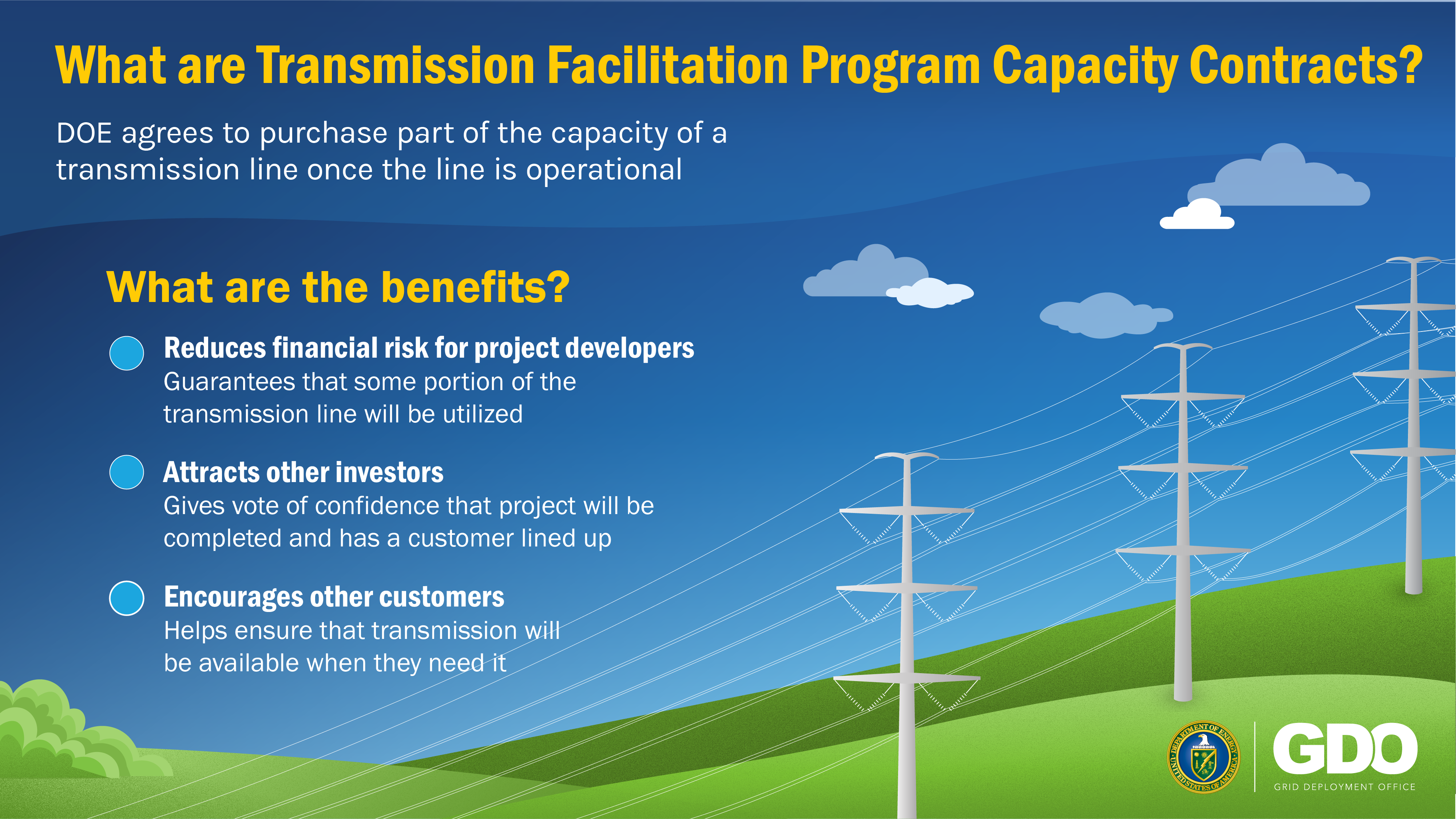
The U.S. Department of Energy (DOE) has developed a $2.5 billion Transmission Facilitation Program (TFP) that will help build out new interregional transmission lines across the country. The TFP is a revolving fund program that will provide Federal support to overcome the financial hurdles in the development of large-scale new transmission lines and upgrading existing transmission as well as the connection of microgrids in select States and U.S. territories.
Financing Tools
Under the TFP, DOE is authorized to borrow up to $2.5 billion through three financing tools:
- Capacity contracts with eligible projects where DOE would serve as an “anchor customer” to buy up to 50% of planned line rating for up to 40 years and to sell the contract to recover costs
- Loans from DOE
- DOE participation in public-private partnerships within a national interest electric transmission corridor (NIETC) and necessary to accommodate an increase in electricity demand across more than one state or transmission planning region
TFP is best fit for projects that are nearly “shovel ready” and are in regions that rely on firm point-to-point transmission. TFP is designed for projects that would otherwise not be constructed without support. TFP will not include projects that already are fully subscribed or have a fully allocated source of revenue.
Selections
Capacity Contracts
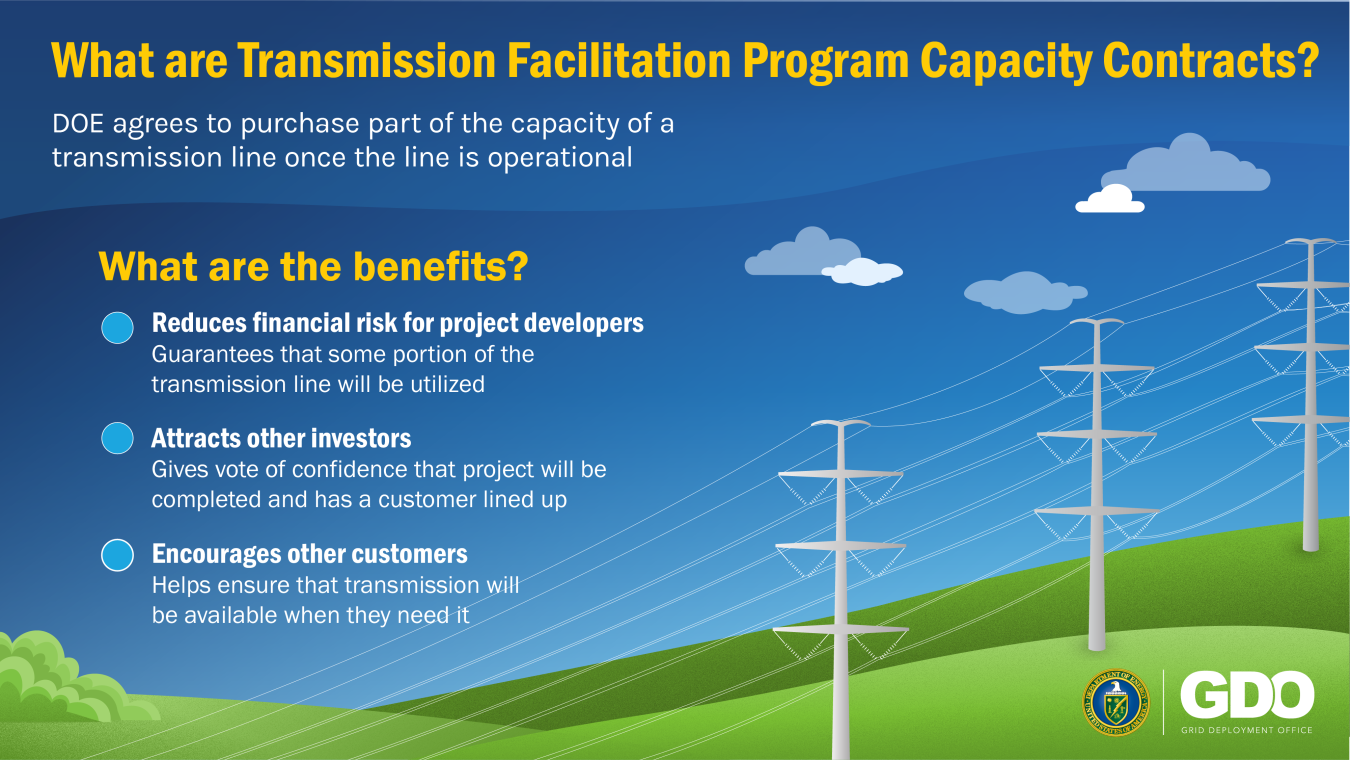
Through capacity contracts, DOE will commit to purchasing a percentage of the total proposed capacity of the eligible transmission line. By offering capacity contracts, DOE increases the confidence of additional investors, encourages additional customers to purchase transmission line capacity, and reduces the overall risk for project developers.
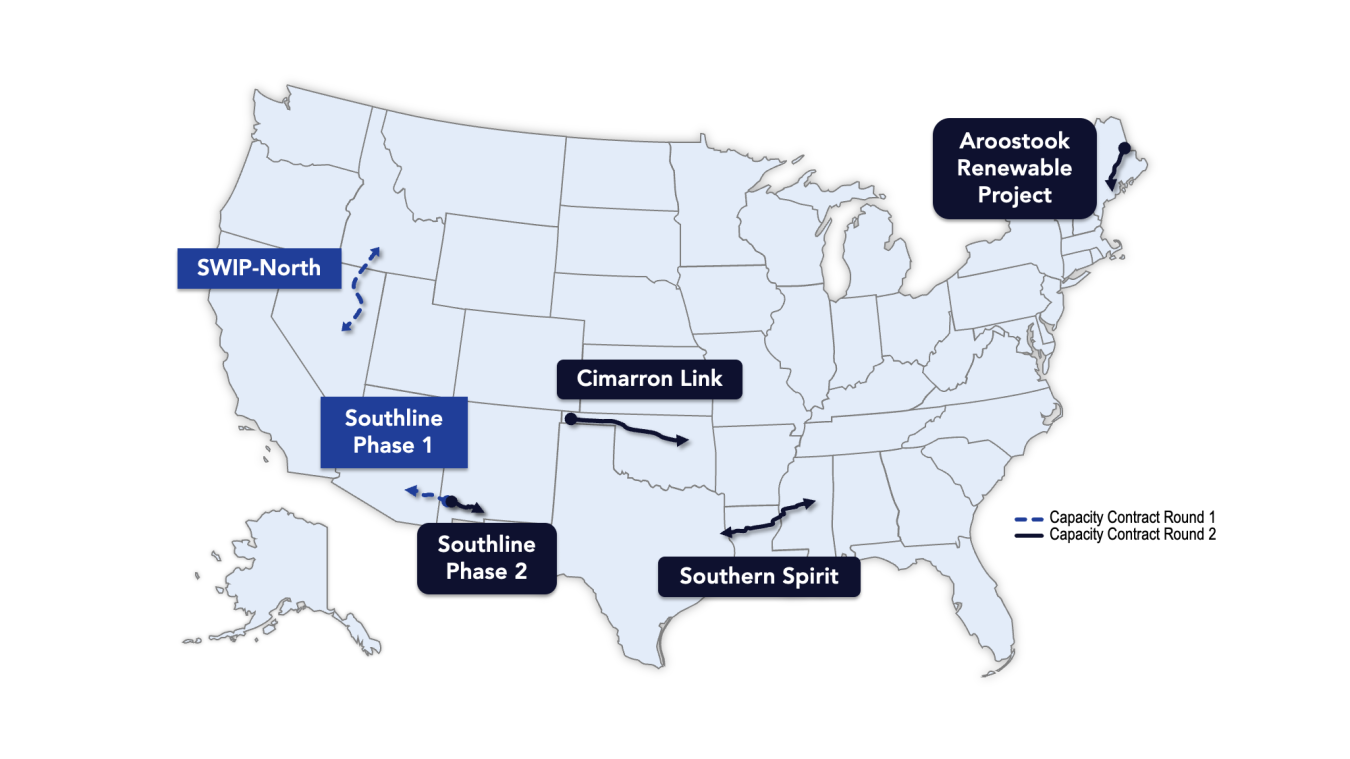
On October 3, 2024, DOE selected four transmission projects for conditional capacity contract awards. This round of capacity contract selections represents a total DOE commitment of approximately $1.5 billion. The projects selected will enable nearly 1,000 miles of new transmission development and 7,100 MW of new capacity throughout Louisiana, Maine, Mississippi, New Mexico, Oklahoma, and Texas.
On October 30, 2023, DOE announced that it is entering into capacity contract negotiations with three transmission projects across six states aimed at adding 3.5 GW of additional grid capacity and creating more than 13,000 direct and indirect jobs. On April 25, 2024, DOE also announced the selection of one additional conditional project from the first round of capacity contract applications. All three projects from the first round have signed facilitation agreements with DOE.
Frequently Asked Questions
What are some of the important features of the Transmission Facilitation Program (TFP)?
TFP is designed to allow DOE to invest in transmission projects to help accelerate their deployment and/or increase their capacity while also allowing DOE to eventually recoup its costs. DOE will use project proceeds to replenish its borrowing authority and support additional projects in the future. DOE has three different funding mechanisms available to use under TFP: capacity contracts, public-private partnerships, and loans. DOE has the flexibility to select which tool to use based on near- and longer-term opportunities and market conditions.
How will DOE prioritize TFP projects and address the need for transmission to ensure reliability and resilience, lower consumer costs, and support electricity sector decarbonization?
In identifying projects to support under the TFP, Congress required DOE to prioritize projects that meet certain objectives. Specifically, eligible projects must demonstrate sufficient viability to enable DOE to recover its costs in a timely manner; cost recovery will permit DOE to replenish TFP’s revolving fund and offer support to additional eligible projects. Within the broader mandate to accelerate the delivery of transmission service projects, the statute also directs that the TFP prioritize projects that promote the public interest by delivering beneficial grid outcomes to the maximum extent practical, specifically projects that use technologies that enhance the capacity, efficiency, resiliency, or reliability of the bulk electric system; improve the resilience and reliability of the system; facilitate interregional transfer capacity that promotes economic growth; and contribute to national or subnational goals to lower electricity sector greenhouse gas emissions.
Can TFP support be combined with other federal programs and funding?
TFP funding can be used with other sources of funding. However, projects will need to confirm with the other federal programs if their rules allow using other funding sources.
Can TFP be used to fund the construction of generation resources or microgrids?
No, TFP facilitation is limited to (i) eligible electric power transmission lines and (ii) eligible projects that connect an isolated microgrid to an existing infrastructure corridor located in Alaska, Hawaii, or a territory of the United States, in accordance with 42 U.S.C. 18713(a).
Can TFP be used to fund battery projects?
No, TFP is limited to (i) eligible electric power transmission lines and (ii) eligible projects that connect an isolated microgrid to an existing infrastructure corridor located in Alaska, Hawaii, or a territory of the United States, in accordance with 42 U.S.C. 18713(a).
Can TFP be used to fund cybersecurity projects?
No, TFP is limited to (i) eligible electric power transmission lines and (ii) eligible projects that connect an isolated microgrid to an existing infrastructure corridor located in Alaska, Hawaii, or a territory of the United States, in accordance with 42 U.S.C. 18713(a).
What happens to conditional funds if a project withdraws from Capacity Contract negotiations or contract negotiations are otherwise not finalized?
DOE does not formally commit any funding when it announces a conditional selection for TFP. Instead, DOE enters into contract negotiations with the selectee. If a selectee withdraws from contract negotiations, DOE can repurpose the funding for another TFP project.
DOE will set aside or “obligate” the total value of the award to a project when it completes contract negotiations and signs the contract with the selectee. The applicable contract will specify when DOE actually expends funds. For example, DOE will not be obligated to pay for transmission service under a capacity contract award until construction of the transmission line is complete and the transmission line is energized and ready to provide electric transmission service. In the case of a public-private partnership, the partnership agreement will specify when DOE must expend funds and what work DOE will pay for. In either structure, DOE expects to exit the project and terminate its commitment when the transmission provider has secured sufficient commitments from new customers or other funding sources and DOE is no longer needed for the project to move forward.
What happens when the $2.5 billion revolving fund is obligated to projects?
DOE will continue to evaluate the TFP revolving fund balance and availability of funds for deployment and will seek to support additional projects when sufficient funding is available.
How much money is DOE committing in total through the second TFP capacity contracts RFP and to each selectee?
As of September 2024, the total amount that DOE is committing through the second TFP capacity contracts RFP and the public-private partnerships Connecting Microgrids RFP is $1.5 billion to five selectees.
Why did DOE proceed with a second round RFP for capacity contracts?
DOE sought to build on the success of the first round to capitalize on the familiarity with this offering as well as the lessons learned to accelerate transmission project deployment. DOE received significant interest in the first round and positive feedback from stakeholders to continue the program. DOE released another RFP for transmission infrastructure that connects isolated microgrids to the grid in Alaska, Hawaii, and U.S. territories to continue to build out the program offerings.
Why did DOE require that capacity contract applicants for the second round RFP commit to commence construction by December 2029?
DOE’s priority is to deploy funding for projects that are near shovel-ready. The 2029 construction commencement date balanced the goal of timely deployment with a reasonable amount of time for the project developer to complete design, permitting, financing and other activities required to begin construction.
When will DOE announce further opportunities for financing under the TFP?
The TFP $2.5 billion revolving fund is now nearly fully obligated or in contract negotiation. Future funding opportunities will be available when DOE exits those capacity contracts or public-private partnerships, a sufficient amount has been de-obligated for additional awards, and those funds are otherwise available.
Why were the awarded projects selected?
The chosen transmission projects were selected based on a rigorous evaluation process and criteria outlined in the Request for Proposals. Of the many strong projects that applied, these projects were chosen because applicants demonstrated how the TFP capacity contract would help accelerate the projects’ development and advance these overarching program goals:
- Projects are likely to be economically viable enabling DOE to recover its costs associated with the project for taxpayers.
- Projects advance DOE goals to increase renewable energy and interregional transfer capabilities.
As the demand for transmission grows across the country, what is the impact and goal of federal financial assistance to support the development of these projects?
Transmission projects face several challenges, including financial viability. Transmission infrastructure financing relies on demonstrating to potential investors that the transmission line has committed transmission service customers. But customers cannot always commit until they are confident a project will be developed and available when needed. DOE’s commitment helps catalyze demand by establishing DOE as an anchor customer who can provide confidence in the project for potential financers and other customers.
What percentage of the planned capacity will be used for clean energy?
The projects were selected because of the important role they are expected to have in bringing clean energy to the populations that need these clean resources while also bolstering reliability and improving resilience and overall interregional connectedness of the grid.
When does DOE expect these projects to get built?
The selected projects for the first TFP RFP must begin construction no later than the end of 2027. All projects anticipate being able to begin construction earlier, from the beginning of 2025 to the first half of 2026. A transmission project can be expected to be completed and begin transmitting electricity within 2 to 4 years after commencement of construction.
What type of benefits does DOE foresee with these projects? How will DOE hold developers accountable for community-related commitments?
Each application included commitments to invest in the communities hosting transmission projects and to invest in job creation. DOE will hold selectees responsible for fulfilling these commitments and successfully meeting the metrics they outlined in their applications. During the duration of construction, DOE will monitor each selectee’s progress toward meeting their community investment and job creation commitments. Successful implementation of community engagement goals will be a binding contract commitment of each project.
How much money did DOE commit to each selectee?
The total amount that DOE is committing for the three projects selected in the first round RFP as of April 2024 is approximately $1.03 billion. For the Southline project, Southline Transmission, LLC is contracted for $477 million; for the Cross-Tie project, Transcanyon Western Development, LLC is contracted for about $226 million; and for the SWIP-N project, GBT Northbound, LLC is contracted for $331 million.
When will DOE expend funds for these projects? How will DOE recover the funding?
DOE first negotiated a facilitation agreement with each selectee that establishes the conditions that must be met during the development period. When the relevant conditions are met, DOE and the transmission provider will enter into the capacity contract that memorializes the specific financial commitment that DOE is making. DOE has entered into facilitation agreements with selectees from the first round capacity contracts RFP as of September 2024. The parties will likely be in a position to sign the capacity contract prior to commencement of construction of the transmission line. However, DOE will not be obligated to pay for transmission service until construction of the transmission line is complete and the transmission line is ready to provide electric transmission service. DOE expects to exit the project and terminate its commitment prior to commercial operation when the transmission provider has secured sufficient commitments from new customers and DOE is no longer needed for the project to move forward. In that case, DOE will have not incurred any charges for transmission service. If the line is not fully subscribed by other customers by the time the line is finished and providing service, then DOE will begin making capacity contract payments. In that case, DOE will continue to seek a transmission service buyer to assume DOE’s capacity commitment and will also market its capacity on a short-term basis to recover its costs.
Have selected projects already been through relevant federal, state, and local regulatory and permitting processes?
The projects are in different phases of their permitting. Each selected project must successfully complete its permitting to move to construction and operation.
Why do projects need to commence construction by December 2027?
It is a program priority to deploy funds quickly, by facilitating projects that are close to ready for construction. The December 2027 construction commencement date balances the goal of timely deployment with a reasonable amount of time for the project developer to complete design, permitting, financing and other activities required to begin construction.
What is a capacity contract?
A capacity contract, also referred to as a transmission services agreement, is an agreement under which the transmission customer agrees to pay for the right to use the capacity of a transmission line for a set number of megawatts of electricity and for a set contract term at an agreed upon price. A capacity contract allows a transmission customer to move electricity from the area where the electricity is produced, across the new transmission line, to the market where consumers will use the electricity.
Image
Why does DOE want to purchase capacity?
Under the TFP, DOE purchases capacity as a way of supporting the project and providing a firm commitment to incentivize project lenders and other customers to commit to the project. The capacity contract provides certainty to the developer and reduces their risk as they move the project forward.
What type of projects can apply for these contracts?
For purposes of this RFP, an eligible project means an electric power transmission line that is capable of transmitting not less than (1) 1,000 megawatts (MW); or (2) in the case of a project that consists of upgrading an existing transmission line or constructing a new transmission line in an existing transmission, transportation, or telecommunications infrastructure corridor, not less than 500 MW. Transmission projects to connect isolated microgrids in Alaska, Hawaii, and the U.S. territories are not being considered as eligible projects for awards under the capacity contract RFPs because capacity contracts do not align with the ownership, technical, and commercial characteristics of microgrid connection projects.
Can a TFP capacity contract be used for reconductoring projects with advanced conductors?
TFP capacity contracts can be used if (1) the reconductoring of a transmission line with advanced conductors increases the commercial capacity of the project by at least 500 MWs; and (2) the increase of capacity is made available to the market for transmission service. For more information, the Grid and Transmission Program Conductor is a clearinghouse for financing programs, as well as other existing DOE transmission and grid programs. Please visit the website to learn more about other programs, including the potential for reconductoring, which offer additional funding opportunities.
How will TFP capacity contract selections interact with existing planning processes?
Prior to entering into a capacity contract, DOE is required to consult with the relevant transmission planning region regarding the transmission planning region's identification of needs. In selecting projects for capacity contracts, DOE intends to minimize, to the extent possible, duplication or conflict with the transmission planning region's needs determination and selection of projects that meet such needs.
Is a National Environmental Protection Act (NEPA) review required for entry into a capacity contract?
NEPA is not triggered by DOE’s entry into and performance of a capacity contract with the project developer. However, the use of a capacity contract does not avoid any other applicable NEPA or other federal, state, or local permitting requirements applicable to the project.
Can TFP capacity contracts be used for offshore wind transmission projects?
Yes. An offshore wind transmission project may be an eligible project and can submit an application for a capacity contract if it meets the requirements established in the RFP.
How do capacity contracts entered into by DOE under the TFP help speed the development of needed transmission projects?
Capacity contracts are a tool provided by Congress through the TFP to help provide revenue certainty to projects. This allows eligible projects that need such revenue certainty to move forward in the near term to construct the project and/or to add capacity that is anticipated to be needed in the future. DOE’s commitment to enter a capacity contract also plays an important role in providing certainty and confidence to other customers to enter into capacity contracts with the project and to financial entities to finance the project. TFP capacity contracts are designed to provide financial commitment for energization of this new transmission faster and potentially at greater capacity than the market might otherwise support while enabling DOE to recover its expenditures.
Is a TFP capacity contract designed to facilitate permitting?
No, a TFP capacity contract is not designed as a tool to assist with local, state, or federal permitting requirements.
Why did DOE proceed with a public-private partnerships RFP?
Congress identified public-private partnerships in the Transmission Facilitation Program (TFP) as an available tool to facilitate connecting isolated microgrids to existing infrastructure corridors to enhance grid reliability and resilience, and enable access to clean, diverse, and lower cost energy for communities in Alaska, Hawaii, and the U.S. Territories. The public private partnership developed through this RFP will be designed to address the unique electric grid configurations and challenges faced by consumers in these communities.
What is a public-private partnership as it’s defined under the Transmission Facilitation Program?
In a public-private partnership, DOE would be an equity investor in the project alongside the project’s existing owners. That means DOE would take an interest in the project commensurate with its contribution to the project. DOE may provide both technical assistance and capital to projects. DOE may also assist projects during the early stages of project development; for example, facilitating negotiations with relevant authorities or providing TFP funding for surveys or studies necessary for project development. For projects closer to the start of construction, DOE may also, for example, assist in reviewing the terms of material contracts, in addition to funding a repayable portion of the construction costs. Importantly, public-private partnerships under TFP are not grants, and before entering into an agreement, DOE must certify that there is a likelihood that funds will be recovered to invest in future projects.
What type of projects qualify as eligible projects under a TFP public-private partnership?
Consistent with the intent of Congress, a transmission project that connects an isolated microgrid to an existing transmission, transportation, or telecommunications infrastructure corridor located in Alaska, Hawaii, or a territory of the United States is eligible for TFP public-private partnerships under this RFP.
What entities are eligible to apply for public-private partnership funding under this RFP?
Any entity with an eligible project proposal may apply for a TFP public-private partnership. DOE recognizes that a wide variety of entities operate microgrids in eligible jurisdictions (including municipalities and other local, state and Federal bodies, cooperatives, and Tribal and native corporations), and DOE seeks to support the broadest possible range of participants and project structures.
What is an isolated microgrid? Can this funding be used to construct a microgrid?
An isolated microgrid is a group of interconnected electric loads and distributed energy resources that does not have a sustained or reliable connection to a larger-scale utility electric grid.
Public-private partnership funding under this RFP may only support transmission projects that connect an isolated microgrid to an existing transmission, transportation, or telecommunications infrastructure corridor located in Alaska, Hawaii, or a territory of the United States. For example, a proposed project that connects two or more isolated microgrids to each other through a proposed transmission project or a transmission project that facilitates emergency sectionalization/reenergization capability would be considered for this program, where the project includes the use of an existing infrastructure corridor at some point in its path.
These funds may not be used to construct a new microgrid or for the construction of or upgrades to generation or distribution infrastructure.
What is an infrastructure corridor?
An infrastructure corridor is a right-of-way for transmission facilities, or transportation or telecommunications infrastructure.
Are improvements to telecommunications facilities eligible for funding under this program?
A project that only makes improvements to telecommunications facilities would not be eligible under this program. However, a transmission project that connects an isolated microgrid to an existing infrastructure corridor could possibly include improvements to telecommunications facilities that have a relationship to the transmission project.
How will DOE recover funds under this program?
DOE is to determine that it has a reasonable likelihood of recovering the costs of its TFP activities under a public-private partnership. Applicants must include a cost recovery plan and/or financial model that demonstrates the ability for DOE to recover its funding under this program as part of their application, for example from revenues generated by the project in excess of its operating costs.
Can applicants use other federal funding, such as grant funding from the Grid Resilience and Innovation Partnerships Program (GRIP) or the Grid Resilience State/Tribal Formula Grant Program, to repay TFP funding they receive under this program?
The legislation authorizing TFP does not prohibit recipients from using other sources of state or federal funding to repay DOE for TFP funding. However, such funding sources, including the GRIP and State/Tribal Formula Grant Program, may have restrictions on how those funds can be used, which recipients must adhere to.
The Grid and Transmission Program Conductor can provide more information on grid-and transmission-related financing programs administered by DOE, as well as questions concerning the ability to pair different funding opportunities offered by DOE.
What does DOE mean by a cost recovery plan and how should applicants describe their project’s cost recovery plan?
Public-private partnerships are an opportunity for communities to make a long-term infrastructure investment. Before entering into a public-private partnership agreement, DOE must certify that there is a likelihood that its funds will be recovered, to invest in future projects. Per Appendix A, Section C of the TFP RFP, all applicants must identify a proposed cost recovery plan and/or provide a model to assist DOE in determining how and when DOE will recover its funding.
DOE has considerable flexibility over the partnership terms of its investment. Through the RFP, DOE is seeking high-level information from an applicant to understand what cost recovery form best meets the applicant’s community investment approach. Under the RFP, an applicant may wish to describe current sources of funding for infrastructure and how these may be used to support recovery of costs, or how additional sources of funding may be secured. The applicant may also wish to describe the preferred cost recovery timeline and any other details that illustrate how DOE’s costs would be successfully recovered. During due diligence, an applicant should anticipate working closely with DOE to provide additional project information, including information to further assist in determining DOE will recover its costs.
When does DOE expect these projects to be constructed?
DOE expects that the maturity of projects that qualify for this program varies widely and invites applications for projects within any stage of development, ranging from the initial planning stage to shovel ready, so long as the applicant can demonstrate the need for a public-private partnership to ensure project completion, consistent with the requirements included in this RFP.
What if a community doesn’t have a microgrid built yet but is anticipating building one?
Public-private partnership funding cannot be used to construct a microgrid itself; it can only be used to connect an isolated microgrid to an infrastructure corridor.
Why is this program limited to Alaska, Hawaii, and the U.S. Territories?
Alaska, Hawaii, and the U.S. territories experience unique challenges related to the electric grid and connecting isolated microgrids to infrastructure corridors can support community needs in many ways, including enhancing grid reliability and resilience and enabling access to clean, diverse, and lower cost energy.
Is a National Environmental Policy Act (NEPA) review required for entry into a public-private partnership?
Yes, DOE’s decision whether and how to distribute federal funds under this program is subject to NEPA review. All recipients selected for a public-private partnership will be required to assist in the timely and effective completion of the NEPA review process in the manner most pertinent to their project.