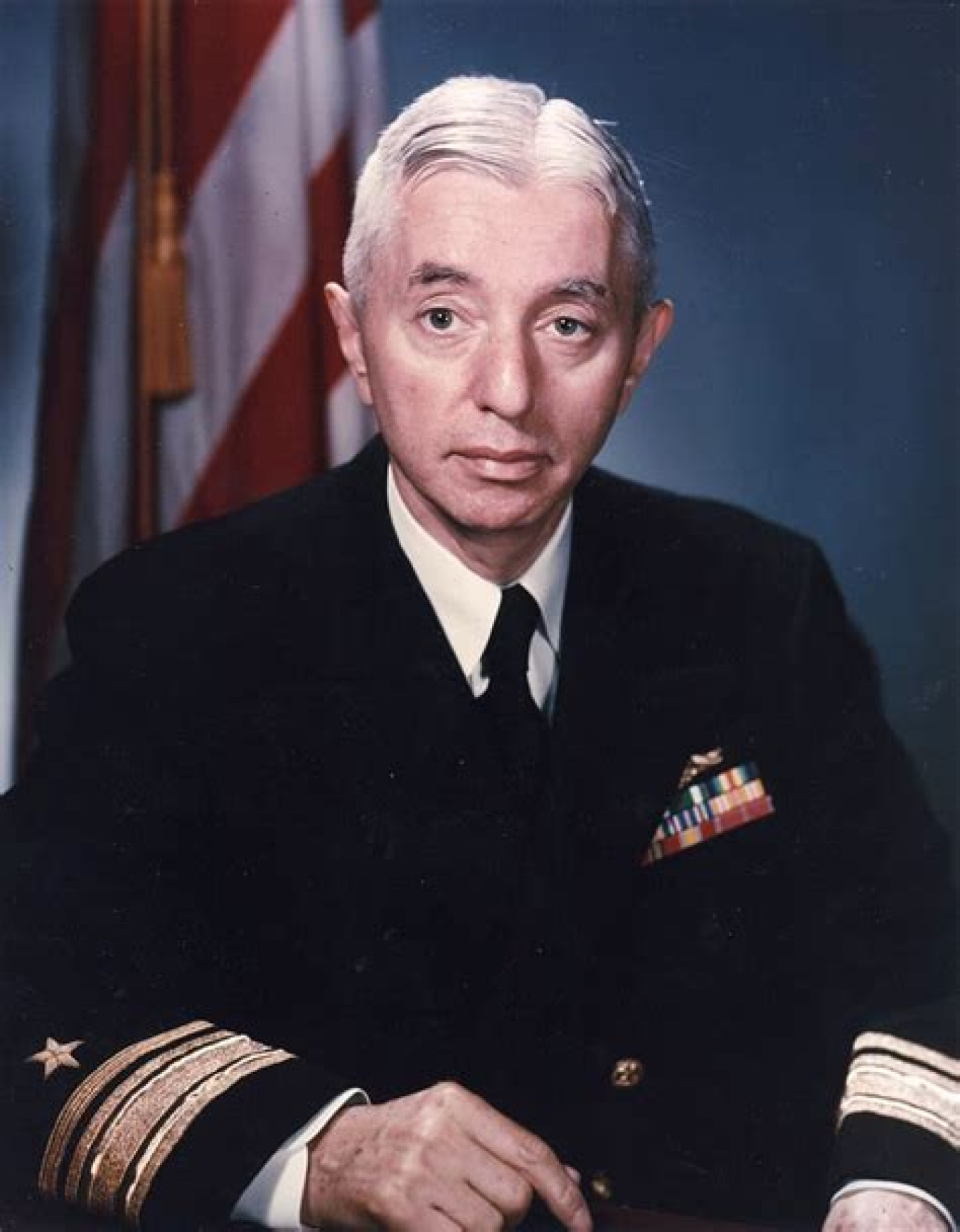
NNSA Administrator Brandon M. Williams pays tribute to Admiral Hyman G. Rickover, the pivotal figure in developing nuclear propulsion for the U.S. Navy recognized as the "Father of the Nuclear Navy", whose leadership and innovations significantly enhanced U.S. national security during the Cold War and beyond.
National Nuclear Security Administration
July 8, 2026 Estimated Read Time min
Admiral Hyman G. Rickover’s death 40 years ago today marked the passing of one of America’s national security titans, a man who shaped the future to his vision through sheer force of will. Together with J. Robert Oppenheimer, he was one of the chief architects of the nuclear age, ushering into being a new paradigm that remains a defining element of our nation’s defense.
As the “Father of the Nuclear Navy,” Rickover pioneered a technology no less revolutionary to nautical science than the sail, the keel, or the magnetic compass. In doing so, he assured the survivability of the United States’ second-strike force during the most perilous years of the Cold War, contributing indispensably to our country’s defense. That the American people passed unscathed through this period is due in no small measure to Rickover’s extraordinary prescience and tenacity.
As a former submarine officer, I am a product of Rickover’s nuclear Navy, and he has long been one of my personal heroes. His humble origins, commitment to excellence, and fervent devotion to the nation represent the very best of America. Today, as the Administrator of the National Nuclear Security Administration, I am responsible for supporting the U.S. Naval Nuclear Propulsion Program alongside the U.S. Navy, and my duty is to ensure the organization Rickover once led continues to be guided by the same timeless principles he championed.
Born Chaim Gdala Rykower in 1900, in what was then part of the Russian Empire, Rickover arrived in New York City at age six, fleeing antisemitic pogroms in Poland. He began working at age nine—for three cents an hour—and retired from the Navy at 82 only when forced to do so. Having worn the uniform for 63 years, his active-duty service remains the longest in American history.
Rickover graduated from the United States Naval Academy in 1922, beginning his career as a surface combatant before volunteering for submarine duty. In the decades that followed, he made his reputation as a master organizer and keen judge of talent, running progressively larger and more complex programs for the Navy. When Rickover appeared on Time magazine’s cover in 1954, the accompanying article distilled his essential quality as “a man who gets things done.”
On January 17, 1955, when the USS Nautilus slipped into the Thames River in Connecticut, the commander of the world’s first nuclear submarine signaled, “UNDERWAY ON NUCLEAR POWER.” This was the culmination of Rickover’s almost fanatical determination to eliminate two central shortcomings of earlier submarines. Diesel-electric subs were limited in range by the amount of fuel they carried and had to surface frequently to recharge their batteries, making them vulnerable to attack. Nuclear-powered submarines, by contrast, had virtually unlimited range and could stay submerged for long periods—at first days and later months at a time.
These qualities made nuclear-powered submarines ideal for assuring the nation’s ability to retaliate against a nuclear strike. At the time, the U.S. strategic community was gripped by fears of a surprise Soviet attack against our land-based nuclear deterrent. By 1960, American nuclear subs were conducting strategic deterrence patrols armed with Polaris missiles, and by the time of the Cuban Missile Crisis in 1962, the sea leg was an established pillar of the U.S. nuclear triad.
Today, the vast majority of U.S. nuclear weapons are deployed aboard ballistic missile submarines. Our nuclear-powered fast attack submarines are the ocean’s apex predators. And for more than six decades, America’s nuclear-powered aircraft carriers have provided sovereign bases at sea from which to launch unconstrained operations worldwide.
Since Rickover’s vision of a nuclear Navy became a reality, perhaps its most extraordinary attribute has been the emphasis on safety. In over 179 million miles steamed on nuclear power—almost twice the distance from the Earth to the sun—no American vessel has ever experienced a reactor accident, nor any radioactive release, that has harmed human health or the environment. This record is a direct outgrowth of Rickover’s perfectionism. When asked to explain his obsession with safety, he responded, “I have a son. I love my son. I want everything that I do to be so safe that I would be happy to have my son operating it. That’s my fundamental rule.”
Rickover personally interviewed every officer for the Navy’s nuclear program. The interrogations became legendary for his merciless grilling to test each candidate’s intellect and composure under pressure. He famously shortened the front legs of the interviewee’s chair, causing the individual to slide forward throughout the session and allowing the admiral to gauge his self-possession while uncomfortable. Rickover detested answers that he thought reflected an attempt to please him rather than express the candidate’s genuine views, prizing candor and logical thinking above all.
The result of this exacting process was a corps of officers and engineers of surpassing quality, and by extension a standard of safety and performance that established the benchmark for navies around the world. Yet, for all his talents, Rickover was a controversial figure. While deeply respected in the halls of Congress and among the American people for his brilliance and record of achievements, he was, to put it bluntly, widely despised within the Navy and the defense industry. Abrasive, harsh in his assessment of others, and unforgiving of mediocrity, Rickover made as many enemies as he did admirers.
Nevertheless, his imprint on the nuclear Navy is still ubiquitous even four decades after his death. Rickover’s insistence on the continuous advancement of technologies, methods, and materials is evident throughout the Naval Reactors program today, demonstrated by its maintaining preeminence in nuclear propulsion and maximizing operational readiness for the nuclear fleet. The culture of personal accountability that he instilled remains fundamental to the ethos of the organization.
Rickover was deeply philosophical, grappling with the moral complexity of his profession and arriving at sometimes startling conclusions. Upon his retirement, he pronounced nuclear-powered ships to be “a necessary evil” and suggested he would “sink them all.” He identified himself as “a great exponent of stopping this whole nonsense of war.” Yet, even as Rickover claimed, “I am not proud of the part I have played” in building the nuclear Navy, he acknowledged, “I did it because it was necessary for the safety of our country.”
Rickover’s self-image as a reluctant warrior is one that many of us at NNSA and in the nuclear Navy can identify with. In our philosophy, nuclear weapons and the nuclear-powered submarines that carry them are instruments of peace and stability rather than destruction and war. We maintain these weapons to deter our enemies, reassure our allies, and protect our people, with the solemn hope that they never have to be used. If we discharge this heavy responsibility with the same stoicism and fortitude as Hyman Rickover, we will have done the nation a tremendous service.
———
Brandon M. Williams serves as the Department of Energy’s Under Secretary for Nuclear Security and Administrator of the National Nuclear Security Administration.