



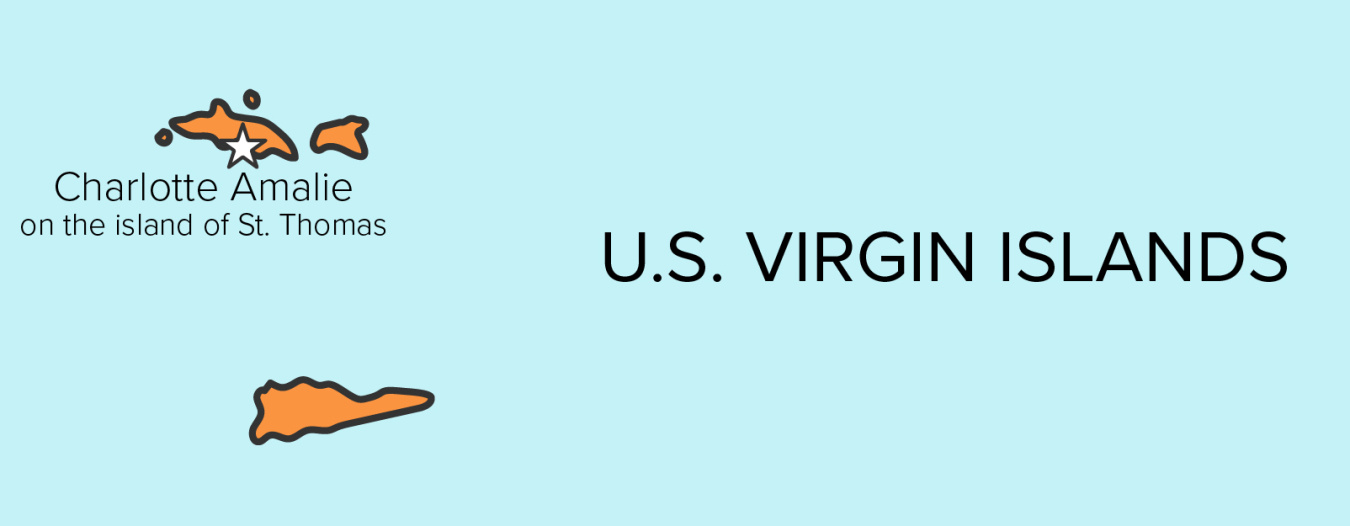
The U.S. Virgin Islands (USVI) consist of Saint Croix, Saint John, and Saint Thomas and 50 other surrounding minor islands and cays in the Caribbean making them continually exposed to extreme tropical storms and weather. In 2017, hurricanes Irma and Maria caused extensive damage to critical energy infrastructure, with many rebuilding and hardening efforts still ongoing. But USVI’s efforts to build more robust, reliable, and cost-effective power and water systems are often hindered by capacity constraints related to staffing and the technical complexity of the territory’s needs.
In 2025, the average electricity price for residential customers in the U.S. Virgin Islands was approximately $0.42/kWh.
U.S. Virgin Islands Energy Baseline Report
This report was developed with the support of the U.S. Department of the Interior’s Office of Insular Affairs and in collaboration with several key partners in the U.S. Virgin Islands (USVI).
Territory of the U.S. Virgin Islands Energy Sector Risk Profile
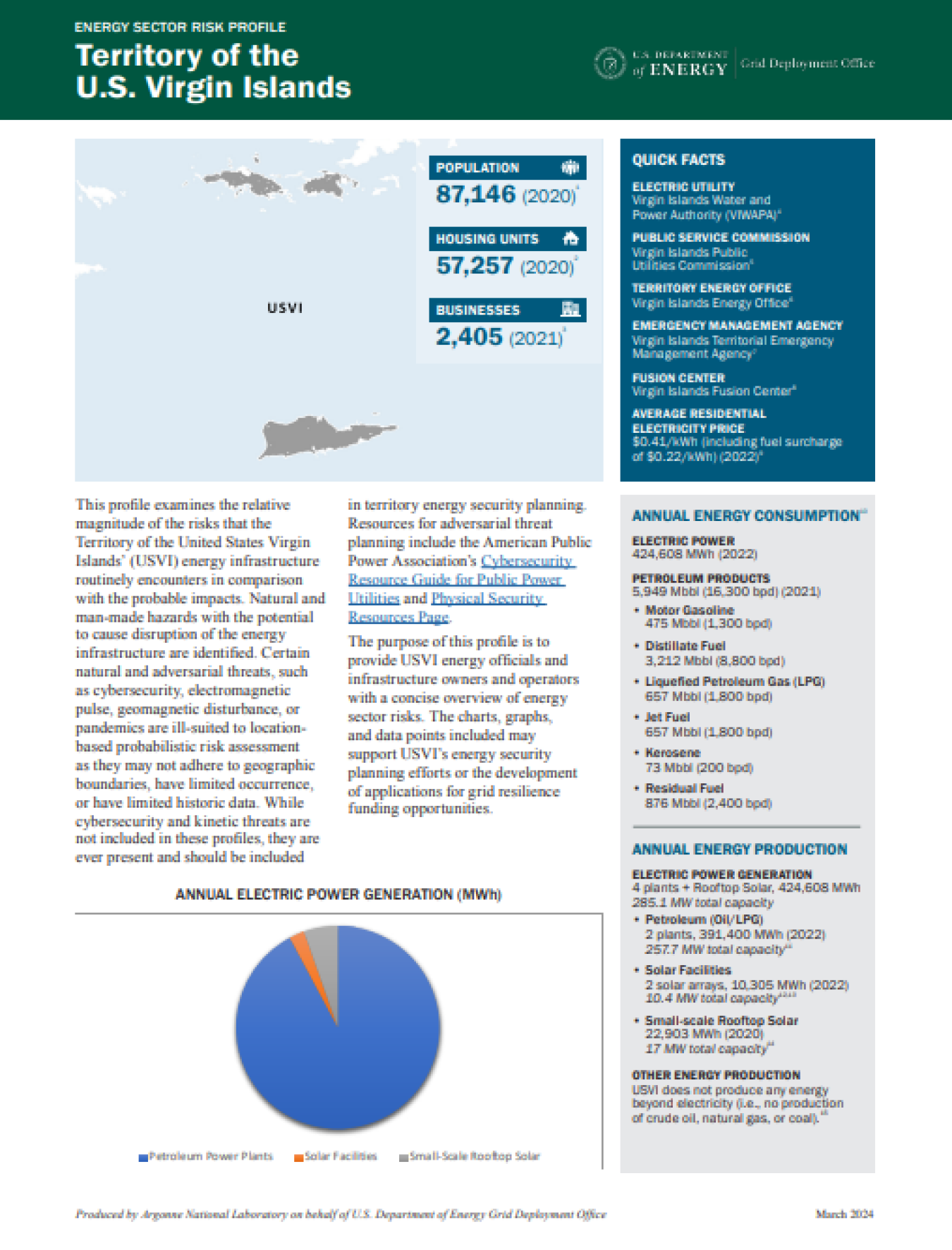
This profile examines the relative magnitude of the risks that the Territory of the United States Virgin Islands’ (USVI) energy infrastructure routinely encounters in comparison with the probable impacts.
Grid Resilience Activities
Grid Resilience Formula Grant:
USVI received over $3.1 million in Fiscal Year 22-24 funding to:
- Provide workforce development to increase staff available to operate and maintain various grid modernization and resilience efforts.
- Increase utility-managed distributed energy resources to provide energy resilience closer to the point of demand.
Managed through the Office of Electricity (OE) and administered by the National Energy Technology Laboratory (NETL), the Grid Resilience State and Tribal Formula Grants program is designed to strengthen and modernize America’s power grid against wildfires, extreme weather, and other natural disasters.
Technical Assistance
Since 2018, DOE has been providing technical assistance to USVI public entities in the implementation of the federal investments being made in the long-term, resilient recovery of the U.S. Virgin Island’s power system. The National Laboratory of the Rockies (NLR), Lawrence Berkely National Laboratory, and Sandia National Laboratory are the lab performers for the energy sector recovery work. Local stakeholders include the Virgin Islands Water & Power Authority (VIWAPA), Virgin Islands Energy Office (VIEO), and Virgin Islands Housing & Finance Authority (VIHFA).
USVI Grid Modernization Roadmap: DOE and NLR are working with VIWAPA to identify and prioritize investments that support a more reliable, resilient, and modern power system by leveraging more than $3 billion in federal funding. (See the completed technical assistance below).
The modernization roadmap includes efforts to:
- Identify current reliability issues and challenges in day-to-day operations.
- Pinpoint the infrastructure needed to connect VIWAPA’s planned renewable energy systems.
- Recommend upgrades and actions to strengthen the grid against hurricanes and other disruptions.
- Improve system protections as more distributed systems are added.
Completed Technical Assistance:
Review and Advising
- Development of interconnection procedures and processes for customer-owned systems.
- Develop guidance for data collection and model validation for St. Thomas microgrid RFP.
- Review and advise on VIWAPA’s Integrated Resource Plan.
- Support microgrid studies with data, models, and peer reviews.
- Assist FEMA in reviewing cost assessments for replacing outdated electricity generation equipment.
- Support VIWAPA staff in improving and updating operations tools.
Capacity Building and Coordination
- Train VIWAPA staff on reviewing customer interconnection applications.
- Work with VIWAPA to test and install data collection equipment.
- Host technical workshops on grid technologies.
- Hold weekly coordination calls with VIWAPA and consultants.
- Organize and host the Energy Technical Coordination Team to align federal, local, and private efforts on resilience and recovery.
System Planning and Analysis
- Develop more efficient process for reviewing customer-owned energy system applications.
- Collect and tune data for baseline power system models.
- Conduct production cost modeling and grid -stability analysis to assess new capacity needs.
- Host and support technical reviews for FEMA-funded microgrids.
- Study battery storage needs —how much and where it’s most useful.
- Analyze causes of outages and load shedding events.