



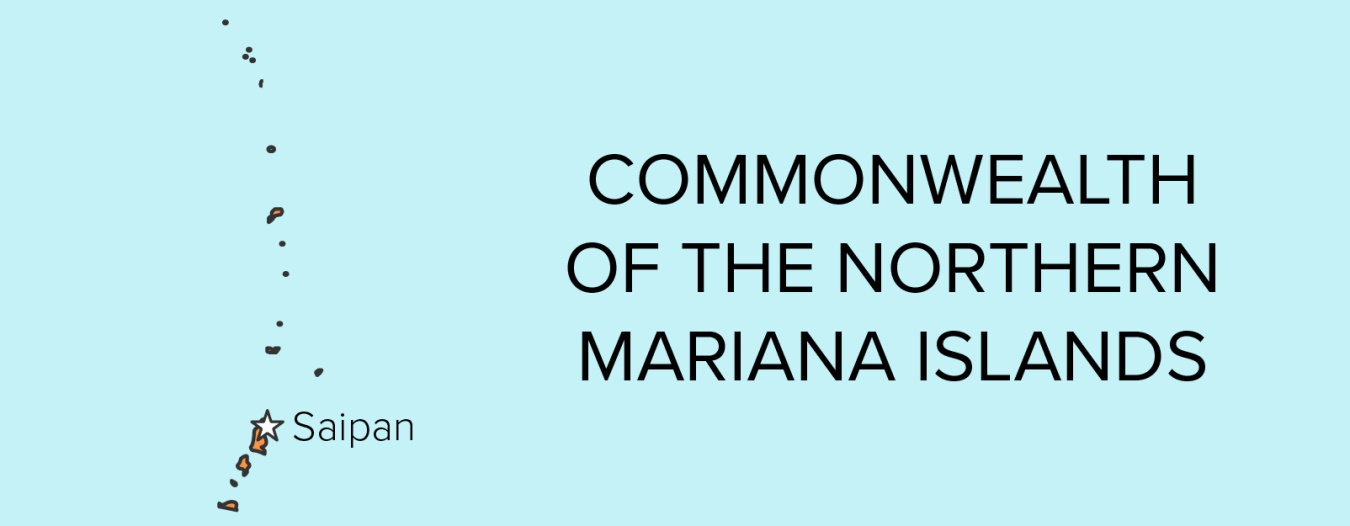
The Commonwealth of Northern Mariana Islands (CNMI) consists of 14 islands in the northwestern Pacific Ocean and its aging electricity infrastructure and vulnerability to natural disasters make a resilient power system critical to basic survival. The energy landscape can be challenging given its near-total reliance on imported petroleum products for both electricity generation and transportation. The territory does not have domestic crude oil reserves, making CNMI sensitive to regional oil market fluctuations.
Electricity costs for residential customers in the CNMI in 2025 ranged from $0.19 to $0.33 U.S. dollars per kilowatt-hour (kWh).
Commonwealth of the Northern Mariana Islands 2023 Energy Baseline Report
This report was developed with the support of the U.S. Department of the Interior’s Office of Insular Affairs (OIA) and in collaboration with several key partners in the Commonwealth of the Northern Mariana Islands (CNMI).
Territory of the Commonwealth of Northern Mariana Islands Energy Sector Risk Profile
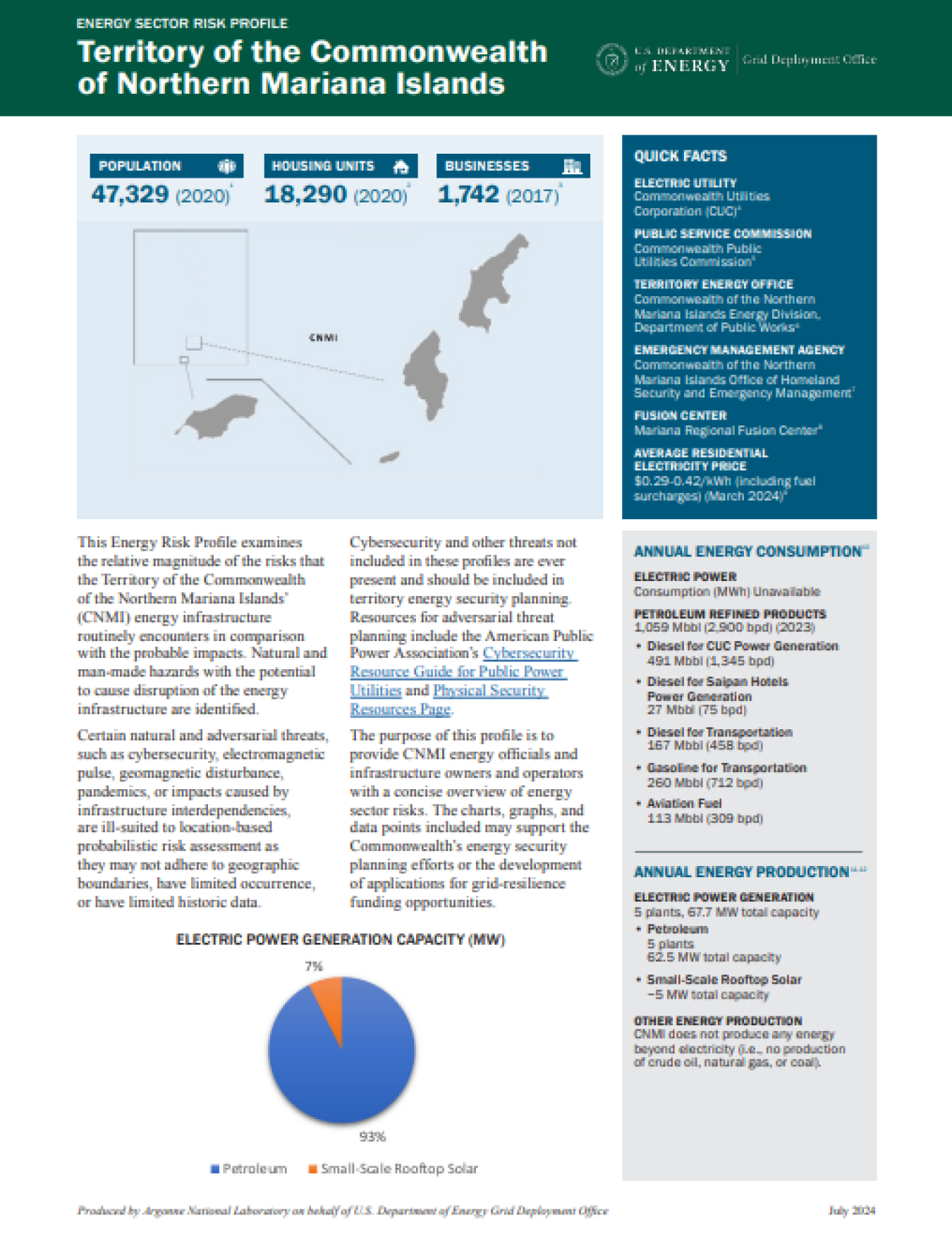
This Energy Risk Profile examines the relative magnitude of the risks that the Territory of the Commonwealth of the Northern Mariana Islands’ (CNMI) energy infrastructure routinely encounters in comparison with the probable impacts.
Grid Activities
Grid Resilience State and Tribal Formula Grants:
Managed through the Office of Electricity (OE) and administered by the National Energy Technology Laboratory (NETL), the Grid Resilience State and Tribal Formula Grants program is designed to strengthen and modernize America’s power grid against wildfires, extreme weather, and other natural disasters.
Technical Assistance
DOE is providing technical assistance like modeling, analysis, and inter-agency coordination to local CNMI stakeholders to better leverage the federal investment towards recovery made by Federal Emergency Management Agency (FEMA). Critical to Typhoon Yutu recovery efforts, this technical assistance includes augmenting planning and operational activities for disaster recovery as well as capacity building for public entities, such as the Commonwealth Utilities Corporation-Energy Division, Northern Marianas Housing Corporation, Office of Planning and Development, and Commonwealth Utilities Commission.
Municipality of Tinian and Aguiguan: OE is also currently working with the Municipality of Tinian and Aguiguan (MOTA) to:
- Identify resilient power supply options to power the planned Small Communities Exemption Landfill (SCEL).
- Identify the potential for onsite energy to power the existing Transfer Station and Recycling Center (Transfer Station).
- Provide educational materials related to onsite energy (i.e., signage, brochures, draft brief language) for use by the Transfer Station.
Pacific Assistance for Localized Management of Secure Energy (PALMS): Building on existing relationships—and bridging new ones—PALMS aims to identify, share, and address gaps in resources needed to implement projects for secure, reliable, and affordable electric grids in the northern Pacific Island territories. Robust energy infrastructure is required to support the strategic value of these locations for national security. DOE National Labs (Pacific Northwest National Lab, National Laboratory of the Rockies, and Argonne National Lab), will work with key local and federal stakeholders to collaborate on a broad shared knowledge base of energy plans, analysis, and projects that will help identify, rank, and accelerate next steps in power system improvements.
Saipan Airport Energy Resilience & Security: The Saipan International Airport facility is approximately 60 years old, with outdated electrical infrastructure, inefficient equipment, and power costs averaging almost $250,000 per month. Saipan’s electrical grid is also subject to periodic power outages, and cybersecurity for the energy system is either unimplemented or only partially implemented. This project aims to reduce overall energy costs, minimize the impact of future power outages, and improve energy security at the Saipan International Airport, a critical and essential facility operated by the Commonwealth Ports Authority (CPA).
In 2023 DOE’s Pacific Northwest National Laboratory (PNNL) released a feasibility study exploring additional power supply options for the landfill. The study found that best results, based on feasibility and stakeholder priorities, would be found with a combination of diesel, photovoltaic, and battery storage. Phase two of the project included reassessing power supply options to account for 24/7 power supply, electrified landfill equipment, and costs for new and replacement distribution lines. A final report was provided to local CNMI stakeholders in November of 2024, which included research on Federal grant opportunities to pursue. Local stakeholders are using the report findings to populate grant applications seeking to obtain funding for the technology mix outlined in the report.
Past Technical Support
Power Supply Options for the Marpi Landfill Report: The Marpi Landfill, located on the island of Saipan, is powered by an on-site diesel generator that previously only operated when the landfill was open and fully staffed. DOE and FEMA have made it possible for the Marpi Landfill to provide 24-hour power availability, despite its remote location.