



Most U.S. homes are heated with either furnaces or boilers. Furnaces heat air and distribute the heated air through the house using ducts. Boilers heat water, and provide either hot water or steam for heating. Steam is distributed via pipes to steam radiators, and hot water can be distributed via baseboard radiators or radiant floor systems, or can heat air via a coil. Steam boilers operate at a higher temperature than hot water boilers, and are inherently less efficient; however, high-efficiency versions of all types of furnaces and boilers are currently available.
Understanding the Efficiency Rating of Furnaces and Boilers
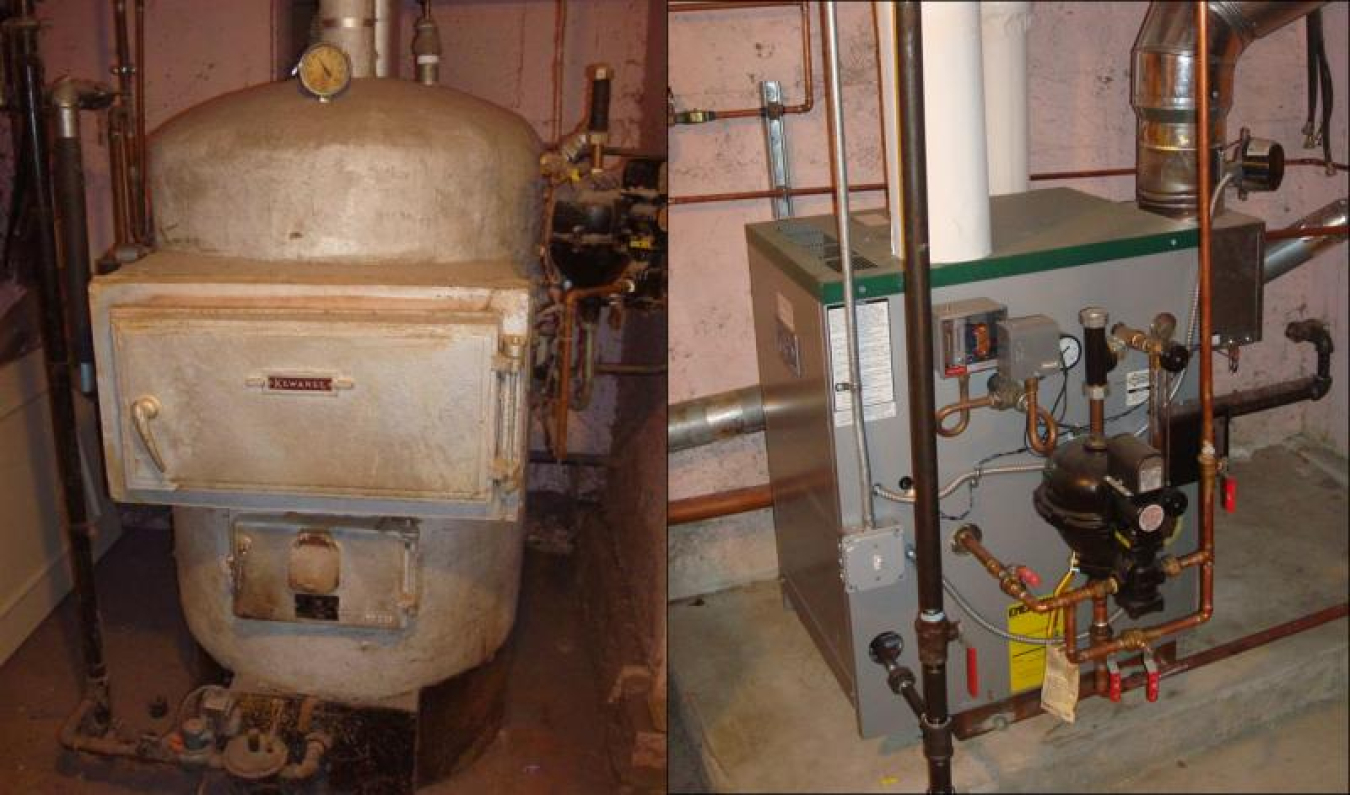
A central furnace or boiler's efficiency is measured by annual fuel utilization efficiency (AFUE). The Federal Trade Commission requires new furnaces or boilers to display their AFUE so consumers can compare heating efficiencies of various models. AFUE is a measure of how efficient the appliance is in converting the energy from fuel to heat over the course of a typical year.
Specifically, AFUE is the ratio of the furnace's or boiler's annual heat output compared to its total annual fossil fuel energy consumed. An AFUE of 90% means that 90% of the energy in the fuel becomes heat for the home and the other 10% escapes up the chimney and elsewhere. AFUE doesn't include the heat losses of the duct system or piping, which can be as much as 35% of the energy for output of the furnace when ducts are located in the attic, garage, or other partially conditioned or unconditioned space.
- Natural draft that creates a flow of combustion gases
- Continuous pilot light
- 56% to 70% AFUE.
- Exhaust fan controls the flow of combustion air and combustion gases more precisely
- Electronic ignition (no pilot light)
- Compact size and lighter weight to reduce cycling losses
- Small-diameter flue pipe
- 80% to 83% AFUE.
- Condensing flue gases in a second heat exchanger for extra efficiency
- Sealed combustion
- 90% to 98.5% AFUE.
Retrofitting Your Furnace or Boiler
Furnaces and boilers can be retrofitted to increase their efficiency. These upgrades improve the safety and efficiency of otherwise sound, older systems. The costs of retrofits should be carefully weighed against the cost of a new boiler or furnace, especially if replacement is likely within a few years or if you wish to switch to a different system for other reasons, such as adding air conditioning. If you choose to replace your heating system, you'll have the opportunity to install equipment that incorporates the most energy-efficient heating technologies available.
Retrofits are fuel-specific, so see the following sections for retrofit information:
- Gas-Fired Furnaces and Boilers (includes units fired with natural gas and propane)
- Oil-Fired Furnaces and Boilers.
Other retrofitting options that can improve a system's energy efficiency include installing programmable thermostats, upgrading ductwork in forced-air systems, and adding zone control for hot-water systems, an option discussed in Heat Distribution Systems.
Replacing Your Furnace or Boiler
Although older fossil fuel furnace and boiler systems have efficiencies in the range of 56% to 70%, modern conventional heating systems can achieve efficiencies as high as 98.5%, converting nearly all the fuel to useful heat for your home. Energy efficiency upgrades and a new high-efficiency heating system can often cut your fuel bills and your furnace's pollution output in half. Upgrading your furnace or boiler from 56% to 90% efficiency in an average cold-climate house will save 1.5 tons of carbon dioxide emissions each year if you heat with natural gas, or 2.5 tons if you heat with oil.
If your furnace or boiler is old, worn out, inefficient, or significantly oversized, the simplest solution is to replace it with a modern high-efficiency model. Old coal burners that were switched over to oil or gas are prime candidates for replacement, as well as natural gas furnaces with pilot lights rather than electronic ignitions. Newer systems may be more efficient but are still likely to be oversized, and can often be modified to reduce their operating capacity.
Before buying a new furnace or boiler or modifying your existing unit, it is suggested that you first improve the energy efficiency of your home by adding insulation and/or new energy-efficient windows, then have a heating contractor size your furnace. Energy-efficiency improvements will save money on a new furnace or boiler, because you can purchase a smaller unit. A properly sized furnace or boiler will operate most efficiently, and you'll want to choose a dependable unit and compare the warranties of each furnace or boiler you’re considering.
When shopping for high-efficiency furnaces and boilers, look for the ENERGY STAR® label. If you live in a cold climate, it usually makes sense to invest in the highest-efficiency system. In milder climates with lower annual heating costs, the extra investment required to go from 80% to 90% to 95% efficiency may be hard to justify. However, keep in mind that higher efficiency units will have lower emissions than units in the 80% range.
Specify a sealed combustion furnace or boiler, which will bring outside air directly into the burner and exhaust flue gases (combustion products) directly to the outside, without the need for a draft hood or damper. Furnaces and boilers that are not sealed-combustion units draw heated air into the unit for combustion and then send that air up the chimney, wasting the energy that was used to heat the air. Sealed-combustion units avoid that problem and also pose no risk of introducing dangerous combustion gases into your house. In furnaces that are not sealed-combustion units, back drafting of combustion gases can be a big problem.
High-efficiency sealed-combustion units generally produce an acidic exhaust gas that is not suitable for old, unlined chimneys, so the exhaust gas should either be vented through a new duct or the chimney should be lined to accommodate the acidic gas (see the section on maintaining proper ventilation below).
Maintaining Your Furnace or Boiler
- Check the condition of your vent connection pipe and chimney. Parts of the venting system may have deteriorated over time. Chimney problems can be expensive to repair, and may help justify installing new heating equipment that won't use the existing chimney.
- Check the physical integrity of the heat exchanger. Boiler heat exchangers may leak water and are easy to spot. Furnace heat exchangers mix combustion gases with house air when they leak—an important safety reason to have them inspected. Combustion gases leaking into the house can cause carbon monoxide poisoning. It is suggested that ever home have a working carbon monoxide alarm.
- Adjust the controls on the boiler or furnace to provide optimum water and air temperature settings for both efficiency and comfort.
- If you're considering replacing or retrofitting your existing heating system, have the technician perform a combustion-efficiency test.
- Check the combustion chamber for cracks
- Test for carbon monoxide (CO) and remedy if found
- Adjust blower control and supply-air temperature
- Clean and oil the blower
- Remove dirt, soot, or corrosion from the furnace or boiler
- Check fuel input and flame characteristics, and adjust if necessary
- Seal connections between the furnace and main ducts.
- Test pressure-relief valve
- Test high-limit control
- Inspect pressure tank, which should be filled with air, to verify that it's not filled with water
- Clean the heat exchanger.
- Drain some water from the boiler to remove sediments and improve the heat exchange efficiency
- Test low-water cutoff safety control and high-limit safety control
- Drain the float chamber to remove sediments, which will prevent the low-water cutoff control from sediment clogs
- Analyze boiler water and add chemicals as needed to control deposits and corrosion
- Clean the heat exchanger
- See also steam radiators.
Chimneys
Properly functioning chimney systems will carry combustion byproducts out of the home. Therefore, chimney problems put you at risk of having these byproducts, such as carbon monoxide, spill into your home.
Most older furnaces and boilers have natural draft chimneys. The combustion gases exit the home through the chimney using only their buoyancy combined with the chimney's height. Natural draft chimneys often have problems exhausting the combustion gases because of chimney blockage, wind or pressures inside the home that overcome the buoyancy of the gases.
Atmospheric, open-combustion furnaces and boilers, as well as fan-assisted furnaces and boilers, should be vented into masonry chimneys, metal double-wall chimneys, or another type of manufactured chimney. Masonry chimneys should have a fireclay, masonry liner or a retrofitted metal flue liner.
Many older chimneys have deteriorated liners or no liners at all and must be relined during furnace or boiler replacement. A chimney should be relined when any of the following changes are made to the combustion heating system:
- When you replace an older furnace or boiler with a newer one that has an AFUE of 80% or more. These mid-efficiency appliances have a greater risk of depositing acidic condensation in chimneys, and the chimneys must be prepared to handle this corrosive threat. The new chimney liner should be sized to accommodate both the new heating appliance and the combustion water heater (if present) by the installer.
- When you replace an older furnace or boiler with a new 90+ AFUE appliance or a heat pump. In this case, the heating appliance will no longer vent into the old chimney, and if the combustion water heater is present it will now vent through an oversized chimney. This oversized chimney can lead to condensation and inadequate draft. The new chimney liner should be sized for the water heater alone, or the water heater in some cases can be vented directly through the wall.
Other Ventilation Concerns
Some fan-assisted, non-condensing furnaces and boilers, installed between 1987 and 1993, may be vented horizontally through high-temperature plastic vent pipe (not PVC pipe, which is safely used in condensing furnaces). This type of venting has been recalled and should be replaced by stainless steel vent pipe. If horizontal venting was used, an additional draft-inducing fan may be needed near the vent outlet to create adequate draft. Floor furnaces may have special venting problems because their vent connector exits the furnace close to the floor and may travel 10 to 30 feet before reaching a chimney. Check to see if this type of venting or the floor furnace itself needs replacement. If you smell gases, you have a venting problem that could affect your health. Contact your local utility or heating contractor to have this venting problem repaired immediately.
Subscribe to receive updates from Energy Saver, including new blogs, updated content, and seasonal energy saving tips for consumers and homeowners.