



Energy savings performance contracts (ESPCs) are a partnership between a federal agency and an energy service company (ESCO). After being selected for a potential award, the ESCO conducts a comprehensive facility energy audit and identifies improvements to save energy. In consultation with the agency, the ESCO designs and constructs a project that meets the agency's needs and arranges financing to pay for the project.
The ESCO guarantees that the improvements will generate sufficient energy cost savings to pay for the project over the term of the contract. After the contract ends, all cost savings accrue to the agency. The agency is responsible for contract administration for the entire term of the contract.
Ready to start an ESPC project? Reach out to your federal project executive.
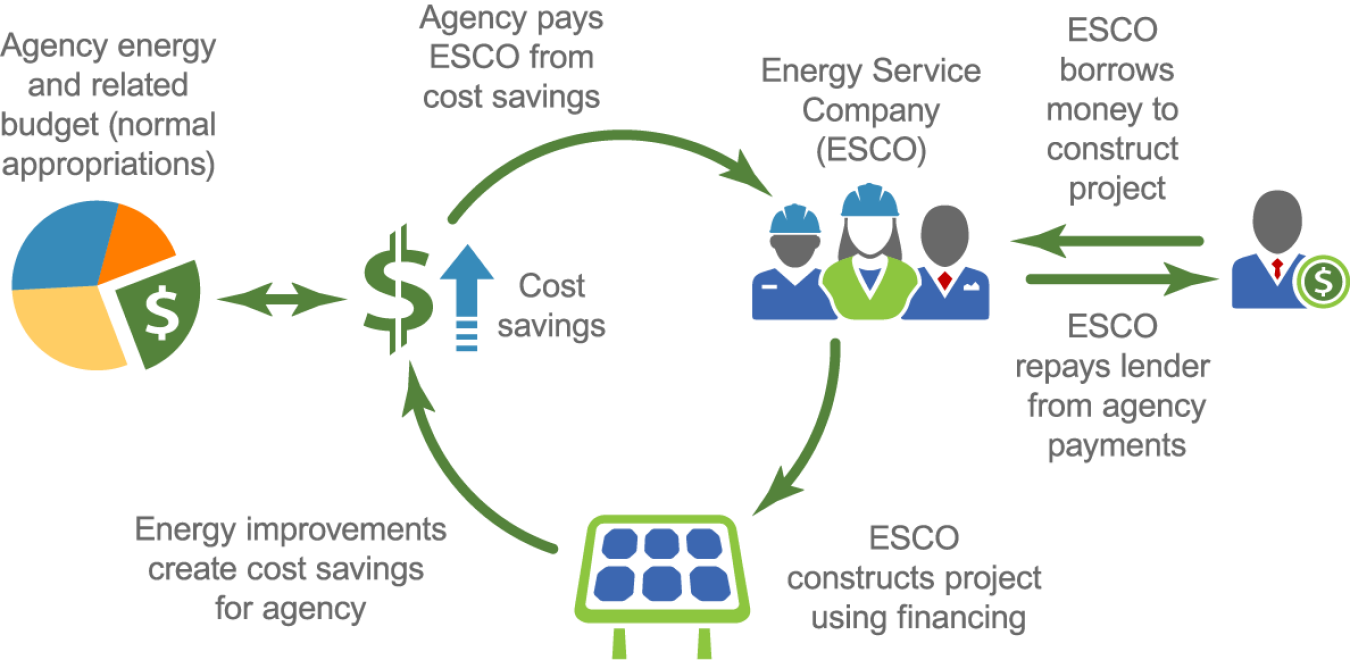
Cycle of Cost Savings and Payments
Types of Federal ESPCs
Most federal ESPC projects have been implemented as task orders awarded under U.S Department of Energy (DOE) indefinite-delivery, indefinite-quantity (IDIQ) ESPCs. The DOE IDIQ ESPCs were established to streamline the ESPC process and make ESPC procurements as practical and cost-effective for agencies as possible. DOE awarded these master IDIQ (or "umbrella") ESPCs to competing ESCOs that were best qualified to serve federal agencies under the terms and conditions in the DOE IDIQ ESPCs. More than 300 projects have been awarded under the DOE ESPC IDIQs since their inception in 1998.
The U.S. Army Corps of Engineers' ESPC program awards master ESPCs and multiple award task order contracts (MATOCs), which are available to federal agencies. For more information, visit the Army Corps' Energy Division ESPC Program website.
Historically, the U.S. Department of Veterans Affairs (VA) implemented ESPC projects through task orders under the DOE IDIQ ESPC contact. In order to use service-disabled, veteran-owned small businesses (SDVOSBs) for ESPC projects, VA has developed a new VA ESPC procurement program.
VA awarded an ESPC project for Veterans Integrated Service Network I, in White River Junction, VT. This project was awarded to a SDVOSB with a project investment value of nearly $3.0 million. To learn more, see the VA ESPC Awarded Projects Report.
For more information about VA energy savings performance contracts, visit the U.S. Department of Veterans Affairs - Energy Management Program Service.
A few agencies have implemented ESPCs without using an IDIQ or MATOC but by working with a DOE-qualified ESCO to establish a "stand-alone" contract. Learn more about DOE-qualified ESCOs.
ESPC Legislated Authority
The use of ESPCs is authorized, required, or encouraged by:
- Multiple statutes, including 42 U.S.C. § 8287 et seq.; 10 C.F.R. § 436.30 et seq.
- Federal Acquisition Regulations (FAR)
- FAR Part 2.101: ESPC definition
- FAR Part 23.205: Energy savings performance contracts
- FAR Part 16.505: Ordering
The legislated authority for federal agency use of ESPCs determined these key characteristics and benefits of federal ESPCs.
Key Characteristics
- The legislated purpose is to achieve energy savings and ancillary benefits.
- Savings guarantees are mandatory.
- Measurement and verification is mandatory.
- Savings must exceed payments for each contract year.
- Contract term cannot exceed 25 years.
Key Benefits
- Infrastructure improvements that pay for themselves over time.
- Ability to purchase long-payback equipment by bundling with short-payback ECMs.
- Reduced vulnerability to budget impacts from utility rate hikes and extreme weather.
- Enhanced ability to plan and budget accounts.
- Guaranteed cost savings and equipment performance.

ESPC Resources
FEMP offers resources to help federal agencies navigate each step of the ESPC process.