



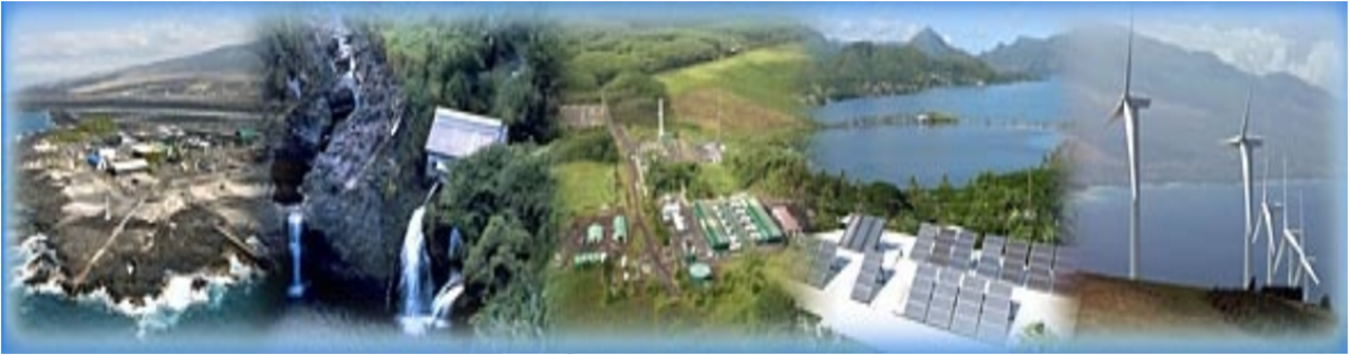
Hawaii has two different Energy Management Systems (EMS) on the islands of Oahu and Maui, and already has very high solar penetration. This project will design new capabilities for these systems to enable visibility to thousands of uncontrolled, distributed roof-top PV resources and factor advanced 15-minute short term wind and solar forecasting capability for the region into the EMS decision-making process. This project is innovative in incorporating solar generation forecasts into the operational EMS and working with two major EMS vendors (Siemens & Alstom) to create advanced EMS software. The results of this project will motivate technology development to enable operational change under high renewables penetration, thereby reducing the cost and impact of integrating large amounts of solar.
Download Project Presentation
This 2 year project supports development of the next generation, integrated energy management infrastructure (EMS) able to incorporate advance visualization of behind-the-meter distributed technology performance information and probabilistic renewable energy generation forecasts to inform operational decisions. The project involves end-users and active feedback from an Utility Advisory Team (UAT) to help inform how information can be used to enhance operational functions (e.g. unit commitment, load forecasting, Automatic Generation Control (AGC) reserve monitoring, ramp alerts) within two major EMS platforms.
Objectives include:
- Engaging utility operations personnel to develop user input on displays, set expectations, test and review
- Develop ease of use and timeliness metrics for measuring enhancements
- Develop prototype integrated capabilities within two operational EMS environments
- Demonstrate an integrated decision analysis platform with real-time wind and solar forecasting information and timely distributed resource information
- Seamless integration of new 4-dimensional information into operations without increasing workload and complexities, yet sufficient analytics learn and confidently transform and adopt new operating practices and procedures
- Disseminate project lessons learned through industry sponsored workshops and conferences
- Building on collaborative utility-vendor partnership and industry capabilities
The goal of the Distributed Resource Energy Analysis and Management System (DREAMS) Development for Real-time Grid Operations project is to support development of the next generation energy infrastructure and EMS environment with the ability to account for behind-the-meter distributed generation in an aggregated fashion reducing site-specific forecasting by 2 orders of magnitude and be able to factor in 15-min short-term probabilistic weather information into EMS algorithms to inform operational decisions (e.g. unit commitment, load forecasting, reserve monitoring and ramp alerts).
The purpose is to provide utility operators with more timely information and seamless EMS capability to “see” and “get a heads up” to manage change impacts arising from high penetrations of renewable resources from transmission down to distribution levels, specifically distributed Photovoltaic (PV) located on the customer side where utilities have limited visibility and controls. It is anticipated that as this effort progresses, the project will provide the following impacts:
- Lessons learned and experience gained in integrating one of the first short-term wind and solar forecasting and ramp event datasets into utility EMS environments
- Efforts leverage 2 major EMS providers to develop and demonstrate robust EMS platforms and renewable integration solutions applicable to a broad base of utility users
- Enable new operational tools for Utility Operators to see and manage behind the meter generation and develop better awareness in the use of real-time wind and solar forecasting tools
- Provide guidance on VER/DER data management needs for real-time control and operations
- Enable interaction across a broad base of industries and technology providers that normally would not engage
- Broad base of utility expertise providing insight and input to ensure replicable capabilities and robust development of operational awareness tools
- Advance state of the art in the area of EMS tools to integrate DG information and forecasting data.
- Direct access through vendors to dissemination and commercialization conduits into national and international market space
- Pilot activities represent innovation in transformational technologies that will shape future grid intelligence and provide guidance on standardization of data formats/protocol, network security and communication of data across multiple platforms

- Hawaii Solar Energy Association (HSEA), a solar industry advocacy group, made inquiry to Hawaii Public Utility Commission and US DOE on provide assistance to Hawaii utilities. The DREAMS initiative was highlighted by Hawaiian Electric Companies' executive as proactive efforts by the Company to revise our visualization tools, offer transparency to the public and enhance our operating capabilities in partnership with industry partnerships. Kevin Lynn was also able to communicate the DREAMS initiative as an example of the type of industry-federal collaboration to advance the state of the industry to adopt renewables
- Hawaiian Electric is also actively engaged in community outreach activities at the K-8, high school and university levels. Hawaiian Electric has a staff serving as an adjunct professor in the College of Engineering providing industry perspective and needs via seminars and NSF proposal support. The Renewable Energy staff also provides mentorship of undergraduate and graduate students through internships and research projects pertaining to advancing forecasting, monitoring, DG monitoring, and social-economic research related to consumer energy consumption and technology adoption
- Hawaiian Electric will be presenting DREAMS effort at DOE SunShot Summit in Anaheim, CA May 19-22, 2014 through poster presentation and peer review
- Hawaiian Electric staff will present at AWEA WindPower 2014 in Las Vegas, NV, May 2014 on the need for DREAMS and integration and visualization initiatives. Forecasting capabilities developed in collaboration with AWS Truepower for the Hawaiian Electric Companies and integration lessons learned, training sessions for Operators, and EMS integration collaboration with Siemens and Alstom will be presented. Presentation will also share continuing DREAMS effort to realize forecasting potential, issues such as process change, training, large-data management and integration into the EMS as next steps toward improving operations with high penetrations of renewables
- Hawaiian Electric presented DREAMS effort at DOE SunShot Summit in Anaheim, CA May 19-22, 2014 through poster presentation and peer review
- Hawaiian Electric staff presented at AWEA WindPower 2014 in Las Vegas, NV, May 2014 on the need for DREAMS and forecasting integration and visualization initiatives
- Hawaiian Electric staff presented a poster and participated in a panel discussion at PV America in Boston, MA, June 2014 on the DREAMS project. Presentations continued to share DREAMS effort to realize forecasting potential, issues such as process change, training, large-data management and integration into the EMS as next steps toward improving operations with high penetrations of renewables
- DREAMS team presented at CIM User group meeting in November 2014. Efforts will continue to engage the community in development of new schema to provide recommendations for a draft renewable forecasting CIM standard applicable to planning models and system operations algorithms
- DREAMS presented at Distributech and UVIG 2015 events