



The U.S. Department of Energy (DOE) Integrated Energy Systems Office (IESO) provides awardees with several resources to build awareness of their work and maximize the positive exposure received over the lifetime of the award. This includes the IESO Awardee Communications Guidelines, the DOE awardee presentation template, and the DOE awardee program logo. A great place to start is the Communications Quick Start Guide (PDF), which provides guidance on how to think proactively and develop a plan to communicate about your project. It includes a worksheet, plan outline, tips and tricks for media engagement, and examples of successful communication. If you have any questions, please reach out to IESOWebInquiries@doe.gov.
Please note that this is not an exhaustive list of resources. Program specific resources will be sent to awardees via email.
Awardee Communication Guidelines
This resource shares how to communicate with the public and other stakeholders about your project. This document explains proper naming conventions as well as how to attribute your DOE funding in reports and articles, publish your reports on OSTI.gov, and best practices for media outreach and using social media to promote your success. Download the Communications Guidelines (PDF) or expand the sections below to learn more.
Award Attribution Language
The Integrated Energy Systems Office relies on its brand identity to build awareness of and participation in its work. Strong brand awareness improves the quality of applications to the office funding programs and enables progress toward realizing its vision and goals. Furthermore, proper attribution in your reports, presentations, and other materials allows the Energy Department to evaluate the impact of its funding over time.
Please follow these guidelines when creating reports or communications materials related to your project.
Please use the following naming conventions to identify and distinguish work performed with funding assistance from the U.S. Department of Energy Integrated Energy Systems Office. Refer to the office as the U.S. Department of Energy Integrated Energy Systems Office upon first mention. Note that “Department of Energy” is not possessive. Upon second mention, the office may be called the Integrated Energy Systems Office. Consistent and proper use of this name encourages quality and accuracy of all communications. The following are acceptable ways to refer to the U.S. Department of Energy:
Proper Naming
• U.S. Department of Energy
• Energy Department
• Energy Dept.
• U.S. Energy Department
• U.S. Energy Dept.
Improper Naming
• U.S. DOE• Department of Energy(missing U.S.)When creating communications materials about your project—including press releases, webpages, presentations, fact sheets, and brochures—please include this boilerplate at the bottom:
About the Integrated Energy Systems Office
The U.S. Department of Energy Integrated Energy Systems Office drives research and development of energy solutions that enhance grid reliability and resilience, foster U.S. technological leadership, and reduce the cost of energy for Americans. Learn more at energy.gov/cmei/systems/integrated-energy-systems office.
When issuing press releases, please acknowledge that you received funding from the U.S. Department of Energy Integrated Energy Systems Office. For online communications, when the office is first referenced, please link the Integrated Energy Systems Office’s name to energy.gov/cmei/systems/integrated-energy-systems-office.
Funding recipients must include the following acknowledgement in publications arising from or relating to work performed under their award, regardless of whether it’s copyrighted. Please reach out to your technology manager in the Integrated Energy Systems Office if you do not know your award number (i.e., DE-000000).
Acknowledgment: This material is based upon work supported by the U.S. Department of Energy’s Office of Critical Minerals and Energy Innovation (CMEI) under the Integrated Energy Systems Office Award Number DE-________.
Disclaimer: This report was prepared as an account of work sponsored by an agency of the United States Government. Neither the United States Government nor any agency thereof, nor any of their employees, makes any warranty, express or implied, or assumes any legal liability or responsibility for the accuracy, completeness, or usefulness of any information, apparatus, product, or process disclosed, or represents that its use would not infringe privately owned rights. Reference herein to any specific commercial product, process, or service by trade name, trademark, manufacturer, or otherwise does not necessarily constitute or imply its endorsement, recommendation, or favoring by the United States Government or any agency thereof. The views and opinions of authors expressed herein do not necessarily state or reflect those of the United States Government or any agency thereof.
Abridged Legal Disclaimer: The views expressed herein do not necessarily represent the views of the U.S. Department of Energy or the United States Government.
The U.S. Department of Energy requires funding recipients to publish or otherwise make publicly available the results of work performed under their award. Funding programs require that all publications resulting from Integrated Energy Systems Office funding be published on the Energy Department’s Office of Scientific and Technical Information (OSTI) website, OSTI.gov. For details on publishing on OSTI.gov, see below.
U.S. Department of Energy awardees are encouraged to review the DOE Awardee Logo and Branding Guidelines for information on appropriate brand usage, logo placement, and treatment.
Use “U.S. Department of Energy Awardee” for use in first text reference on each new page of a document. For later references when the full program name appears previously or in a more prominent location, “Energy Dept. Awardee” is allowed.
Proper Naming
• U.S. Department of Energy Awardee
Improper Naming
• Awardee• DOE AwardeePresentations related to projects funded by the Integrated Energy Systems Office require the U.S. Department of Energy Awardee logo, and the presenter should acknowledge the office as the funder of the project, both verbally and in writing, and must submit a copy of the conference proceeding, paper, or presentation to E-Link. This includes but is not limited to conference presentations, trade show demonstrations, webinars, and seminars.
To improve brand awareness and search engine optimization, please use the following conventions when referring to the Integrated Energy Systems Office online:
- When referring to your work on a webpage, in a digital newsletter, or in a report, please embed a link to energy.gov/cmei/systems/integrated-energy-systems office on the office’s first reference and on any images or graphics related to the project.
- When referring to your work on a webpage or in a blog post or article, acknowledge the Integrated Energy Systems Office as the funder of your project in the text, and include a link to your funding program webpage.
- When referencing the U.S. Department of Energy Awardee logo for the first time in a digital piece of content, embed a link within the words “U.S. Department of Energy Awardee” to energy.gov/cmei/systems/integrated-energy-systems-office.
- For webpages, blog posts, or articles referring to your award, tag your content with “Integrated Energy Systems Office” and “U.S. Department of Energy” and add the office’s name, funding program, and any other relevant details to your webpage’s metadata and/or webpage summary.
- The DOE seal and logo are intended for official Energy Department use only. If you have questions about how these should be used, read the guidelines or contact your technology manager.
You are required to publish all scientific and technical documents generated through the award on OSTI.gov. Awardees must publish all reports, presentations, and manuscripts relating to their work funded by the Integrated Energy Systems Office on OSTI.gov. This complies with Energy Department policy to publicly disseminate the work funded by taxpayers. It ensures access to scientific work and that the work reaches the widest possible audience to increase its impact.
If you publish an article in a journal, you must upload the accepted manuscript to OSTI through E-Link before the online publish date. This video shows you how to upload the accepted manuscript. The accepted manuscript is the version of the article that has been accepted for publication and includes all modifications resulting from the peer- review process.
Scholarly publications must be made available without any embargo or delay after publication. If the article is published as open access (OA), you may provide either the accepted manuscript or the OA article (provided there are no restrictions on DOE ingesting the OA article), along with the metadata. DOE will permanently retain accepted manuscripts and any ingested OA articles in DOE PAGES for archival and preservation purposes.
Every journal and publishing group has its own policy on releasing published work to the public. Before submitting journal-published work to OSTI, awardees should review that particular journal’s data-sharing policies. Here are some of the major publishers and their policies:
- American Physical Society
- Elsevier
- Institute of Electrical and Electronics Engineers (IEEE)
- Nature
- PLOS One
- Science
- Taylor & Francis Online
- IOP Publishing
- The Royal Society of Chemistry
All awards include terms and conditions for submitting journal articles. Information specific to DOE can be found at https://www.osti.gov/public-access.
Some journals will charge authors a fee to make their articles open access. While DOE funded authors may publish in journals of their choice—including open-access journals if the award’s terms and conditions allow it—they do not need to pay fees to enable public access. DOE provides public access through its license to the accepted manuscript or through publishers’ voluntary efforts. If you have any questions about this process, please refer to your Federal Assistance Reporting Checklist (FARC) and contact your technology manager.
The Recipient is required to include the following acknowledgment in publications arising out of, or relating to, work performed under this Award, whether copyrighted or not:
Acknowledgment: This material is based upon work supported by the U.S. Department of Energy's Office of Critical Minerals and Energy Innovation (CMEI) under the Integrated Energy Systems Office Award Number DE-_______.
You are required to disclose any inventions or patents resulting from IESO-funded work on iEdison.gov by submitting a utilization report, which explains how your invention is used. This report is an annual requirement, and you will receive reminders to submit it. For help with the iEdison system, contact edison@od.nih.gov or 1-866-504- 9552. You can find more details on intellectual property reporting and utilization reports in the Award Documents section of FedConnect.
All content on the Energy Department website and its affiliated webpages, unless otherwise stated, is in the public domain. This includes webpages (.gov), social media posts, and related images/video/media featured in the posts, and Energy Department affiliated websites and accounts like Flickr and the National Laboratory of the Rockies image gallery.
Awardees are encouraged to repost success stories, blog posts, video, and other digital content featured on the Energy Department’s website. When content created by the Integrated Energy Systems Office is remixed or reposted, please attribute it to the Integrated Energy Systems Office at the top of the webpage or in a similarly prominent way, with a link to the original content source and the following statement:
This [blog post/success story/news brief/video/graphic—embed a link to the content source here] was originally created and published by the U.S. Department of Energy Integrated Energy Systems Office.
Communicating Awardee Success
When your project meets a major milestone, we want to know about it. Please tell your technology manager, who can then recommend that we write a success story. Success stories highlight a project’s significant research or technical accomplishment that will significantly impact the energy industry. We publish stories about:
- First-of-its-kind inventions that help to modernize America’s power grid
- Projects with significant implications for end users, industry members, utilities, and/or adjacent industries
- Research developments that have real-world applications, improve the state of the art, receive an award, and/or achieve major milestones
In addition, the Integrated Energy Systems Office has a news section, where it can feature awardee work.
While there are limitations on how the Energy Department can promote an organization’s work, content drafted by the Integrated Energy Systems Office can be promoted on Energy Department social media channels and used in speeches or briefings by department officials.
The Integrated Energy Systems Office does not need to review awardee press releases but appreciates knowing about them in advance. Please notify your technology manager or the engagement team—especially if you anticipate significant media attention from a major achievement or high-profile partners.
For announcements about funding program selections, the engagement team may provide press release templates that can help selectees and their organizations disseminate information quickly and accurately. Use of this template is not mandatory. The template includes instructions to make it easier for organizations with limited communications staff or experience to participate in media engagement.
Press releases should mention the Integrated Energy Systems Office’s funding in the body of the text. They should link to the office’s website and include the boilerplate office description (see pages 3-4).
Note: The Energy Department does not participate in third-party press releases and prohibits agency officials from providing quotes for external press releases. However, an awardee may include a quote from an agency official that appears in an Energy Department press release, if it’s clear the quote came from an Energy Department press release.
The Integrated Energy Systems Office does not own or manage its social media properties, but the Energy Department’s social media channels feature the office’s announcements and success stories. Awardees are encouraged to stay up to date on the office’s news by signing up for the office newsletter and following the social media sites listed below.
IESO Website: https://www.energy.gov/cmei/systems/integrated-energy-systems-office
Twitter: https://twitter.com/ENERGY
Facebook: https://www.facebook.com/energygovhttps://www.facebook.com/DOECMEI/
LinkedIn: http://linkedin.com/company/u-s--department-of-energyhttps://www.linkedin.com/showcase/doecmei/
Instagram: https://www.instagram.com/energy
YouTube: https://www.youtube.com/user/USdepartmentofenergy
Flickr: https://www.flickr.com/photos/departmentofenergy/
Partner Videos
When creating a video about an Energy Department-funded project, to avoid the appearance of endorsement by the Energy Department, it should be clear that the project is from an Energy Department partner and that the Department did not create the video. When creating the video:
- Do not feature your organization’s logo except alongside the DOE Awardee logo once briefly at the beginning and once at the end of your video. Also ensure that the DOE Awardee logo is equally as prominent as the organization’s logo.
- Please ensure high-quality production and accurate content.
- Be careful not to include personally identifiable information, such as license plates, name tags, addresses, etc.
- Avoid shots with any prominent corporate logos, including those of non-partners. Incidental logos in footage are OK, but efforts should be taken to limit them.
- Make sure that any workers shown are using proper safety equipment.
- Do not use copyrighted content, including images, footage, and music.
For proper attribution, please include the following statement in the video at the beginning and/or end when featuring partner logos and/or funders:
This video was created by [ORGANIZATION NAME] with support from the U.S. Department of Energy Integrated Energy Systems Office.
In addition, the office suggests adding the following statement as a caption to the video and/or as a part of the webpage text directly following the video:
This video was created by [ORGANIZATION NAME] with support from the U.S. Department of Energy Integrated Energy Systems Office. This video is intended for educational purposes only and may be used or redistributed for noncommercial purposes, provided credit is given to [ORGANIZATION NAME] and content is not altered.
When creating videos and digital media, it’s important to remember to make your content accessible to people with disabilities, as required by Section 508 of the Rehabilitation Act. This means you must write alternative text for images and add captions and transcripts to videos.
A transcript is a text version of a video that typically includes all spoken language, a description of all important events and actions that occur in the video, and anything displayed visually in the video, such as words or symbols. Transcripts can be posted as a separate webpage or as a text file. This page or file is then linked beneath the embedded video on the website. Captions should be uploaded as a separate caption file on your video-hosting site.
Press Release Examples
- Developing new grid-forming inverter controls to handle higher amounts of solar power while improving grid stability
- Plans to deploy and test new controls with GE Renewable Energy’s commercial PV LV5 inverter platform
- Inverter improvements will support nation’s increasingly distributed, renewable-intensive grid network
February 6, 2020, NISKAYUNA, NY – GE Research, the central technology development arm for the General Electric Company (NYSE: GE), has been awarded $4.2 million in funding from the U.S. Department of Energy Integrated Energy Systems Office (IESO) to help develop and deploy advanced grid-forming photovoltaic (PV) inverter control technologies that can reliably support higher amounts of solar power on the grid. This work keeps pace with the nation’s changing electric grid system, which is getting more energy from distributed and renewable sources.
Today, wind and solar inverters connected to the grid depend upon existing voltage and frequency levels to deliver power. This is different from traditional generators, like gas and steam turbines, which dictate, or form, the voltage and frequency levels at which the grid operates.
The development of “grid-forming” controls will allow wind and solar inverters to form voltage and frequency levels like traditional generators, creating an opportunity for greater and more resilient integration of these resources into the grid.
“When it comes to solar and other renewable resources, all roads lead through the inverter,” said Maozhong Gong, Senior Engineer, Electric Power Technologies, GE Research. “As the nation’s grid sees more electricity from the sun and wind, it will require advanced inverters to maintain reliability.”
Gong added, “As part of this project, we will develop and field-test advanced grid-forming controls that enable many distributed resources to deliver reliable and resilient power like traditional generators do. We will test and validate these new technologies utilizing GE Renewable Energy’s commercial PV LV5 inverter platform. The goal is to have a solution ready to commercially deploy and implement to support the nation’s increasing solar power portfolio.”
Gong explained that while grid-forming inverter control technology is not new, the big challenge is enabling so many distributed grid-forming inverter resources to act together like traditional generators without causing stability issues. The team will address this with a holistic solution that includes advanced grid-forming controls, system modeling and analysis, and extensive tests and validation.
According to the most recent data from the U.S. Energy Information Administration, U.S. renewable electricity generation doubled from 382 million megawatt-hours (MWh) in 2008 to 742 million MWh in 2018. Solar generation has increased nearly 50 times over that same period, from 2 million MWh to 96 million MWh.
This year, the EIA says solar and wind will account for 76% of all planned capacity additions. This growth is giving rise to inverter-dominated grids that will require more advanced technologies to ensure grid stability.
GE Research was selected as a part of the Integrated Energy Systems Office Fiscal Year 2019 funding program. For its project, Gong will lead a multi-disciplinary team of electric power and electrical controls experts to develop advanced control technologies for PV inverters that can support increasing solar power loads on the grid. The team will develop controls for individual and clusters of grid-forming PV inverters to improve grid stability under various conditions and field-test them in GE’s commercial PV inverter.
As part of its $4.2 million cooperative award from IESO, GE and its partners will contribute a cost share of $1.4 million, bringing the total funding for the project to $5.6 million.
About the Integrated Energy Systems Office
The U.S. Department of Energy Integrated Energy Systems Office supports early-stage research and development to improve the affordability, performance, and value of integrated technologies on the grid. Learn more at Integrated Energy Systems Office | Department of Energy
About GE Research
GE Research is GE’s innovation powerhouse where research meets reality. We are a world-class team of scientific, engineering and marketing minds working at the intersection of physics and markets, physical and digital technologies, and across a broad set of industries to deliver world-changing innovations and capabilities for our customers. To learn more, visit our website at https://www.ge.com/research/.
Enhancing power supply resilience to first responders
University of Utah engineer receives $4.4 million grant to develop management system for power distribution systems
Apr 2, 2019 - If a city experiences a major power outage due to a natural disaster or a cyberattack, it is vital to bring back power as soon as possible for first responders and critical infrastructure.
University of Utah electrical and computer engineering assistant professor Masood Parvania and his team at his Utah Smart Energy Laboratory (U-Smart) have received a three-year, $4.4 million research award from the U.S. Department of Energy Integrated Energy Systems Office (IESO) to advance solar energy’s role in strengthening the resilience of the U.S. electricity grid. This project will develop an automated resilience management system (ARMS) to enhance the city’s power grid in case of a power outage.
“It is critical to ensure resilience of power supply to emergency services and first responses, such as hospitals, after a major power outage caused by widespread events like natural disasters,” Parvania, says. “The ARMS solution will use distributed solar photovoltaics, distributed energy resources, fault detection sensors, and distribution monitoring and switching equipment to improve the resilience of critical infrastructure and emergency centers.”
The project partners include PacifiCorp, Utah Governor’s Office of Energy Development, Idaho National Laboratory and Washington State University.
“In a rapidly evolving energy landscape, we are proud to see Utah’s collaborative partnerships demonstrate national leadership in energy research and planning to advance grid resilience,” said Laura Nelson, the Utah Governor’s energy advisor and executive director of the Utah Governor’s Office of Energy Development. “In Utah, our renewable portfolio is expanding, and we rank fifth nationally for installed solar capacity. This grant enables us to analyze opportunities presented through greater integration of new, intermittent resources and maintain resilience, security and affordability.”
Rocky Mountain Power, a division of PacifiCorp, which services more than one million customers in Utah, Wyoming and Idaho, will work with the Utah Smart Energy Laboratory to test and validate the technology at multiple locations in Utah.
“Implementation of the ARMS solution will provide the framework to substantially improve real-time information exchange with field devices and reduce the time spent to locate, isolate and restore power to emergency services and critical infrastructure,” said Rohit Nair, grid solutions manager at Rocky Mountain Power.
The University of Utah was selected to receive this award as a part of the Energy Department’s effort to invest in new projects that enable grid operators to rapidly detect physical and cyberbased abnormalities in the power system and utilize solar generation to recover quickly from power outages.
Making the next leap in solar power manufacturing
BlueDot Photonics aims to lower the production cost of solar panels by 50% using a new high-throughput manufacturing process
November 18, 2019, [Seattle, WA] – BlueDot Photonics, a company focused on commercializing next-generation solar panels, announces being selected to receive a $1,000,000 award from the U.S. Department of Energy Integrated Energy Systems Office (IESO) to advance innovations in solar manufacturing. This project will accelerate the development of a new manufacturing process to produce high efficiency solar panels at a fraction of today’s costs.
Most commercial solar panels today are about 20% efficient at converting sunlight into electricity. Although more efficient technology exists, the costs of these alternatives have been too high for broad implementation. A new class of materials, known as perovskites, have great potential to solve this problem. But a cost-effective, scalable, and reproducible manufacturing process for perovskite materials has not been identified. The team at BlueDot have invented such a process.
“Cost is king in solar. And for the market to grow at its current rates, solar costs must continue to fall rapidly. The industry needs simple, scalable, and efficient approaches to produce panels. This project develops the technology to meet this need,” said Jared Silvia, CEO and Co-Founder of BlueDot.
Most of the focus on perovskite solar device production has been on what’s known as solution processing. Perovskite inks are printed to make a working solar cell. Although theoretically capable of high production rates, solution processing is limited by materials compatibility, reproducibility at high rates, and the safe handling of often toxic solvents. BlueDot’s manufacturing process simplifies the process. Solvents are eliminated. BlueDot’s process takes perovskite powders, vaporizes them, and redeposits the material as high-quality thin films. The flexibility of the process means the design and performance of the solar device can be tuned for a specific customer need. And it should achieve high throughput, like the rates used to make food packaging and high-performance glass.
BlueDot Photonics was selected as a part of the Integrated Energy Systems Office Fiscal Year 2019 funding program, an effort to invest in new projects that will lower solar electricity costs, while working to boost solar manufacturing, reduce red tape, and make solar systems more resilient to cyberattack. BlueDot Photonics is one of several manufacturing innovation projects with early-stage product ideas that can lower solar costs and rapidly achieve commercialization, with an emphasis on projects that contribute to a strong U.S. solar manufacturing sector.
A spinoff of the University of Washington, BlueDot’s core technology was originally developed in the research lab of Prof. Daniel Gamelin. CoMotion, the University of Washington’s collaborative innovation hub supported BlueDot Photonics with intellectual property management and initial funding from the CoMotion Innovation Gap Fund and the Commercialization Fellows Program.
BlueDot Photonics is driven to realize terawatt scale implementation of solar power in the next decade and is grateful for the support and backing of the Department of Energy in its mission.
About BlueDot Photonics
BlueDot Photonics is accelerating the implementation of next-generation solar technology by developing simple, cost-effective solutions to improve solar panel performance and durability. BlueDot is based in Washington State and is a spin-out of the University of Washington. Learn more at bluedotphotonics.com
About the Integrated Energy Systems Office
The U.S. Department of Energy Integrated Energy Systems Office supports early-stage research and development to improve the affordability, reliability, and performance of solar technologies on the grid. Learn more at Integrated Energy Systems Office | Department of Energy
SwRI AND GE DESIGN AND OPERATE THE HIGHEST TEMPERATURE SCO2 TURBINE IN THE WORLD
April 8, 2019 — A team of Southwest Research Institute and General Electric (GE) engineers have designed, built and tested the highest temperature supercritical carbon dioxide (sCO2) turbine in the world. The turbine was developed with $6.8 million of funding from the U.S. Department of Energy (DOE) Integrated Energy Systems Office (IESO), in addition to $3 million from commercial partners GE Research, Thar Energy, Electric Power Research Institute, Aramco Services Company and Navy Nuclear Laboratory. Additionally, the DOE’s Advanced Research Projects Agency – Energy (ARPA-E) Full-Spectrum Optimized Conversion and Utilization of Sunlight (FOCUS) program provided financial support and extended the test program to validate advanced thermal seals.
“The full 10 megawatt turbine is the size of a desk and yields the highest power density of any industrial turbine, rivaled only by the turbopumps used on the space shuttle engines,” said Dr. Jeffrey Moore, a mechanical engineer at SwRI and the principal investigator of the project. “This will not only improve concentrated solar power plant efficiency but also improve the efficiency of fossil and nuclear power plants, as well as lower the cost of waste heat recovery and energy storage.” This small but powerful turbine can withstand the tough operating conditions of concentrated solar power (CSP) plants and is highly scalable, to as much as 450 MW. This technology could result in a two to four percent efficiency increase for fossil plants, reducing CO2 emissions equivalent to 14 million cars.
CSP plants use mirrors to concentrate solar energy to drive turbines, which generate electricity using a working fluid, typically steam, at high pressures and temperatures. Achieving the conditions needed for sCO2-based systems required the SwRI team to overcome a number of significant engineering challenges.
Over the past five years, the SwRI team worked with IESO and their collaborators to create a multistage axial flow sCO2 hot gas turbo-expander. Collaborator GE Research contributed significantly to the turbine’s design, especially in the creation of the turbine’s rotor.
The axial turbine expands high-pressure sCO2 gas to produce enough power to drive the compressor and generator that create electricity in CSP plants. These turbo-expanders must operate at temperatures greater than 1,300°F and pressures over 3,600 psi under a wide range of load conditions. They must also maintain high efficiency, a fast start-up time and the ability to handle rapid swings in transient heat input. Tested in custom-built high-pressure sCO2 test loop, the turbine met all mechanical and performance objectives, including full temperature, pressure and speed.
“Most conventional CSP systems operate at a thermal efficiency of 35 to 40 percent. The newly designed turbine with the sCO2 power cycle can approach a 50 percent efficiency,” Moore said. “In addition to more efficient and cost-effective power, the new turbine will also allow CSP plants to be more economically competitive with fossil fuel power plants.”
A variation of the turbine will be incorporated into the Supercritical Transformational Electric Power (STEP) 10 megawatt demonstration plant, a $119 million sCO2 pilot plant currently under construction at SwRI’s headquarters in San Antonio. Developed through a collaborative partnership between Gas Technology Institute (GTI),SwRI and GE and funded by DOE’s National Energy Technology Laboratory, STEP will demonstrate a fully integrated sCO2 power plant that generates power at higher efficiency and lower costs with a smaller carbon footprint than conventional plants.
“We’re hoping to prove that we can operate at scale with good safety and control systems,” said Engineer Douglas Hofer, who guided the turbine development at GE Research headquarters in Niskayuna, New York.
Guidance to Usage of the U.S. Department of Energy Awardee Logos

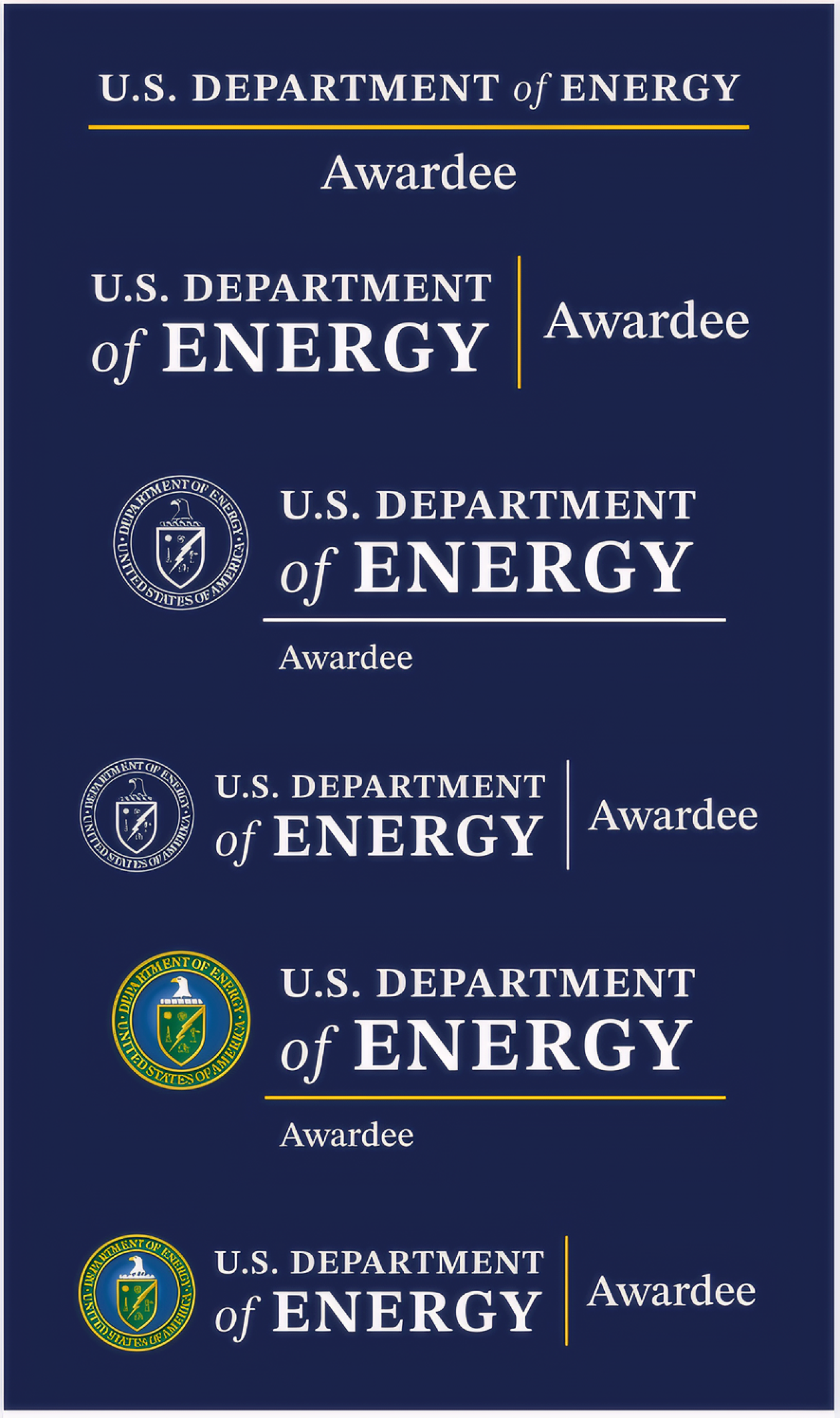
U.S. Department of Energy awardees are encouraged to use the above brand identity, which consists of the phrase “U.S. Department of Energy Awardee” and a symbol which identify and distinguish the work under the U.S. Department of Energy via DOE funding. Use of this brand identity is conditional: awardees must clearly explain its appearance on any non-Federal materials, its appearance must be accompanied by a disclaimer, and it must not be used by the awardee in any way that applies or gives the appearance that DOE endorses the awardee. Correct use of this brand identity encourages consistency, quality, and accuracy of all communications products—whether in print or online.
The following are placement and treatment requirements for awardee use of the DOE Awardee logo:
- Use of the logo on non-DOE materials must be accompanied by a statement clearly explaining its presence, such as “This project is being funded in part by [insert DOE logo]”.
- Use of the logo on non-DOE materials must contain the disclaimer “Logo was developed by the
- U.S. Department of Energy to indicate receipt of DOE funding. Not an endorsement by DOE.” This must be displayed in a reasonably prominent position and easily readable type size on any such materials.
- The logo must not be used in a manner that expressly or implicitly implies DOE endorses the views, opinions, products or services of any person or entity that is displaying the logo.
- The logo must not be used in a manner that would disparage DOE or the Federal government, or on any partisan materials.
- The logo may not be altered.
- By displaying this logo, you understand and agree that your company and its employees using the logo are responsible for its proper use and for ensuring any person or entity to whom you or your company distribute this logo is informed of these guidelines, including but not limited to, advertising agencies, contractors, and companies that produce promotional items on its behalf.
Use “U.S. Department of Energy Awardee” for use in first text reference on each new page of a document. For subsequent references when the full program name appears previously or in a more prominent location, “Energy Dept. Awardee” is permitted.
Proper Naming of DOE Awardee
- U.S. Department of Energy Awardee
Improper Naming of DOE Awardee
- Awardee
- DOE Awardee
Proper Naming of U.S. Department of Energy
- U.S. Department of Energy
- Energy Department
- Energy Dept.
- U.S. Energy Department
- U.S. Energy Dept.
When creating communications materials about your project, including press releases, webpages, presentations, fact sheets, and brochures, please use the following language to describe the U.S. Department of Energy. In addition to using this language, awardees are encouraged to acknowledge the Energy Department as the funding organization within the body of all press releases. For web communications, when the U.S. Department of Energy is first referenced, please link the U.S. Department of Energy Awardee name to energy.gov/about-us and provide the following statement:
“The mission of the Energy Department is to ensure America’s security and prosperity by addressing its energy, environmental and nuclear challenges through transformative science and technology solutions. Learn more at energy.gov.”
The recipient is required to include the following acknowledgement in publications arising out of, or relating to, work performed under this award, whether copyrighted or not:
Acknowledgment: “This work is based upon work supported by the U.S. Department of Energy under Award Number(s) [enter the award number(s)].”
Disclaimer: “This report was prepared as an account of work sponsored by an agency of the United States Government. Neither the United States Government nor any agency thereof, nor any of their employees, makes any warranty, express or implied, or assumes any legal liability or responsibility for the accuracy, completeness, or usefulness of any information, apparatus, product, or process disclosed, or represents that its use would not infringe privately owned rights. Reference herein to any specific commercial product, process, or service by trade name, trademark, manufacturer, or otherwise does not necessarily constitute or imply its endorsement, recommendation, or favoring by the United States Government or any agency thereof. The views and opinions of authors expressed herein do not necessarily state or reflect those of the United States Government or any agency thereof.”
Presentations related to projects funded by the U.S. Department of Energy require the U.S. Department of Energy Awardee logo and verbally — and in writing acknowledge the Energy Department as the funder of the project or study. This includes, but is not limited to conference presentations, tradeshow demonstrations, webinars, and seminars.
In order to improve brand awareness and search engine optimization, when referring to your DOE awardee status online, DOE requires the following conventions:
- When using any treatment of the U.S. Department of Energy Awardee logo on a webpage, digital newsletter, or report, DOE requires an embed a link to http://www.energy.gov on the image.
- When referencing the U.S. Department of Energy Awardee logo for the first time in a digital piece of content, embed a link within the words “U.S. Department of Energy Awardee” to http://www.energy.gov.
- For webpages referring to your organization’s position as a U.S. Department of Energy Awardee, tag your content with “U.S. Department of Energy Awardee” and/or add the words to your page’s metadata or page summary.
Awardees are encouraged to repost awardee Success Stories, blog posts, video, and other pieces of digital content created by the Department of Energy and featured on the Department’s websites. When content created by the Department of Energy is remixed or reposted in any form, attribution to the Department of Energy is required at the top of the page or in a similarly prominent way and the content must be linked to the original content source. For proper attribution, the following or a similar statement is required:
Acknowledgement: “This [blog post/success story/video/infographic] originally appeared on [PLACE – include link to original piece of content] and was created and funded by the U.S. Department of Energy.
The Department of Energy Office of Public Affairs team is available to review press releases associated with Department of Energy- funded projects prior to their release to the media. This review process benefits both DOE and the awardee because it enables DOE to verify that brand consistency standards are being met, while offering constructive feedback to awardees. While this is not a required approval process, the DOE communications team has successfully used press release reviews as a way to help its awardees frame their work within the context of trends in the energy sector and DOE priorities.
- Awardees are encouraged to stay up-to-date on Energy Department news by following the social sites below.
- Awardees are encouraged to retweet, like, and share Energy Department social media posts and promote content using hashtags, @mentions, etc., in social media activities.
- Website: www.energy.gov
- Twitter: www.twitter.com/energy
- Facebook: https://www.facebook.com/energygov
- YouTube: https://www.youtube.com/user/USdepartmentofenergy
- Flickr: https://www.flickr.com/photos/departmentofenergy/
- Instagram: www.instagram.com/energy
- LinkedIn: https://www.linkedin.com/company/energygov/
The DOE Awardee logo is available in EPS, PNG, and JPEG. For all print materials, use the native vector format. Large formats require the logo to be in vector format (EPS). Do not scale up a rasterized format (TIFF, GIF, JPG); it will lose resolution and look pixelated. Please do not modify the shape, proportion, or colors of the logo.
The preferred use of the DOE Awardee logo is horizontal on a white background. Do not reduce below minimum size of ½ inch. Do not rotate the logo.
When adding the DOE Awardee logo in an awardee partnership video being displayed on the DOE website, the same logo placement and treatment requirements above apply. The following requirements also apply when creating the video:
- The video must feature your DOE-funded project or projects.
- When posted, it must be clear that the video is made “from a partner”, and clear that DOE did not produce it.
- To avoid the appearance of endorsement by DOE, do not feature your organization’s logo except alongside the DOE Awardee logo once briefly at the beginning and once at the end of your video. Also ensure that the DOE Awardee logo is equally as prominent as the your organization’s logo.
- The video should have accurate content.
- Do not include personally identifiable information, such as license plates, nametags, addresses, etc.
- Avoid shots with any prominent corporate logos, including those of non-partners. Incidental logos in footage are OK, but efforts should be taken to limit them.
- Make sure that any workers shown are using proper safety equipment.
- Make sure not to use copyrighted content, including images, footage and music.
When creating videos and digital media, it’s important to remember to make your content accessible to people with disabilities. Section 508 of the Rehabilitation Act requires the federal government to make electronic and information technologies accessible to people with disabilities, which includes writing alt text for images and including captions and text versions of visual media.
When creating videos to be promoted through DOE channels, make sure that you create both captions and a text version to comply with Section 508 requirements.
A text version is a detailed transcript that is often posted on its own, separate content page. The text version typically includes all spoken language, a description of all important events and actions that occur in the file, and anything displayed visually in the file such as words or symbols. This page is then linked beneath the embedded video.
Captions should also be uploaded as a separate caption file on your video hosting site. DOE does not recommend using a video provider’s automatic captioning service—such as YouTube’s auto caption service, since there is guarantee that the results will be accurate.
If you have questions, please email your DOE funding contact.
END.
Learn More
Learn more about IESO’s current funding opportunities.
Sign up to receive the latest news, updates, and opportunities from the Integrated Energy Systems Office.