



Utilizing diverse funding sources allowed the Minnesota Department of Commerce (Commerce) to take advantage of the complementary features of each funding program and implement a cost-effective solar program.
Weatherization Assistance Program
June 5, 2024 Estimated Read Time min
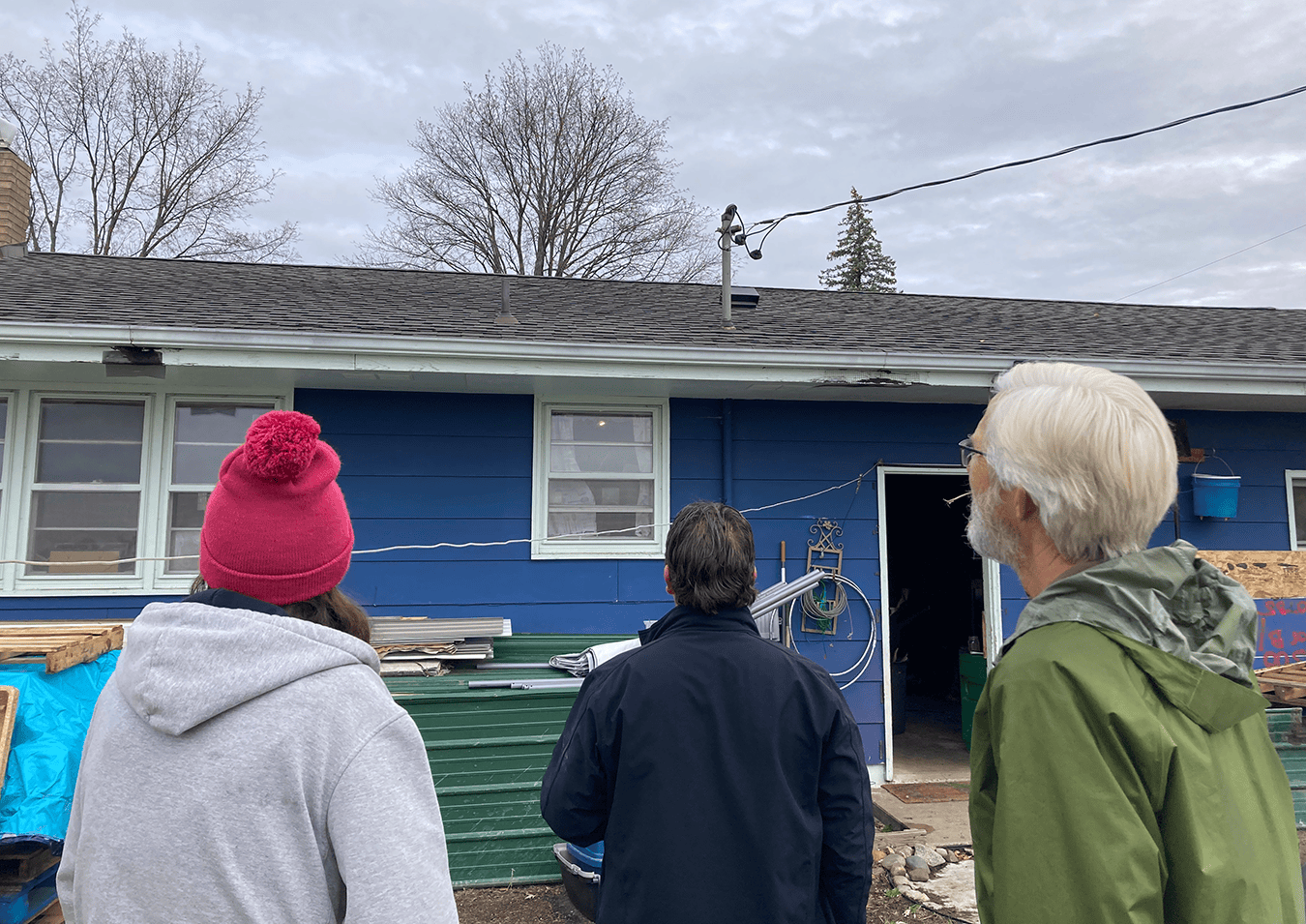
A site assessment for solar with a client. Photo from Minnesota Department of Commerce
About the Project
Utilizing diverse funding sources allowed the Minnesota Department of Commerce (Commerce) to take advantage of the complementary features of each funding program and implement a cost-effective solar program.
Challenge
Commerce set out to implement solar through the U.S. Department of Energy’s Weatherization Assistance Program (WAP). While WAP does provide funds for renewable energy systems, these funds are adjusted annually and would only cover a portion of the cost of a new residential solar installation. Additional funds would be required in order to cover the remaining costs. Moreover, WAP funds are constrained by specific cost limits per unit which further restricts the possibilities, even with utility contributions. To establish a sustainable rooftop solar program, multiple funding streams would be needed.
Solution
Commerce worked with local utility provider Xcel Energy to develop a solar rewards program, providing an upfront incentive and critical funding for the WAP solar pilot project. These additional utility funds covered approximately two-thirds of the total cost in the initial pilot program, while WAP funds covered the remaining third of the total solar installation costs. During this pilot, rooftop solar arrays were installed on 15 homes by two service providers. The total cost of the pilot program was $163,177, of which $56,097 were WAP funds.
In addition to this pilot program, Commerce updated the rules governing the Low Income Home Energy Assistance Program (LIHEAP), known as the Energy Assistance Program (EAP) in Minnesota, to expand services to cover rooftop solar. Because EAP funds are not subject to the same average cost per unit limits, the EAP (LIHEAP) funds can buy down the system costs in cost-effectiveness calculations.
Positive Impact
The initial pilot program, utilizing a combination of WAP and Xcel Solar Rewards funds, resulted in an average cost per watt of $3.80 and an estimated average annual savings of $587 per home. The successful pilot also led to approval from the U.S. Department of Energy for rooftop solar to be an eligible WAP measure across the state.
Through the combination of WAP, EAP (LIHEAP), and utility funds, solar funding sources have increased significantly. Commerce has been able to leverage these combined funds to fund more rooftop solar installations, meet all cost-effectiveness requirements, and qualify for a National Environmental Policy Act categorical exclusion.
As of June 2023, Commerce has allocated a total of $530,315 from a combination of WAP, EAP, non-federal funding, and state funds to install 21 rooftop solar arrays with a total capacity of 73.11 kW.
This story was developed with content from a National Renewable Energy Laboratory case study.